U.S. Immigration Policy Program
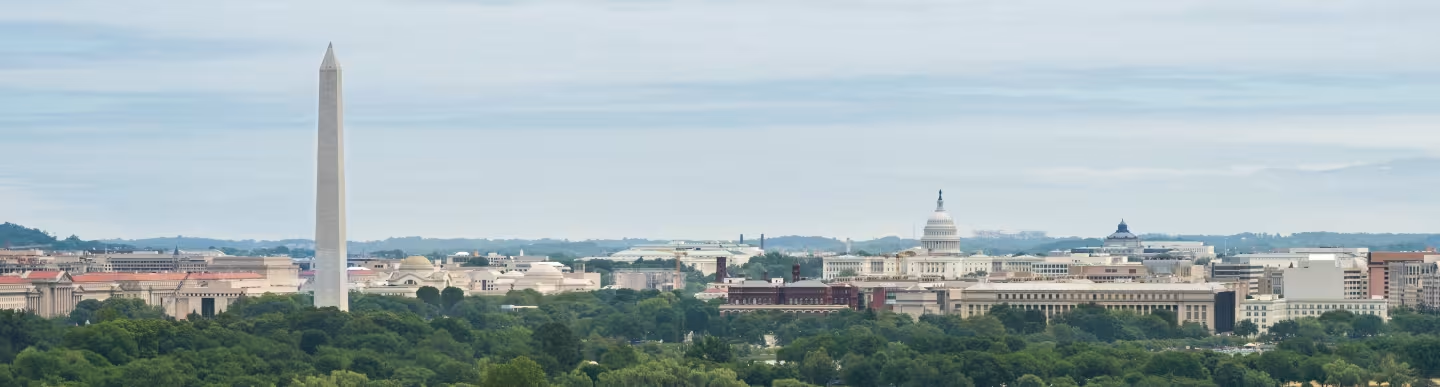
The U.S. Immigration Policy Program provides thought leadership on ways to improve the U.S. immigration system so that it works most effectively in the national interest. To that end, its work focuses on immigration pathways to the United States and immigration enforcement policies and their impacts. It examines the complex demographic, economic, social, political, foreign policy, and other forces that shape U.S. immigration.
Program staff produce data and analyses of immigration trends and the characteristics of U.S. immigrant populations, including unauthorized immigrants. And they conduct original research on the impacts of policy change and the experiences of immigrant populations in diverse parts of the country. This work is frequently informed by private convenings of policymakers and key stakeholders. For more, click here.
The Latest Research
U.S. Deportations and “Self-Deportations” in the First 18 Months of the Second Trump Term
Filling a gap amid a slowdown in official data reporting from the federal government, this analysis offers a window into deportation and "self…

Featured
Physicians in an Era of Changing Immigration Policy: The Case of Nephrology
The care of kidney disease in the United States relies heavily on international medical graduates (IMGs). Recent policy changes could deepen…

Temporary Visa Holders in the United States
The number of U.S. temporary visas plummeted during the COVID-19 pandemic, rebounded, and then fell again in fiscal year (FY) 2025. Preliminary data…

Following Years of High Border Arrivals, the U.S. Unauthorized Immigrant Population Hits New Peak
MPI estimates the U.S. unauthorized immigrant population reached a new peak of 15.8 million as of mid-2024, after holding steady at around 11 million…

More Featured Work
From Counterterrorism to Immigration Enforcement: 25 Years On, Post-9/11 U.S. Changes Have Been Repointed
Post-9/11 national security tools have been repurposed for immigration, expanding the U.S. government’s capacity for surveillance, data sharing, and…

Attacked as "De Facto Amnesty," U.S. Temporary Protected Status Is Abruptly Eroded
The Trump administration moved to terminate most of the 17 Temporary Protected Status (TPS) designations in place when its second term began,…

Though Rare, Birth Tourism to the United States Sparks Outsized Concern
While rare, birth tourism has become a central but contested justification in the Trump administration's push to end the guarantee of birthright…

Key Statistics
Learn more about immigrants and immigration to the United States
14.8%
The immigrant share of the total U.S. population
Learn how this share has evolved (opens in a new tab)50.2 million
The number of immigrants in the United States
Explore Data Profiles by State (opens in a new tab)18.4%
The share of workers in the U.S. civilian labor force who are immigrants
Get the data at U.S. and state levels (opens in a new tab)
Showing 401–410 of 824 results
Trump Executive Order on Refugees and Travel Ban: A Brief Review
A January 2017 Trump executive order suspending the U.S. refugee resettlement program and imposing a travel ban on seven countries was immediately challenged in court and later replaced.
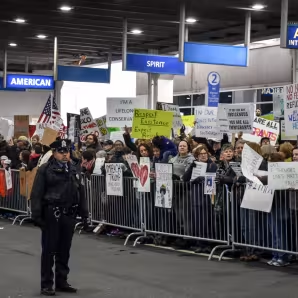
Trump Executive Order and DHS Guidance on Interior Enforcement: A Brief Review
President Trump's January 2017 executive order ends targeted prosecutorial discretion, revives Secure Communities, expands 287(g) enforcement, and targets “sanctuary city” funding.

Leaked Draft of Possible Trump Executive Order on Public Benefits Would Spell Chilling Effects for Legal Immigrants
A leaked draft executive order from President Donald Trump would broaden public charge rules, restricting legal immigrants' access to benefits and expanding grounds for deportation.

Hanging in the Balance: The Future of DACA and the Dreamers
As the Trump administration assumes office and the impacts of rescinding DACA are under review, MPI hosts a discussion with University of California President Janet Napolitano; Donald Graham, cofounder of TheDream.Us; and Ike Brannon, Visiting Fellow at the CATO Institute.
The Obama Record on Deportations: Deporter in Chief or Not?
President Barack Obama's deportation record was more nuanced than critics claimed, focusing on criminals and recent border crossers while reducing removals of long-settled immigrants.

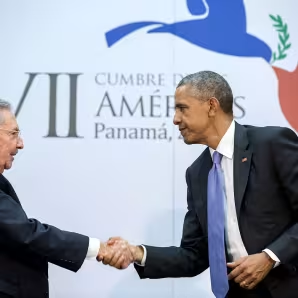
Taking Action to Reflect Current Reality: Obama Administration Ends “Wet Foot, Dry Foot” Policies on Cuban Migration
The Obama administration in 2017 ended the “wet-foot, dry-foot policy,” treating Cuban arrivals like other migrants as part of broader U.S.-Cuba normalization.
The U.S. Refugee Resettlement Program Is an Unsuitable Target
President Donald Trump's first-term order cutting refugee resettlement misidentifies risk: no resettled refugee has ever killed anyone in a U.S. terrorist attack.

Doctors as Taxi Drivers: The Costs of Brain Waste among Highly Skilled Immigrants in the United States
A report release and presentation of first-ever U.S. estimates on the actual economic costs of skill underutilization for immigrants, their families, and the U.S. economy, in terms of forgone earnings and unrealized federal, state, and local taxes.

Brain Waste: Researchers Discuss Economic Costs of Skill Underutilization among Highly Skilled Immigrants
What does it cost the U.S. economy when college-educated immigrants cannot find work at their skill level?

Despite Hard-Line Immigration Campaign Pledges, Trump Policy Remains in Flux
Incoming President Donald Trump's postelection comments reflected narrower deportation targets, but the choice of Jeff Sessions attorney general signaled a tougher line.

- General Inquiries
- Media Inquiries
-
Michelle Mittelstadt
202 266 1910 [email protected]