U.S. Immigration Policy Program
The U.S. Immigration Policy Program provides thought leadership on ways to improve the U.S. immigration system so that it works most effectively in the national interest. To that end, its work focuses on immigration pathways to the United States and immigration enforcement policies and their impacts. It examines the complex demographic, economic, social, political, foreign policy, and other forces that shape U.S. immigration.
Program staff produce data and analyses of immigration trends and the characteristics of U.S. immigrant populations, including unauthorized immigrants. And they conduct original research on the impacts of policy change and the experiences of immigrant populations in diverse parts of the country. This work is frequently informed by private convenings of policymakers and key stakeholders. For more, click here.
The Latest Research
U.S. Deportations and “Self-Deportations” in the First 18 Months of the Second Trump Term
Filling a gap amid a slowdown in official data reporting from the federal government, this analysis offers a window into deportation and "self…

Featured
Physicians in an Era of Changing Immigration Policy: The Case of Nephrology
The care of kidney disease in the United States relies heavily on international medical graduates (IMGs). Recent policy changes could deepen…

Temporary Visa Holders in the United States
The number of U.S. temporary visas plummeted during the COVID-19 pandemic, rebounded, and then fell again in fiscal year (FY) 2025. Preliminary data…

Following Years of High Border Arrivals, the U.S. Unauthorized Immigrant Population Hits New Peak
MPI estimates the U.S. unauthorized immigrant population reached a new peak of 15.8 million as of mid-2024, after holding steady at around 11 million…

More Featured Work
From Counterterrorism to Immigration Enforcement: 25 Years On, Post-9/11 U.S. Changes Have Been Repointed
Post-9/11 national security tools have been repurposed for immigration, expanding the U.S. government’s capacity for surveillance, data sharing, and…

Attacked as "De Facto Amnesty," U.S. Temporary Protected Status Is Abruptly Eroded
The Trump administration moved to terminate most of the 17 Temporary Protected Status (TPS) designations in place when its second term began,…

Though Rare, Birth Tourism to the United States Sparks Outsized Concern
While rare, birth tourism has become a central but contested justification in the Trump administration's push to end the guarantee of birthright…

Key Statistics
Learn more about immigrants and immigration to the United States
14.8%
The immigrant share of the total U.S. population
Learn how this share has evolved (opens in a new tab)50.2 million
The number of immigrants in the United States
Explore Data Profiles by State (opens in a new tab)18.4%
The share of workers in the U.S. civilian labor force who are immigrants
Get the data at U.S. and state levels (opens in a new tab)
Showing 241–250 of 824 results
Vulnerable to COVID-19 and in Frontline Jobs, Immigrants Are Mostly Shut Out of U.S. Relief
Immigrants powered the U.S. frontline pandemic response but faced disproportionate health and economic risks and were largely excluded from federal COVID-19 relief efforts.

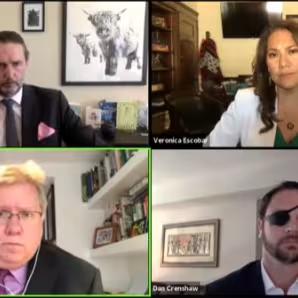
Immigration and the U.S.-Mexico Border during the Pandemic: A Conversation with Members of Congress
In this bipartisan discussion, two border-state members of Congress—Rep. Veronica Escobar and Rep. Dan Crenshaw—discuss the response to the coronavirus outbreak, how it is affecting the interconnected border region, and what the future might hold.
Humanitarian Protection in an Era of Pandemic
MPI and MPI Europe experts discuss the effects of the coronavirus pandemic on asylum systems in Europe and North America, as well as in developing regions, where 85 percent of refugees live. During this freeform conversation, our analysts also assess the implications for the principle of asylum and the future for a post-World War II humanitarian protection system that is under threat.
Immigration and U.S. National Security: The State of Play Since 9/11
Post-9/11 reforms strengthened U.S. immigration security, but misplaced priorities now divert resources from real threats to pursue low-risk migrants.

An Untapped Pool of Critical U.S. Health-Care Workers in a Time of Pandemic
As the U.S. health-care system sags under the strain of the COVID-19 pandemic, health-care workers are not only on the frontlines fighting the virus but also some of the most at-risk individuals.

As U.S. Health-Care System Buckles under Pandemic, Immigrant & Refugee Professionals Could Represent a Critical Resource
In a time of critical shortages of U.S. health-care workers during the COVID-19 pandemic, retired doctors are being called back to work and medical students are graduating on a fast track. There is another important pool that could be tapped: Immigrants and refugees who have college degrees in health fields but are working in low-skilled jobs or out of work. MPI estimates 263,000 immigrants are experiencing skill underutilization and could be a valuable resource.

Expert Podcast: Meeting Seasonal Labor Needs in the Age of COVID-19
What happens to agriculture and food security when pandemic travel restrictions block seasonal migrant workers?
Crisis within a Crisis: Immigration in the United States in a Time of COVID-19
COVID-19 forced dramatic U.S. immigration restrictions, including ending asylum at the border, halting benefit processing, and excluding some immigrants from pandemic relief.

Migration & Coronavirus: A Complicated Nexus Between Migration Management and Public Health
This webinar, organized by MPI and the Zolberg Institute on Migration and Mobility at The New School, discussed the state of play around the globe surrounding COVID-19 and examined where migration management and enforcement tools may be useful and where they may be ill-suited to advancing public health goals.

Green Cards and Public Charge: Who Could Be Denied Based on Benefits Use?
On this webinar MPI experts discuss their estimates of the populations that could be deemed ineligible for a green card based on existing benefits use. They also discuss the broader consequences of the public-charge rule implemented in February 2020, through its "chilling effects" and imposition of a wealth test aimed at assessing whether green-card applicants ever would be likely to use a public benefit in the future.
- General Inquiries
- Media Inquiries
-
Michelle Mittelstadt
202 266 1910 [email protected]