U.S. Immigration Policy Program

The U.S. Immigration Policy Program provides thought leadership on ways to improve the U.S. immigration system so that it works most effectively in the national interest. To that end, its work focuses on immigration pathways to the United States and immigration enforcement policies and their impacts. It examines the complex demographic, economic, social, political, foreign policy, and other forces that shape U.S. immigration.
Program staff produce data and analyses of immigration trends and the characteristics of U.S. immigrant populations, including unauthorized immigrants. And they conduct original research on the impacts of policy change and the experiences of immigrant populations in diverse parts of the country. This work is frequently informed by private convenings of policymakers and key stakeholders. For more, click here.
The Latest Research
U.S. Deportations and “Self-Deportations” in the First 18 Months of the Second Trump Term
Filling a gap amid a slowdown in official data reporting from the federal government, this analysis offers a window into deportation and "self…

Featured
Physicians in an Era of Changing Immigration Policy: The Case of Nephrology
The care of kidney disease in the United States relies heavily on international medical graduates (IMGs). Recent policy changes could deepen…

Temporary Visa Holders in the United States
The number of U.S. temporary visas plummeted during the COVID-19 pandemic, rebounded, and then fell again in fiscal year (FY) 2025. Preliminary data…

Following Years of High Border Arrivals, the U.S. Unauthorized Immigrant Population Hits New Peak
MPI estimates the U.S. unauthorized immigrant population reached a new peak of 15.8 million as of mid-2024, after holding steady at around 11 million…

More Featured Work
From Counterterrorism to Immigration Enforcement: 25 Years On, Post-9/11 U.S. Changes Have Been Repointed
Post-9/11 national security tools have been repurposed for immigration, expanding the U.S. government’s capacity for surveillance, data sharing, and…

Attacked as "De Facto Amnesty," U.S. Temporary Protected Status Is Abruptly Eroded
The Trump administration moved to terminate most of the 17 Temporary Protected Status (TPS) designations in place when its second term began,…

Though Rare, Birth Tourism to the United States Sparks Outsized Concern
While rare, birth tourism has become a central but contested justification in the Trump administration's push to end the guarantee of birthright…

Key Statistics
Learn more about immigrants and immigration to the United States
14.8%
The immigrant share of the total U.S. population
Learn how this share has evolved (opens in a new tab)50.2 million
The number of immigrants in the United States
Explore Data Profiles by State (opens in a new tab)18.4%
The share of workers in the U.S. civilian labor force who are immigrants
Get the data at U.S. and state levels (opens in a new tab)
Showing 181–190 of 824 results
Strengthening Services for Unaccompanied Children in U.S. Communities
Tens of thousands of unaccompanied children arrive in U.S. communities each year with critical legal and service needs that local systems are ill-equipped to meet.

Leaving Money on the Table: The Persistence of Brain Waste among College-Educated Immigrants
As of 2019, 2 million college-educated immigrants were underemployed in the United States, with race, English proficiency, and legal status the key predictors of this brain waste.

Immigrant and Other U.S. Workers a Year into the Pandemic: A Focus on Top Immigrant States
A year into the pandemic, immigrant workers, especially women, faced steeper job losses than the U.S. born, with recovery patterns varying sharply by state and industry.

Lessons from Europe: The U.S. opportunity to rethink the links between development assistance and migration
As the United States embarks on a new strategy to address the root causes of migration and displacement from Central America, there is much that it can learn from Europe's experience in linking up migration and development aid. This commentary examines the experience of the EU Emergency Trust Fund for Africa (EUTF), drawing five key lessons directly applicable to the situation in Central America.

A Solvable Challenge: Improving Asylee Access to Health and Other Benefits
While asylees are eligible for many of the same public benefits and services as resettled refugees, including health care and employment assistance, there is no system to inform them of their eligibility and to help connect them to resources. MPI estimates that fewer than 20 percent of those granted asylum in recent years received Office of Refugee Resettlement benefits during their first year. The U.S. government could address this gap with a few simple measures.

Slowing U.S. Population Growth Could Prompt New Pressure for Immigration Reform
The 2020 decennial Census revealed near-record-low U.S. population growth, driven by declining immigration and birth rates. Will this drive immigration policy change?

Rethinking the U.S. Legal Immigration System: A Policy Road Map
Last updated in 1990, the U.S. legal immigration system needs deep reforms so employment and family pathways better match today’s economic and demographic realities.

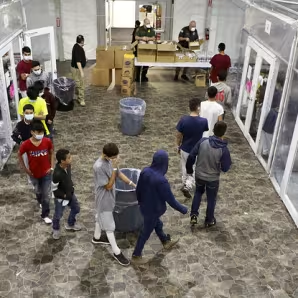
U.S. Government Makes Significant Strides in Receiving Unaccompanied Children but Major Challenges Remain
The federal government has made notable progress since March 2021 in getting unaccompanied children arriving at the U.S.-Mexico border out of Border Patrol facilities and into Office of Refugee Resettlement (ORR) custody, and then releasing them to parents or other sponsors. Yet there are serious concerns about standards of care and conditions in a new type of ORR facility: emergency intake sites, as this commentary explores.
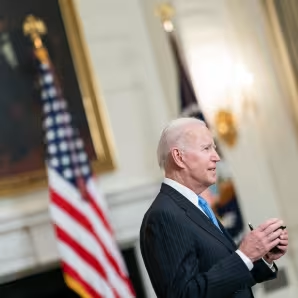
Border Challenges Dominate, But Biden’s First 100 Days Mark Notable Under-the-Radar Immigration Accomplishments
President Joe Biden's first 100 days brought sweeping immigration changes. But a record surge of border arrivals exposed significant gaps between promises and policy capacity.
The Integration of Immigrant Health Professionals: Looking beyond the COVID-19 Crisis
In 2019, about 270,000 immigrant and refugee health professionals in the United States were underemployed. This brief examines barriers and reforms to better tap their skills.


- General Inquiries
- Media Inquiries
-
Michelle Mittelstadt
202 266 1910 [email protected]