U.S. Immigration Policy Program
The U.S. Immigration Policy Program provides thought leadership on ways to improve the U.S. immigration system so that it works most effectively in the national interest. To that end, its work focuses on immigration pathways to the United States and immigration enforcement policies and their impacts. It examines the complex demographic, economic, social, political, foreign policy, and other forces that shape U.S. immigration.
Program staff produce data and analyses of immigration trends and the characteristics of U.S. immigrant populations, including unauthorized immigrants. And they conduct original research on the impacts of policy change and the experiences of immigrant populations in diverse parts of the country. This work is frequently informed by private convenings of policymakers and key stakeholders. For more, click here.
The Latest Research
U.S. Deportations and “Self-Deportations” in the First 18 Months of the Second Trump Term
Filling a gap amid a slowdown in official data reporting from the federal government, this analysis offers a window into deportation and "self…

Featured
Physicians in an Era of Changing Immigration Policy: The Case of Nephrology
The care of kidney disease in the United States relies heavily on international medical graduates (IMGs). Recent policy changes could deepen…

Temporary Visa Holders in the United States
The number of U.S. temporary visas plummeted during the COVID-19 pandemic, rebounded, and then fell again in fiscal year (FY) 2025. Preliminary data…

Following Years of High Border Arrivals, the U.S. Unauthorized Immigrant Population Hits New Peak
MPI estimates the U.S. unauthorized immigrant population reached a new peak of 15.8 million as of mid-2024, after holding steady at around 11 million…

More Featured Work
From Counterterrorism to Immigration Enforcement: 25 Years On, Post-9/11 U.S. Changes Have Been Repointed
Post-9/11 national security tools have been repurposed for immigration, expanding the U.S. government’s capacity for surveillance, data sharing, and…

Attacked as "De Facto Amnesty," U.S. Temporary Protected Status Is Abruptly Eroded
The Trump administration moved to terminate most of the 17 Temporary Protected Status (TPS) designations in place when its second term began,…

Though Rare, Birth Tourism to the United States Sparks Outsized Concern
While rare, birth tourism has become a central but contested justification in the Trump administration's push to end the guarantee of birthright…

Key Statistics
Learn more about immigrants and immigration to the United States
14.8%
The immigrant share of the total U.S. population
Learn how this share has evolved (opens in a new tab)50.2 million
The number of immigrants in the United States
Explore Data Profiles by State (opens in a new tab)18.4%
The share of workers in the U.S. civilian labor force who are immigrants
Get the data at U.S. and state levels (opens in a new tab)
Showing 171–180 of 824 results
Two Decades after 9/11, National Security Focus Still Dominates U.S. Immigration System
National security continues to shape U.S. immigration policy, driving federal immigration enforcement spending to $25 billion annually.

From Immigrant Detention to a More Effective U.S. Immigration Custody System
The sprawling U.S. immigration detention system has long been controversial for its conditions of care, detention numbers, and costs. This discussion provides a vision for a reimagined immigration custody system.
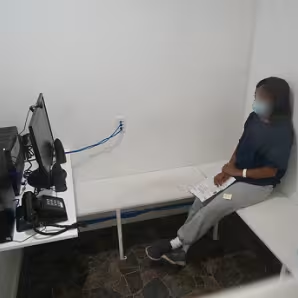
Immigrants’ U.S. Labor Market Disadvantage in the COVID-19 Economy: The Role of Geography and Industries of Employment
Immigrants faced steeper labor losses than U.S.-born workers during the COVID-19 pandemic, driven by concentration in high-risk industries and geographic clusters hit hardest.

Different Statuses, Different Benefits: Determining Federal Assistance for Afghan Evacuees
Afghans evacuated to the United States are entering with a range of legal statuses, with important implications for their ability to access benefits and services that will help them settle into their new communities. This commentary outlines the different statuses and resulting consequences for eligibility for assistance, based on whether the arrivals are recognized as refugees, Special Immigrant Visa (SIV) recipients, or parolees.

From Jailers to Case Managers: Redesigning the U.S. Immigration Detention System to Be Effective and Fair
U.S. immigration detention cost up to $200 per person per day in fiscal year 2021. Shifting to case management and supervised release can reduce costs and improve outcomes.
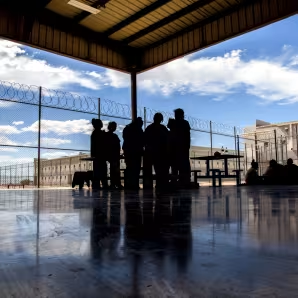
Biden Administration Asylum Processing Revamp at the U.S. Border Could Be a Game Changer
The Biden administration’s proposed asylum processing rule represents a fundamental retooling of the asylum system that preserves asylum as a bedrock element of the U.S. immigration system while also recognizing that a secure border and deterring unlawful crossings are legitimate and necessary attributes of an effective, credible immigration system, as this commentary explains.
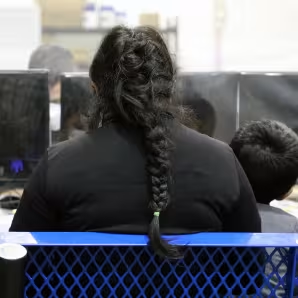
U.S. Government Rush to Evacuate Afghan Allies and Allocate Sufficient Special Visas Comes at Eleventh Hour
As U.S. forces withdrew from Afghanistan in 2021, chronic processing failures left tens of thousands of Afghans in limbo, prompting last-minute legislative and evacuation efforts.

Supporting Unaccompanied Children in the U.S. Communities Where They Live
Featuring findings from a recent MPI report, speakers examined the process of releasing unaccompanied children to sponsors, the current structure of federal post-release services, and the most significant needs these children and their U.S. sponsors experience. The discussion also explored efforts by philanthropic, state, and local actors to address the needs of this population and their communities, what service gaps exist, and key recommendations to improve access to services.

Texas Once Again Tests the Boundaries of State Authority in Immigration Enforcement
Texas's unilateral border enforcement measures, such as border wall construction and state and local arrests of unauthorized immigrants, are facing significant legal challenges.

Brain Waste among Highly Skilled Immigrants in the United States: A Persistent Problem with Increasing Costs
Experts discuss findings from a report examining the underemployment of college graduates in the United States and explore the promising strategies that exist to mitigate this brain waste for the benefit of the U.S. economy.

- General Inquiries
- Media Inquiries
-
Michelle Mittelstadt
202 266 1910 [email protected]