U.S. Immigration Policy Program

The U.S. Immigration Policy Program provides thought leadership on ways to improve the U.S. immigration system so that it works most effectively in the national interest. To that end, its work focuses on immigration pathways to the United States and immigration enforcement policies and their impacts. It examines the complex demographic, economic, social, political, foreign policy, and other forces that shape U.S. immigration.
Program staff produce data and analyses of immigration trends and the characteristics of U.S. immigrant populations, including unauthorized immigrants. And they conduct original research on the impacts of policy change and the experiences of immigrant populations in diverse parts of the country. This work is frequently informed by private convenings of policymakers and key stakeholders. For more, click here.
The Latest Research
U.S. Deportations and “Self-Deportations” in the First 18 Months of the Second Trump Term
Filling a gap amid a slowdown in official data reporting from the federal government, this analysis offers a window into deportation and "self…

Featured
Physicians in an Era of Changing Immigration Policy: The Case of Nephrology
The care of kidney disease in the United States relies heavily on international medical graduates (IMGs). Recent policy changes could deepen…

Temporary Visa Holders in the United States
The number of U.S. temporary visas plummeted during the COVID-19 pandemic, rebounded, and then fell again in fiscal year (FY) 2025. Preliminary data…

Following Years of High Border Arrivals, the U.S. Unauthorized Immigrant Population Hits New Peak
MPI estimates the U.S. unauthorized immigrant population reached a new peak of 15.8 million as of mid-2024, after holding steady at around 11 million…

More Featured Work
From Counterterrorism to Immigration Enforcement: 25 Years On, Post-9/11 U.S. Changes Have Been Repointed
Post-9/11 national security tools have been repurposed for immigration, expanding the U.S. government’s capacity for surveillance, data sharing, and…

Attacked as "De Facto Amnesty," U.S. Temporary Protected Status Is Abruptly Eroded
The Trump administration moved to terminate most of the 17 Temporary Protected Status (TPS) designations in place when its second term began,…

Though Rare, Birth Tourism to the United States Sparks Outsized Concern
While rare, birth tourism has become a central but contested justification in the Trump administration's push to end the guarantee of birthright…

Key Statistics
Learn more about immigrants and immigration to the United States
14.8%
The immigrant share of the total U.S. population
Learn how this share has evolved (opens in a new tab)50.2 million
The number of immigrants in the United States
Explore Data Profiles by State (opens in a new tab)18.4%
The share of workers in the U.S. civilian labor force who are immigrants
Get the data at U.S. and state levels (opens in a new tab)
Showing 161–170 of 824 results
U.S. Immigration Reform Denied: Destined to Repeat the Cycle of Failure?
Immigration reform failed in 2006, 2007, and 2013—so what would it take to break the cycle?
Biden Immigration Enforcement Priorities Emphasize a Multi-Dimensional View of Migrants
In a major shift, the Biden administration's enforcement guidelines require authorities to consider noncitizens' full circumstances when deciding whether to proceed to arrest and removal.

Building a Modern U.S. Immigration and Asylum System in the National Interest
History rhymes on U.S. immigration—but former INS Commissioner Doris Meissner says the stakes today are categorically different.
Making Migration Policy in an Ever More Complex World
Two decades into MPI's existence, the same immigration debates that seemed intractable in 2001 remain unsolved—so what will it take to move the needle?

Toward a Better Immigration System: Fixing Immigration Governance at the U.S. Department of Homeland Security
DHS's fragmented immigration structure undermines effective governance. Immigration functions should be consolidated under stronger DHS leadership, along with IT modernization and stronger oversight.

Retreating from Climate Disaster in the United States
As climate threats intensify across the United States, what would it take to build a coordinated, equitable framework for communities facing the prospect of managed retreat?
African Migration through the Americas: Drivers, Routes, and Policy Responses
African migrants increasingly transit the Americas via the Darién Gap, though COVID-19 disrupted flows in 2020. Coordinated regional policy responses are needed.

Migración africana a través del continente americano: impulsores, rutas y respuestas normativas
Las detenciones de migrantes africanos en la frontera entre Estados Unidos y México alcanzaron 5,000 en 2019; se requieren respuestas regionales coordinadas.

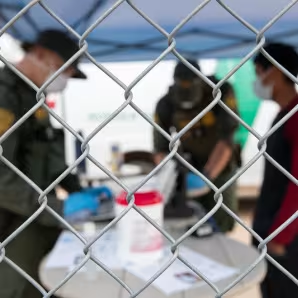
It Is Too Simple to Call 2021 a Record Year for Migration at the U.S.-Mexico Border
While there were more encounters of migrants seeking to cross the U.S.-Mexico border without authorization during fiscal 2021 than any prior year, this does not necessarily mean that more migrants were intercepted or illicitly entered the country than was the case 21 years ago, a new commentary explains.
18th Annual Immigration Law and Policy Conference
The 2021 annual Immigration Law and Policy Conference featured a keynote conversation with Homeland Security Secretary Alejandro N. Mayorkas and top experts analyzing immigration in the early months of the Biden administration.


- General Inquiries
- Media Inquiries
-
Michelle Mittelstadt
202 266 1910 [email protected]