Seeking Safety: Regional Protection Options for Central Americans
Speakers offered analysis on regional resettlement and humanitarian channels for Central Americans, along with specific actions the United States and Canada could take.
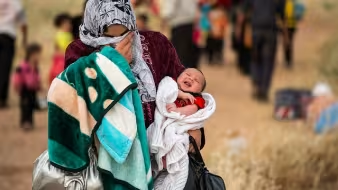
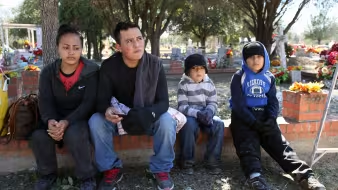
Fleeing gang-related and gender-based violence, human-rights violations, and socioeconomic problems exacerbated by natural disasters in Guatemala, Honduras, and El Salvador, hundreds of thousands of Central American asylum seekers have arrived at the Mexican and U.S. borders, straining these governments’ asylum systems and processing capacities. As a result, thousands of asylum seekers have been left in limbo while they await the resolution of their cases. While refugee resettlement programs are an option to avoid undertaking dangerous journeys, they have been deployed on a very limited basis in the region to date.
Seeking a solution to this growing challenge, policymakers in Canada and the United States have begun to reconsider whether resettlement should play a larger role in addressing regional protection needs, and how resettlement and humanitarian pathways could be scaled up.
Marking the release of a MPI report on possible protection pathways for Central Americans, this webcast offered analysis on resettlement and humanitarian channels already utilized the region—including in-country processing, the Protection Transfer Arrangement, and third-country refugee resettlement—and the opportunities and obstacles to expanding these programs. Speakers also provided recommendations for specific actions that the United States and Canada could take, given their well-established humanitarian protection systems.
The event was in English and Spanish interpretation was provided.
Speakers:
Noah Bullock, Executive Director, Cristosal, El Salvador
Susan Fratzke, Senior Policy Analyst, MPI
Essey Workie, Director, Human Services Initiative, MPI
Moderator:
Andrea Tanco, Strategic Advisor to the President and Associate Policy Analyst, MPI
Latin America and Caribbean Initiative
The Initiative combines rigorous research with direct engagement of governments, institutions, and stakeholders to help build orderly, rights-respecting migration systems across one of the world's most dynamic migration regions.
About the U.S. Immigration Policy Program
The U.S. Immigration Policy Program provides analysis of U.S. immigration pathways, the impacts of enforcement and other policies, and the characteristics of immigrant populations.
About the Global Program
The Global Program bridges policy advice, research, and candid dialogue to design effective migration policies, drawing on global evidence and anticipating the forces reshaping how people move.
-


Noah Bullock
Related Content