Diverging Pathways: Immigrants’ Legal Status and Access to Postsecondary Credentials

Related Content
Highlights
Most of the nearly 24 million U.S. immigrants lacking credentials in 2019 had legal status and Pell Grant eligibility; unauthorized immigrants were barred from federal education support.
- In 2019, 21 percent of all U.S. adults without postsecondary credentials (23.9 million) were immigrants; two-thirds (15.8 million) were legally present and eligible for federal programs such as Pell Grants.
- The 7.7 million unauthorized immigrant adults without credentials were ineligible for federal education support; of these, 788,000 were DACA-eligible and 397,000 held Temporary Protected Status (TPS)—groups that could benefit from pending congressional proposals.
- Legal-status barriers compound other obstacles: more than half of unauthorized immigrants without credentials lacked a high school diploma, were from low-income families, and had limited English proficiency.
For most people in the United States, quality postsecondary credentials—which include two- and four-year college degrees, vocational training certificates, and professional licenses—offer the most direct path to economic and social mobility. In fact, 80 percent of today’s jobs require more than a high school degree. Yet as of 2019, about 115.3 million U.S. adults ages 16–64 did not have a postsecondary credential. About one in five of these adults (23.9 million) were immigrants.
As the U.S. economy seeks to adapt to forces such as population aging and technological change that are reshaping the labor market, much will depend on how well the United States trains and utilizes its available workforce. Immigrants are an important, but often overlooked, target for initiatives seeking to increase the number of credential holders. Including them more fully would help fill gaps in the labor force, expand local economies, and address racial/ethnic disparities in credential access and attainment given that nearly three-quarters of immigrants without postsecondary credentials are Latino or Black.
This issue brief uses MPI’s unique methodology for assigning legal status to immigrants in the U.S. Census Bureau’s American Community Survey to explore the characteristics of adults without postsecondary credentials, broken down by U.S. citizenship and legal status. In doing so, it highlights characteristics that can make credential acquisition more straightforward or more challenging and that should be taken into account in policies and programs that aim to promote workforce development and economic mobility.
Table of Contents
1 Introduction
A. Policies Shaping Immigrants’ Access to Postsecondary Credentials
B. Exploring Immigrants’ Credentials and Other Characteristics
2 U.S. Adults without Postsecondary Credentials
A. Number of Immigrant and U.S.-Born Adults without Postsecondary Credentials
B. Citizenship and Legal Status
3 The Educational Attainment of Immigrants without Postsecondary Credentials
4 The Race/Ethnicity of Immigrants without Postsecondary Credentials
5 Barriers to Credential Attainment
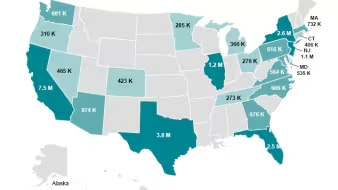
6 State-by-State Estimates
7 Conclusion
About the U.S. Immigration Policy Program
The U.S. Immigration Policy Program provides analysis of U.S. immigration pathways, the impacts of enforcement and other policies, and the characteristics of immigrant populations.
About the National Center on Immigrant Integration Policy
The Center is a national hub connecting policymakers, educators, community leaders, and service providers with evidence-informed policy research, technical assistance, and data to advance effective immigrant integration at U.S., state, and local levels.



Related Content