National Center on Immigrant Integration Policy

The National Center on Immigrant Integration Policy serves as a crossroads for policymakers, community and system leaders, and others looking to understand ways to support successful integration of immigrants and their children into U.S. classrooms, workplaces, and civic spaces.
It produces evidence-informed, nonpartisan policy research and data, and provides technical assistance and cross-state learning opportunities for state and local leaders. By engaging with stakeholders across the early childhood, education, workforce, health, and civic sectors, the Center builds a more coherent, knowledge-driven field. It shines a spotlight on integration issues often overlooked in national debates and promotes solutions that can lift the integration trajectories of immigrant families while also fueling the vibrancy of the communities and local economies where they live. For more about the Center, click here.


More Featured Work




- General Inquiries
Showing 61–70 of 375 results
Dual Language Learners: Key Characteristics and Considerations for Early Childhood Programs
One-third of U.S. children ages 0–5 are Dual Language Learners. Fact sheets offered here examine DLL populations for the 25 largest states.

The Public-Charge Final Rule Is Far from the Last Word
The Biden administration public-charge final rule undoes deep restrictions imposed during the Trump era, codifying much of the policy in place from 1999 to 2019. Yet confusion and fear over triggering negative immigration consequences will continue to keep many immigrants and their U.S.-born relatives from accessing benefits and services for which they are eligible absent a robust educational campaign, this commentary explains.

Changing the Playbook: Immigrants and the COVID-19 Response in Two U.S. Communities
Immigrants in Nashville and the San Francisco Bay area served in essential COVID-19 roles while community groups bridged health gaps and pushed for foreign-born access to pandemic relief.

The Missing Link: Connecting Eligible Asylees and Asylum Seekers with Benefits and Services
Asylees are eligible for many U.S. refugee-equivalent benefits but lack systems to connect them. Weak outreach and fragmented data leave many underserved.

Immigrant Children’s Medicaid and CHIP Access and Participation: A Data Profile
In 2019, 40 percent of income-eligible immigrant children were barred from Medicaid and CHIP, and even eligible children enrolled at much lower rates.

How State Assessments Became and Remain a Driver for Equity for English Learners
While the pandemic has given a boost to efforts to water down or limit end-of-year state assessments of students in K-12, this commentary notes the importance of testing to drive equity for the nation's 5 million English Learners and ensure that they are not overlooked or that resources and support services are misdirected from where they are needed.

Testing Disrupted: Assessment of English Learners Complicated by Pandemic
Marking the release of a report examining the assessment of English Learner (EL) students after pandemic-induced disruptions, this webinar examines ELs’ learning experiences during the 2020-21 academic year and their performance and participation in statewide testing, and how schools are using data to inform interventions and instruction this year.

Building Trust with Immigrant and Refugee Families: Spreading and Adapting 2Gen Working Practices
Hiring staff from immigrant communities, offering integrated services, and creating safe spaces are the core strategies that two-generation (2Gen) programs use to earn family trust.
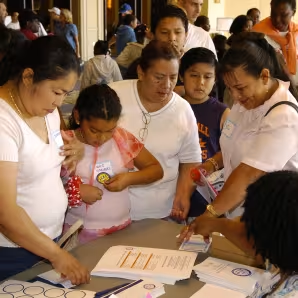
Better Responses to Differing Immigration Statuses: Spreading and Adapting 2Gen Working Practices
Two-generation (2Gen) service providers working with mixed-status families must train staff on eligibility, protect client data, and build partnerships to provide wraparound supports.

Growing Language Skills with Immigrant and Refugee Families: Spreading and Adapting 2Gen Working Practices
A 2021 survey of 125 U.S. organizations found wide gaps between family languages spoken and services offered; flexible, culturally responsive two-generation (2Gen) programs can help.