National Center on Immigrant Integration Policy

The National Center on Immigrant Integration Policy serves as a crossroads for policymakers, community and system leaders, and others looking to understand ways to support successful integration of immigrants and their children into U.S. classrooms, workplaces, and civic spaces.
It produces evidence-informed, nonpartisan policy research and data, and provides technical assistance and cross-state learning opportunities for state and local leaders. By engaging with stakeholders across the early childhood, education, workforce, health, and civic sectors, the Center builds a more coherent, knowledge-driven field. It shines a spotlight on integration issues often overlooked in national debates and promotes solutions that can lift the integration trajectories of immigrant families while also fueling the vibrancy of the communities and local economies where they live. For more about the Center, click here.


More Featured Work




- General Inquiries
Showing 291–300 of 375 results
Mexicans in Hawaiʻi: Challenges and Prospects
This briefing at the State Capitol in Honolulu presented key demographic and socioeconomic information about the Mexican-origin population in Hawai’i.

Newcomers to the Aloha State: Challenges and Prospects for Mexicans in Hawai'i
Hawai'i's Mexican community is predominantly U.S.-born and lawfully present, yet faces disproportionate enforcement, geographic dispersal, and fragmented identity.
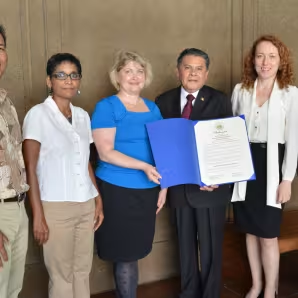
A Year In: A Review of the Deferred Action for Childhood Arrivals Program
MPI experts discussed an MPI profile of the DACA population and reflect on the policy’s success and shortcomings.

Deferred Action for Childhood Arrivals at the One-Year Mark: A Profile of Currently Eligible Youth and Applicants
One year in, the Deferred Action for Childhood Arrivals (DACA) program reached 49 percent of eligible youth, with uptake sharply divided by state, national origin, and access to education.

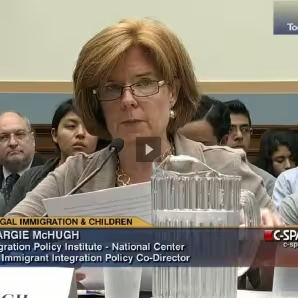
Margie McHugh Testimony Video: Illegal Immigration and Children
Testimony of Margie McHugh, Co-Director of MPI's National Center on Immigrant Integration Policy, before the House Judiciary Subcommittee on Immigration and Border Security, U.S. House of Representatives.
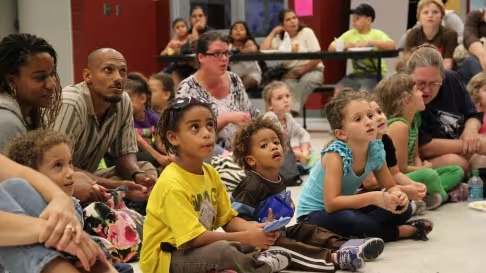
Preparing the Children of Immigrants for Early Academic Success
Despite outperforming expectations set by family socioeconomic disadvantage, the children of immigrants enter U.S. school at greater risk than peers, and early intervention is key to reversing that.

Is the United States Bad for Children’s Health? Risk and Resilience among Young Children of Immigrants
Children of Mexican immigrants start life with health advantages, but those advantages erode in early childhood as poverty, food insecurity, and limited access take hold.

Shaping Our Futures: The Educational and Career Success of Washington State’s Immigrant Youth
Washington State's immigrant youth show a stark achievement gap: college attainment is high in some groups, but only 53 percent of English Learners graduate on time.

Health Care for Immigrant Families: Current Policies and Issues
Low-income immigrants use health care far less than U.S. -born peers even when insured. Proposed reform would bar legalizing immigrants from coverage for up to a decade.

A Demographic, Socioeconomic, and Health Coverage Profile of Unauthorized Immigrants in the United States
Unauthorized immigrants are predominantly low-income, working adults, yet 71 percent of adults lacked insurance in 2011.