To Stay or Go: Factors shaping Ukrainian refugees’ intentions whether to return to Ukraine
This transcript was generated using AI and may contain inaccuracies. If you notice an error, feel free to email [email protected].
[00:00:01.10] - Jasmijn Slootjes
Welcome everyone. My name is Jasmijn Slootjes and I am an Associate Director at MPI Europe, and I will be moderating today's webinar, To Stay or Go? Factors Shaping Ukrainian Refugees' Intentions Whether to Return to Ukraine. Today's webinar was funded with support from IOM and the U.S. Department of State Bureau of Population, Refugees, and Migration. So first, a few housekeeping notes before getting started. If you have any technical problems, please email [email protected]. And we will have a Q&A at the end of the call. Please type any questions into the Q&A box or email them to [email protected], although the Q&A box would be a little bit easier. To start us off, I would like to first welcome Arthur Erken. He's the Regional Director for Europe and Central Asia of the International Organization for Migration. The floor is yours, Arthur.
[00:01:00.22] - Arthur Erken
Thank you, Jasmijn, and welcome everyone. My name is Arthur Erken, Regional Director for Europe and Central Asia and IOM here in Vienna. Of course, my team prepared a long speech, but I'm sure you are not really interested to hear from me a long speech and give all the secrets away of the study. So it's really my pleasure to welcome you. It's a very important study. I love this kind of work where we try to find out what is happening therefore are able to inform policy. And of course, this is such an important topic that we're discussing. Millions of people fled Ukraine. Very few people actually know that some are actually starting to return, um, and of course want to know why. And so we're grateful for MPI and PRM for doing this, and of course for using our data that we are monitoring on a, on a daily basis. And this is an important one. Of course, it's important also to understand that IOM is not at this point actually promoting or incentivizing returns. Returns are voluntary, they have to be done at the choice of people, and of course if they do it, it has to be done safe.
And of course there also has to be attention to reintegration into Ukraine for those that choose to do so. But what's more important is that we find out really what are the reasons for people to return. Is it permanently, is it temporarily? What are the reasons for people to stay and at this point not choose to return to Ukraine and perhaps never return to Ukraine, who knows. So it is that kind of data and that kind of information, that kind of analysis that we, of course, really need in order to inform, as I said, policy, certainly EU policy going forward. Because, of course, this is very much on the mind of many EU member states, what to do eventually. Do we extend their stay? Can we do that? Or are we starting to be more active in it, it's important for us that we, we have a good picture of that situation. So I'm very happy with this webinar. I'm really myself also looking forward to the outcome in our discussion as we go forward and looking forward also to, of course, the interaction with those online at the moment already. And as I said, it will be something that we also at IOM, and I'm sure MPI and others, will start using in the next weeks and months ahead.
So with that, Jasmijn, welcome everyone to this important webinar, and I wish us all a very good and fruitful one. Thank you. Over.
[00:03:28.23] - Jasmijn Slootjes
Thank you for those very kind words. And let's dive into these research findings that we were discussing. I'm very happy to invite to the floor Ravenna Sohst. She's a policy analyst at the Migration Policy Institute Europe, and she will be presenting brand new research findings of a forthcoming study about the factors shaping displaced Ukrainians' intentions to return to Ukraine. The floor is yours, Ravenna.
[00:03:53.24] - Ravenna Sohst
Hello everyone. Also from my side, I hope you're seeing my slides. I'm very happy to be with you and present these studies findings from our upcoming report looking into the factors shaping intentions to return to Ukraine. Sorry, just need to— here we are. Okay. I want to start with a little bit of context just to see where we are at the moment. Of course, in October 2024, there are more than 6 million refugees from Ukraine recorded in other European countries. That represents the largest displacement crisis in Europe since World War II, and many of the refugees have settled in countries neighbouring Ukraine. As you will see here, for instance, Poland is hosting close to 1 million refugees from Ukraine, second only to Germany. But also other countries like the Republic of Moldova are hosting a very large share of refugees compared to their population size. So in the Republic of Moldova, for instance, there are 50 refugees from Ukraine per 1,000 inhabitants currently. The escalation of the war in 2022 was, of course, was, of course, met in the European Union with the historic activation of the Temporary Protection Directive and a similar status in other countries like in the Republic of Moldova.
But despite this really unified and historic approach, we have seen over the time differences in implementation of the Temporary Protection Directive and as a consequence, differences in the support that has been made available to refugees from Ukraine. In addition, we're seeing some signs of compassion fatigue in some countries and discussions around scaling back some of the support that has been made. Available again to refugees. So with that background, let's start to look into our research questions where we're really trying to better understand the drivers and the motivations behind return intentions. And given that there's growing uncertainty among policymakers, both across Europe and in Ukraine, about the continuation of this war and whether to invest more heavily into the longer-term integration of refugees into their host community, or into measures that support their eventual return once the conditions allow and are safe for that. Also knowing, and Mr. Erken mentioned that earlier, there are already refugees returning from abroad to Ukraine. As of August, IOM estimated that about 1 million had returned to Ukraine despite the ongoing fighting. And so in this research, we're trying to respond to several questions. For instance, do return intentions vary across host country?
And if so, how do they vary? What are the factors that influence Ukrainian refugees' intentions to return? What role does security play in Ukraine in shaping these return intentions? Is more generous host country support reducing intentions to return? And finally, what policy responses might be required to support an eventual return or deepen the integration into host communities. So plenty of questions, yeah, to answer. A brief note on the methodology, and I would suggest to read further up on the report for more details, but we're building on over 60,000 surveys that were collected by IOM with refugees from Ukraine between April 2022 until December 2023. And these surveys covered 10 countries, 9 countries in the European Union and the Republic of Moldova. We're focusing mainly on refugees holding Ukrainian nationality in this webinar. We have a small section in the report also on third-country nationals displaced from Ukraine, but in this webinar, for the interest of brevity, we'll only speak about Ukrainian refugees. In addition to these survey-level data, we're augmenting these data with country-level indicators in both host countries and in Ukraine. So in host countries, we're looking, for instance, at GDP and other economic and non-economic indicators.
And also in Ukraine, we're looking at country-level and regional indicators such as war intensity, which in this case is measured as the number of battles and explosions since the start of the war. We also developed a policy index that captures support policies for refugees from Ukraine in host countries along 5 dimensions, including on the labour market, healthcare, social welfare, and housing, for instance. And taking all of this together, we're running an advanced multilevel regression analysis that captures how the factors at both the individual level and the country level shape return intentions among Ukrainian refugees. Okay, now let's dive into a few of the key findings. First, looking at return intentions among refugees, Ukrainian refugees in these 10 countries. What you can see here on these two maps are intentions to return to Ukraine, both in the near future that's on the right-hand side, and more longer-term once conditions are safe and allow for a return on the left-hand side. What we can see from this data, and this has also been confirmed, of course, in other studies, is that overall, a very large share of Ukrainian refugees indicate a desire to return once it is safe to do so.
Over— no, 91% in our sample on average indicate that long-term desire to return. But even in the shorter term, we find that 15% on average say that they have concrete intentions to return in the near future, despite the ongoing war. This is here on the right-hand side. However, we find that intentions to return in the near future vary much more significantly. So, for instance, we find that in Poland and in Czechia, intentions to return are relatively high at over 40%, but they're quite low in countries like the Republic of Moldova, where they're just about 1%. But in this study, as I mentioned earlier, we are trying to go beyond these descriptive statistics and really understand more of the drivers that shape these differences across countries. And so for this webinar, I have picked 3 of the key findings from our forthcoming study relating to employment, the security situation in Ukraine, and relating to host country conditions, well, across the host countries. The first one relates to the role of labour market integration. And what we find is that employment in the host country is one of the very clear drivers at lowering return intentions in host countries.
So here in this figure, you see the predicted share of respondents that would indicate intentions to return to Ukraine in the near future. The upper bar shows those that are not employed in the host country, and the lower bar shows the one that are employed in the host country. And so what you can see is that even over long stretches of displacement, those who are employed in the host country are less likely to indicate intentions to return to Ukraine than those who aren't employed in the host country. A second key finding relates to the safety conditions in Ukraine. So when we asked, when IOM asked a small subsample of these respondents about the reasons for return, What stands out really as the single most decisive factor is the improved security situation in the origin community in Ukraine. As you can see here, it's almost 30% that indicated this. And in comparison to that, employment reasons or, for instance, host country support and reception available there are much less commonly, commonly mentioned. And we also find that confirmed in our multivariate analysis where the intensity of war measured again as is the number of battles and explosions in a region, is a very strong predictor of return intentions in the short term.
So for instance, about 20% of Ukrainian refugees would be predicted to report an intention to return in the short term if their home region had experienced no violent encounters since February 2022, versus 7% for a high-intensity region with more than, with more than 35,000 incidents. And finally, we wanted to look in this study more closely into the role of host country conditions and their impact on intentions to return to Ukraine. And we're looking both at economic conditions, non-economic conditions, and support that has been made available to the refugees. And what we find is that Ukrainian refugees who reside in countries with higher GDP and less poverty, so overall better economic conditions were slightly more likely to indicate intentions to return to Ukraine in the short term. And similarly, refugees that reside in countries that provide more inclusive support overall were more likely to have plans to return to Ukraine in the near future, although they were less likely to return, to plan to return in the long term. This holds across most countries and most dimensions, although there are some exceptions, for instance, for employment where this doesn't necessarily hold. This is also an interesting finding because it might contradict sort of common perceptions that refugees might be most likely to move in a context that are where there's more economic hardship and poverty.
But instead, these patterns really suggest a different mechanism, which is that return intentions might be more a reflection of capacity that can be strengthened by robust policies in host countries, by robust economic conditions in host countries that can support their anticipatory planning and informed decision-making about return. I also want to mention already a few of the limitations for this study before I dive into the recommendations. One, of course, is the continuing uncertainty of the evolution of the factors that shape return intentions in both Ukraine and in host countries. In a way, this study is a snapshot just in time, but of course, the war, the war intensity and the destruction from the war is constantly evolving. Including, for instance, heavy mining in some regions of Ukraine. And host country policies and support policies are also evolving. So this needs to be kept in mind. In addition, we are lacking some clarity about the nature of these planned returns. So as I showed previously, we have some indications on a subsample here what the motivations are for these return intentions. But it is still overall unclear whether these movements are meant for sort of short-term visits or more permanent forms of return.
Given also that we've looked into pre-war patterns of mobility, there is a strong precedent in some countries, for instance, with Poland or with Czechia, of circular mobility. So it's strongly likely that there is, that there's some of this playing out as well. And finally, of course, one question relates to the translation of return intentions into actual return movements, especially in this context. There has been studies on this link and that points towards a relatively close link between intentions and movements. But of course, it needs to be taken carefully because the situation here is quite different. So taking all of this together, what can we draw from these findings? First, one thing that can be done is to build refugees' capacities that supports both integration into host communities and fosters informed decision-making about an eventual return when conditions are safe. This is really an important finding from the study because it is often considered as a trade-off. But instead, the patterns that we see here is that it can actually be a win-win situation pursuing both goals at the same time. The second conclusions from this is that given the persistent uncertainty and the prolonged displacement, we will need to factor in the diversity of refugees' mobility patterns into policy and programmatic decisions.
So this concerns notably, of course, circular mobility options, but also others that might be affected by that. And finally, given that return is already ongoing despite the ongoing war, it will be very important to learn from the experiences of returnees at the moment, as well as monitoring closely the needs and intentions of refugees abroad to provide an evidence base already now for future reintegration and recovery initiatives once the conditions for that are in place. That's it so far, and I'm looking forward to your question after this.
[00:16:52.08] - Jasmijn Slootjes
Thank you so much, Ravenna. It's really, really interesting key findings, and especially about this win-win solution that you were highlighting, that supporting displaced Ukrainians can both promote integration but also potentially support those who wish to return. As already mentioned, this study used IOM data, and we're very happy to have with us today Heather Komenda. She's Senior Regional Thematic Specialist for Protection of the Regional Office for Europe and Central Asia of IOM. And I'm very curious, Heather, what return patterns do you see and how have they evolved over time? And also, what lessons can we learn from IOM's work relating to supporting displaced Ukrainians? The floor is yours.
[00:17:38.06] - Heather Komenda
Thank you so much. Great. So we can move straight into the next slide. And thanks for having me, everybody. So, um, I will address 3 topics. First, I'm going to give an overview of some of the data and information tools that we have before diving into some of the key trends and statistics. And finally, I will speak about the implications for policy and programming based on this data and research. So one of the first most well-known tools is IOM's Displacement Tracking Matrix, which of course informed this study. Now, this data and information is part of a broader data and analytics program that we are implementing within Ukraine, and the DTM monitors population displacement and mobility. It identifies needs and key conditions. Of course, the point of doing this work is to inform the humanitarian response, both IOM's response and the response of the humanitarian community and, of course, government stakeholders. And it's got a multi— multiple methodologies based on field data. So we have quite a few enumerators out in the field gathering primary data at that level, but also it's supplemented with key informant interviews and we implement a randomized sampling in person or by phone.
The second product I'll talk about is the Conditions of Return Assessment, which of course speaks specifically to the topic today. So this provides really very granular data on where returns are occurring and the conditions that returnees are facing upon their return. These conditions are divided into 5 sectors, including livelihoods, utilities and services, residential destruction, public life, and safety and security. And on the right of the screen, it's a bit small, but this is some of the indicators that are assessed in the core. So just for example, for livelihoods, is the agricultural situation improving or recovering? Are large industries improving? For utilities and services, of course, this is critical. Residential destruction, what the housing situation is, the status of rehabilitation, etc. And of course, as the previous speaker mentioned, safety and security, but also participation and the capacities and opportunities for participation in public life. And the third tool I'll talk about is the General Population Survey. So this is a, a representative survey at nationwide, and it's aimed at providing, again, granular, in-depth information on displacement figures and mobility trends. And importantly, it gathers data on the profiles, needs, and intentions of IDPs with the aim of informing durable solutions.
To internal displacement. So these three, three tools and the overall data and analytics program in IOM is aimed at monitoring border movements so that we can identify trends and patterns, typically to see if they reflect significant changes in response to political and security developments, which allows us and partners to anticipate critically and respond to changing needs, allocate resources effectively, and support governments and communities in managing their migration challenges and supporting other actors as they do the same. So moving down to some key statistics that have been produced by these tools, we see here on this graph, we see regional movements. This is our latest observations and figures focused on border crossings from Poland, Moldova, Romania, and Slovakia. So we can see in this wave pattern here that the border crossings are largely aligning with seasonal variations. This has been a trend identified over the past several years. But importantly, also along the bottom, we see the flows by month. But a key point to take away is there is still, despite the fact that there's a lot of mobility, a lot of movement back and forth, this year still saw a greater outflow than inflow.
For the return numbers themselves, we see that within the country there is still 3.55 million IDPs. Of those, that does include some Ukrainians who have returned to Ukraine from abroad but have not returned to their own homes. Ukrainians. So that's 345,000 people are in that situation. And then of the returnees from abroad, there's 4.29 in our most recent statistics, which you see in the top right-hand corner is October 2024. So very, very recent statistics. Of this 1.1 million Ukrainians have returned from abroad, it's 26 of all the returnees returned from abroad, most of which, 86%, returned from Europe. In terms of the return patterns, okay, yeah, 86% from Europe, largely, of course, from Poland, Germany, and Czechia. And those who have been displaced abroad reported longer periods of displacement, median period of 150 days, as compared to those who were displaced internally. The median period was 90 days, and the highest proportion of all returnees from abroad are in Kyiv, Kyivska, and Dnipropetrovsk. In terms of crossing back, crossing the borders from abroad, so the DTM teams interviewed nearly 13,000 Ukrainians crossing back. And here's a little bit of information about the purpose of that particular movement when they were surveyed.
So 63% were living abroad and were visiting Ukraine for short periods of time. This is kind of like the normal life, sort of moving to check on family or friends, seasonal variations, vacations from school, etc. 5% were intending to return to Ukraine, but these are known as prospective returnees. 8% were undecided as to how long their visit would be in Ukraine, and 25% were living in Ukraine and had just been abroad but were coming. So the reasons for these movements, on the left we see for the short-term visitors as opposed to the prospective returnees, reasons for crossing back. Top one for both is reuniting with family. Then short-term visitors We're accessing healthcare, which is really quite interesting because, you know, some of our other work looking at vulnerability of Ukrainians in Europe, access to healthcare, even though they have rights to healthcare, often there's a lot of challenges with accessing it to the full extent that they require. And so indeed, going home for healthcare is pretty common, but also documentation. At checking on property and helping their family, whereas for those who are potentially going back for the longer term, they're missing home. They simply want to be home, but they also have a lot of shortcomings in their situation abroad.
They lack resources, they lack shelter, they have a job to go home to, they weren't able to find employment abroad. Now, in terms of the needs upon arrival, we see very similar patterns. Financial support, they're concerned with their personal safety, they require health and medicine, and then just the last two, general information and employment, are reversed. Now the needs of the returnees from abroad, of course, reflect what we would expect under the situation and especially this time of year. Power banks and generators, given the problems with electricity. Money, medicines, housing, ability to repair housing, health, access to education, food, and MHPSF, the mental health services. So what IOM offers— now it is important to note that our programs are needs and vulnerability based and not status based. So anybody who presents with needs has access to programming from IOM. and our 4 key sectors are protection, shelter, livelihoods, and health. Now, the implications this has for policy and programming, of course, this reflects many of the statements by the previous speaker, but very importantly, the priority is implementing comprehensive support systems. So not slicing and dicing too much based on status or any particular individual factor, but understanding that people have wraparound protection and assistance needs and requirements, and that really these broad structural issues need to be addressed.
Of course, safety and security. So peace and security is the number one concern. And within that, the rebuilding efforts so that people can start to make eventually sound decisions. People want to start rebuilding their lives when they return, and those conditions need to be in place. And for this period where those conditions are not in place, we are likely to continue to see continued back and forth movements. And this really highlights the need to be flexible on both sides with the responses so that if people do go back to Ukraine for a short period of time, that they continue to have access to the lives that they have abroad and vice versa, which is going to require quite a lot of flexibility in thinking as we move forward or, well, unfortunately are in this protracted phase of the war. And I'm sensitive to time, so I will stop there. Thanks very much. Back to you.
[00:28:11.11] - Jasmijn Slootjes
Thank you so much, Heather. Yeah, in my discussions with policymakers, we very often compare the efforts to develop a response in this very uncertain and unfolding situation, that it's much like driving in the dark without a map. And these data tools that you presented are really important in kind of shining a light on what is happening and the road that lies ahead. So thank you so much for sharing those and also making these datasets available for analysis. Let's shift a little. Already there was a little bit of a segue from data towards the actual support. So we heard a bit about the support from IOM that's very needs-based, which is Very important to hear. But we want to shift a little bit more about other initiatives that are happening on the ground for about support that is available for those that are displaced and wish to return. And therefore, I would like to welcome Olga Hamama. She's the co-founder and executive board member of United for Ukraine. And one of the initiatives of United for Ukraine is the Homecoming Initiative. Olga, could you tell us a little bit more about this initiative and maybe also share some lessons that you've learned or that we could learn about how to best support displaced Ukrainians who may want to return to Ukraine.
[00:29:24.21] - Olga Hamama
Absolutely. Thank you. Thank you very much. Thank you very much, Jasmijn. Thank you very much for the invitation. So maybe just very briefly, first of all, I shared some slides about our organization in the comments. So I will be talking about specifically the Homecoming project, which you can find on pages 8, 9, and 10, I think, of the presentation. But just very briefly about UFU. So United for Ukraine is first and foremost an organization that has been created by Ukrainian diaspora, but has been evolved into the biggest pan-European platform providing practical information for Ukrainians leaving the country. And the organization started working within Ukraine supporting IDPs in 2023. The biggest partner of UFU from the very beginning has been International Rescue Committee. So basically with the support of their informational pillars and strategy, but also based on what has been built already by our organization, we built up a so-called, what we called, technological informational platform. But by that we mean a combination of websites and various communication tools, including first and foremost social media, various communication channels and chats that has been used by Ukrainians to provide the possibility to take informative decisions and to facilitate services by our vetted partners, such as, for example, temporary housing, legal protection, mental health services, and so on and so forth.
So within the first 2 years since its inception, the organization reached— well, by now it's almost 90 million views of the information that is being catered through the platform. Picking up a bit on already some of the comments that have been shared, I think it's important to remember that as of the beginning of the full-scale invasion, we were talking about more than 12 million actually leaving the country. And at the moment we are by 6. So we actually have seen many thousands of Ukrainians returning back home, including with the support of our platform. Again, it's been growing with the, at the beginning with the needs and with the movement of refugees, if you wish, throughout the countries offering services. Not just within the European Union but also beyond. Based on the practical requests that we started receiving from the audience, and given that for understandable reasons no official programs as to the support in homecoming procedure have been either formulated or exist from the sides of the hosting governments, or Ukraine as a state really. I mean, it's been— this is now being set up by the state authorities. The organization decided to formulate the so-called official Homecoming program that is providing again vetted information for Ukrainians abroad.
So they can take informative decisions whether they want to return, and when, once they take this decision, support them along this way. Again, we were very much from the very beginning working based on the reverse approach, if you wish. We were very pragmatically and practically reacting to the needs and requests coming in through the platform. Very briefly talking about the reasons maybe that we see for people returning home. Again, we've seen already many returning home and the first scale of returnees or batch of returnees we noticed during the liberation of Kyiv, of some of the occupied territories even back in 2022. So of course, we have safety plays a critical role and we have seen it in the reports and in the statistics. I think here it's also very important to keep in mind that talking about refugees abroad, we are still talking about more than 80%, 90%, I think officially, being women with children. So one thing is to take responsibility for an adult to return back home. And we know some areas in the western Ukraine are at least perceived as much safer ones compared to the east. But returning back with children is still a challenge for many.
As a reason, yes, we receive also indications that people are returning back to their occupation because they have employment possibilities within Ukraine. We are dealing quite often with people that have quite high standard of education, and they just cannot find employment which would respond to the level of their education and respond to the level of their previous employment in Ukraine. We've been also seeing that quite often children, depending on the country and depending on their age, had difficulties in assimilating and adopting within the societies, within schools. So sometimes even for the benefit of children, we've been noticing that people were returning back to Ukraine. So, um, the officially branded, if you wish, program, which is also being supported by the Ministry of Economy, by the official Ukraine Employment Agency, um, has been launched more than about 2 months, about 3 months now in total, 2 and a half months. A year ago. So since then, we received our— the information about Homecoming project has been consumed by more than half a million people. By consumed, I mean, you know, we can very much track how much time people spent in reading the information, you know, whether they actually reading it and engage with it or not.
Also, behind the informational platform behind that is being an information that is being catered to users, there is a team of so-called digital liaisons offices. So if there are individual requests that are being received by the team, they are answered based on the information provided by the partners' organizations or on the vetted research provided to those people. So based on the individual requests that have been received from our side, and I will be naming the reasons in their order of priorities, the following requests for support have been addressed. Financial support in Ukraine, so upon return to Ukraine. And again, this also sometimes differs depending on the places of a region of those people who left Ukraine. So you can imagine people from now occupied territory, territories have no physical home to return to. So they would either be seeking financial assistance or employment in order to be able to afford housing. Many people have been asking for so-called algorithm of their actions for returning home. So they're asking questions, you know, what is it that I have to do in the country of origin? How do I re-register? What do I have to do when I'm back in Ukraine?
Employment options in Ukraine, third place. Again, it has— we noticed it's one of the key questions: humanitarian aid within Ukraine, educational opportunities and skills development, psychological support, temporary housing within Ukraine, and legal aid, legal questions and protections, both in their host countries at the moment and upon return to Ukraine. So these are the key questions that we filter during this this period of time. We continue growing the platform, again, selecting vetted information about the possibilities, informing Ukrainians about these possibilities. And I think even based on the policy recommendations that we've seen from IOM, it already caters to one of the practical recommendations that you formulated, again, based on our reach and on our experience and on the services we provide. We started based on the need, but we have developed, I think, well, it seems like we are developing into the same direction. And pretty much the observations, I think, based on the previous presentations seem to overlap and complement each other.
[00:39:14.24] - Jasmijn Slootjes
Thank you so much, Olga, for sharing about all the work that your organization is doing and the lessons that we could learn from that. With that, our presentations are finished and we can open the floor for Q&A. You can post your questions in the Q&A box or you can send an email to [email protected]. And we already see many questions coming in, so I'll dive right in with some of the ones that I've seen and keep writing them, and hopefully we get to address them. If we don't have time, we will address them after the meeting via email. So let's get started. I have a question for Heather about the data that IOM has collected. First of all, I have two quick questions. Is IOM, is IOM collecting this data directly or through partners? And also there's a lot of back and forth movements across the border. So how do you prevent getting data from the same person multiple times? So double entries in the dataset. I'm curious if you have a reflection on that. Thank you so much.
[[FOR THE Q&A PORTION OF THE TRANSCRIPT, SPEAKERS ARE NOT IDENTIFIED BY NAME. PLEASE SEE THE RECORDING TO IDENTIFY SPEAKERS.]]
[00:40:19.04] - Speaker 4
Great. Thanks so much. So for the first question regarding direct, we collect this direct. So we have our own pool of very well trained, very busy enumerators. And then for duplication, I see my colleague is quickly helping me out with the response, but I believe we have a deduplication process in our database that takes care, that ensures that we don't duplicate. However, also some of these are on specific crossings. So we would still be interested in hearing information on each crossing and the intention for each crossing, if that makes sense.
[00:41:05.18] - Speaker 1
Great. Thank you so much, Heather. Then I also have a question for Ravenna about the study. So considering the impact of having school-aged children, how would this impact the decision to return? Is there any— are there any findings on this? Ravenna, the floor is yours.
[00:41:23.17] - Speaker 3
Yeah, thank you, Jasmijn. Indeed, in the study, we look into several population subgroups and how their return intentions may vary, including not just refugees traveling with children, but with all dependents. So that can include school-aged children, but it can also include older dependents, for instance. And in our data sample, what we find is that refugees traveling with these dependents are less likely to return in the very near future. But we do not find an impact in the longer-term return intentions. We also look at women specifically and find slightly higher return intentions among women compared to men, which can be due to several reasons. One, of course, is that martial law still applies in Ukraine. So men face different obligations there. And also that women, for instance, are more often traveling separately from their partners and therefore might have a desire to reunite or return back, even if temporarily. So yes, this is definitely something we're looking into in this report, among other subgroup analysis.
[00:42:37.05] - Speaker 1
Great. Thank you so much for elaborating on that. I also have a great question here for Olga. And also potentially for IOM, for Heather, thanks a lot for the excellent presentations. Are there any reintegration programs offered to Ukrainian returnees by IOM or by other actors? And also, how would you assess the role of the new upcoming Ministry on Diaspora and Demography on the role of return and reintegration of Ukrainians? Olga, maybe you can start and then Heather, you can come in if you would like to.
[00:43:12.11] - Speaker 5
So I'm looking at— so I've been noting down the questions in the chat and some comments to the topics that we have addressed. So just briefly, problems at school based on our, again, practical experience and conversations with refugees. Problems when it comes to integration in schools are of various, you know, we can have various reasons here. Language barrier. So for example, kids who were doing very well in Ukraine, all of a sudden are kind of, you know, thrown back and feel that they are not, you know, being able to position themselves to where they were in Ukraine. So, and of course have mental challenges and health issues also arising from these circumstances. Multicultural environment, interestingly, has been also named as something that children were simply not used to in Ukraine. Depending on, you know, there are some hubs where you had a share of people from various countries because of the universities and so on, but it's very seldom that the level of multiculturalism and the knowledge how to, you know, to navigate this, to navigate different cultures and how to behave, was simply lacking and maybe is lacking still when it comes to integration.
[00:44:45.15] - Speaker 5
Then one of the practical reasons that we've also heard is a burden on kids because many of them still continue study online in Ukraine. Again, because of this indecisiveness whether they would return back home or not, many, in addition to the schools they went to in the countries of the hosting countries, continue studying in Ukraine online. So once they return back, they don't basically miss the opportunity to be reintegrated in the normal Ukrainian schedule, which naturally feels to enormous, you know, leads to enormous burden for kids as well. Then maybe just very briefly, again, and also very important issue to consider, again, the fact that many families are separated. So many fathers are within Ukraine for various reasons. They might be on the frontline or they might not be able to leave the country. Here it's impossible— it's important to note that also many boys that are turning 16 or 18 will all, you know, well, the situation is changing in Ukraine, but many would consider not to return with children in that age if they think it might entail the result that those kids, you know, young men will be eligible basically for military service.
[00:46:17.11] - Speaker 5
At the moment Ukraine, as of 25, it's mandatory, right, it's mandatory that men can be, how do you call it, pulled to the army, but still the situation is changing. So maybe one last question on the Ministry of its Agency of Unity. I think that's the latest status. I just returned from Kyiv. We had conversation with the Ministry of Economy, with the Ministry of Foreign Affairs. I think the policies are still being developed. So while everything is expedited, we are still, I think, looking at a couple of months until we will see the work being assumed by the agency. And depending on what type of, you know, services will be provided, we will see the practical implications only thereafter. Strategy on work with diaspora and global Ukrainian community, as it's been referred to, is in its final stages, but it's still not clear when it's going to be implemented.
[00:47:25.18] - Speaker 1
Thank you so much, Olga, for addressing multiple questions in one go. There's many coming in, so thank you all so much for the active participation of everyone. I have another question here for Ravenna. There were a few that there was a little bit of confusion about the relationship between integration and the intentions to return back to Ukraine. So maybe, Ravenna, you can clarify that a little bit. Yeah, the floor is yours.
[00:47:50.11] - Speaker 3
Yes, thank you very much. And indeed, a very important clarification. So in this study, we are not measuring refugees' integration into host communities. We're measuring the support. We're measuring, strictly speaking, support policies that have been made available for these refugees and host country conditions. So the link that we are finding is not between integration and return intentions, but between support policies that made available to refugees and their intentions. Just to clarify, and also a note on the selection of the study countries. Yeah, this is based on the data that is being, that is available via these surveys that were provided by IOM. So that's how we selected those 10 study countries.
[00:48:36.14] - Speaker 1
Great. Thank you so much. I have here also a question for Heather. The question is whether the DTM is adapted and tailored into the Ukraine context or whether IOM uses the same set of questions across the globe. And maybe if it's adapted, are there some universal questions that are asked across different situations?
[00:48:56.24] - Speaker 4
Certainly. So our DTM is absolutely used globally, and we have a core set of questions. And in every context, including in Ukraine, we adapt the questions to reflect the context, to reflect the priorities and the realities on the ground. So it's kind of both a global DTM module and set of questions and local adaptations as required.
[00:49:26.16] - Speaker 1
Great. And it's also really nice that there's some comparable data as well across different contexts, right, for comparative research. As a researcher myself, then here I have another question about the conditions in Ukraine itself and the security and the violence there. As the conditions in Ukraine are very risky, how does this impact the intention to return? Does the data show if people surveyed live in areas not touched by the war, or do they live in more risky areas? I don't know, Ravenna, if you could handle this question.
[00:50:01.13] - Speaker 3
Yes, indeed, we do look at the origin region of those respondents, and we find a connection between regions that are more heavily touched by the war than not. So yeah, I think the question, the response is quite intuitive. So those coming from regions touched less by destruction are more likely to indicate short-term return intentions. Yeah.
[00:50:27.15] - Speaker 1
Great. And I think that was also one really of the highlights of this study, right, that it was not just the individual characteristics, the conditions in the host country, but also conditions in the country of origin. So all these three areas, how they impact intentions to return. And I think that's quite a unique approach. Wonderful. I have here another question for Olga and also maybe to the other panellists if you're interested in replying. Is the Ukrainian government actively encouraging returns to Ukraine at the moment? That's a bit the question. What are their policies in this regard?
[00:51:02.16] - Speaker 5
The policies again are being set up. The first move this week, the budget for the creation of the so-called agency of with the European Union has been approved. The strategy for the cooperation with so-called global community is being finalised by the Ministry of Foreign Affairs. So we will see those official-level policy coming in. What we see in practice right now is, you know, what reflects our collaboration with the Ministry of Economy, with the State Employment Service, that basically, you know, where it's not a formulated state policy yet, but by cooperating, by us shedding light on the employment opportunity in Ukraine, on the grant possibilities in Ukraine, naturally, this is meant to keep in touch with Ukrainians, to show them, for those who are seeking for those opportunities right now, to do the step. And honestly speaking, the mathematics and the pragmatism of it are very easy. You know, Ukrainian Ukraine has to keep its economy going because all the taxation from the Ukrainian economy are going at the moment to support Ukrainian army, right? So like in, you know, pay the salaries, and so on and so forth. And to keep the economy going, statistically, it's not a secret, I think 4.5 million, I don't want to have to double check the number, of Ukrainians are needed on the labour market within the next 2 to 3 years.
[00:52:39.13] - Speaker 5
So that's the official number that has been mentioned during the Ukraine Recovery Conference. So naturally, Ukrainian government has an interest in people returning. And just to briefly address the question that has been in the chat with regards to safety and type of the resolution of this conflict, if you wish. I mean, I don't have empirical data on it, But like approaching again from logical and pragmatical sides, we are all subjects to like people need certainty. And the less certain, of course, certain outcome of this war and potential peace negotiations and the protection that Ukraine might or might not receive as a result, in my personal opinion, will greatly influence the willingness and readiness of people to return back home.
[00:53:36.17] - Speaker 1
Great, Olga, thank you. Here I have another question. We see a bit of a rise of compassion fatigue and also a rise of political parties that are maybe more critical of migration. How is this impacting the support for displaced Ukrainians? And this question here is for Ravenna.
[00:53:55.03] - Speaker 3
Thank you. Yes, exactly. That's also something that comes as a background to this research and to the report more widely is that really we've been starting to see some, as you say, compassion fatigue in some countries across Europe and some countries starting to reduce support or even restrict entry. But what our study shows, and I think that's really important in this connection, is that providing support to refugees from Ukraine acts sort of as a double-win situation in that it can both help the integration into host communities, but at the same time can also foster informed decision-making about potential later return, because return in any type of movement requires anticipatory planning. It requires network, it requires financial resources and so on. And these types of decisions can be better taken in an environment that's conducive to both integration and return.
[00:54:52.14] - Speaker 1
Thank you so much, Ravenna. And I'm curious, Heather, what your reflections are on this in this context of compassion fatigue, rise of political right? Yeah, the floor is yours.
[00:55:02.10] - Speaker 4
Well, now IOM would like to talk about this for a long time. Look, this has broad-scale impact on all people on the move and is by no means an encouraging situation for displaced Ukrainians, for refugees, for migrants overall. So of course, here we'd rather see an advocacy point that people continue to keep their hearts and wallets open as this continues to be a protracted situation and the needs have not declined. No easy answer to it other than we can all do our part to continue to offer our support, continue to advocate, but it is a reality. We see a decrease in the support for UN agencies and other partners who are addressing this. And I think we really have to remain very vigilant with anti-migrant, anti-refugee sentiment more broadly and in this situation specifically as well.
[00:56:09.24] - Speaker 1
Great. Thank you so much, Heather. And I think those are really beautiful words to also maybe wrap up the Q&A as we hope to finish sharply on time. We see many, many questions. Thank you for all your interest. Please stay tuned to, to see the report that will be coming out. There's also been a few links that have been shared in the chat. And I would really like to thank the audience and of course the excellent speakers. Really sorry if we weren't able to address your question, but we will get to, to you hopefully via email. An audio and video recording will be available on the event website. Reporters on the call can contact Michelle Mittelstadt at [email protected] with any questions. It's also here listed.
[00:56:57.07] - Speaker 1
So that's maybe a lot easier. And again, a really big thank you to everyone, IOM, Olga, all the speakers, and have a wonderful day. And let's close with Heather's words. It's very important to continue supporting displaced Ukrainians, and this could both support their wellbeing, it could support integration, but maybe also their resilience and capacity to do other things, potentially return if they would like to. So this could really be a win-win approach. Thank you all very much, and I wish you all a very lovely day.
Despite the ongoing war and heavy destruction across Ukraine, an estimated 1 million Ukrainians had returned to their country as of August 2024. Experts discussed what shapes refugees’ intentions to return or remain abroad.
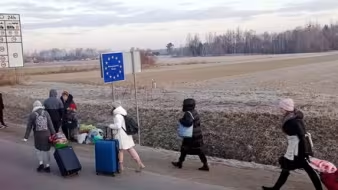
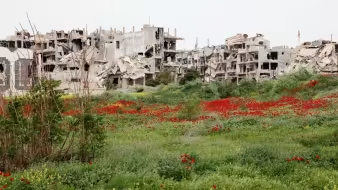
Despite the ongoing war and heavy destruction across Ukraine, some of the more than 6 million Ukrainians who fled after Russia’s invasion in February 2022 are already returning to Ukraine.
As of August 2024, an estimated 1 million Ukrainians had returned to their country from abroad, according to the International Organization for Migration (IOM). While most visit briefly, to see family or tend to their property, others return with the intention of staying permanently.
These actions raised questions for European and Ukrainian policymakers alike about the likely scale and drivers of future returns, and how to adapt their policies to prepare for these movements. For instance, do return intentions vary across host countries, and if so, how? What factors most influence Ukrainian refugees' intentions to return? What role does security in Ukraine play in shaping return decisions? Is more generous host-country support for refugees reducing intentions to return? Finally, what policy measures are necessary to support sustainable return or deeper integration in the host society?
This webinar, resulting from a research collaboration between IOM and MPI Europe, explored how personal circumstances and host-country and home-country conditions shape refugees’ intentions to return or remain abroad.
Speakers:
Arthur Erken, Regional Director for Europe and Central Asia, International Organization for Migration (IOM)
Olga Hamama, Co-Founder and Executive Board Member (Recovery & Homecoming Initiatives), United for Ukraine
Heather Komenda, Senior Regional Thematic Specialist for Protection, Regional Office for Europe and Central Asia, IOM
Ravenna Sohst, Policy Analyst, MPI Europe
Moderator:
Jasmijn Slootjes, Associate Director, MPI Europe
- Topic
- Refugees & Asylum
- Region
- Europe
- Country
- Ukraine
- Speakers
-
Ravenna Sohst
Policy Analyst, MPI Europe

Arthur Erken
Regional Director for Europe and Central Asia,International Organization for Migration (IOM)

Olga Hamama
Co-Founder and Executive Board Member (Recovery & Homecoming Initiatives),United for Ukraine
Heather Komenda
Senior Regional Thematic Specialist for Protection,Regional Office for Europe and Central Asia, IOM
- Moderator
-
Jasmijn Slootjes
Deputy Director, MPI Europe

Related Content