
Ravenna Sohst

Ravenna Sohst is a Policy Analyst at MPI Europe, where she conducts research and policy analysis on European migration policies, the links between development and migration, return migration and reintegration, labor mobility, and remittances.
Prior to joining MPI Europe, Dr. Sohst worked with the International Organization for Migration’s Global Migration Data Analysis Centre (IOM GMDAC) on migration forecasts and scenarios. She also worked at the Organization for Economic Cooperation and Development (OECD) on studies relating to immigrant integration and the social mobility of immigrants and their children. She has provided consultancy services to several organizations, including on labor migration and preparedness.
Dr. Sohst holds a PhD from the University of Luxembourg; her dissertation explored the social impacts of immigration and future outlooks in the European Union. She holds a MSc from the United Nations MERIT University/Maastricht University in public policy and human development, and a BA in political science from the University of Freiburg and the Institut d’Études Politiques d’Aix-en-Provence.
- Media Inquiries
Explore Content by Ravenna Sohst
Showing 1-10 of 20 total results
Private-Sector Engagement: A key element of supporting returnee reintegration through employment
Involving companies and other private-sector actors in helping returning migrants find jobs is a promising—but underdeveloped—approach to returnee reintegration.
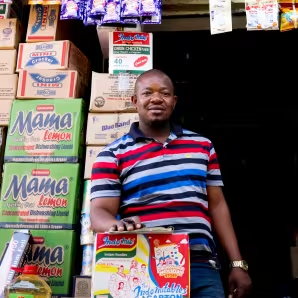
The Future of Reintegration Is a Key Missing Piece in Europe’s Focus on Returns
As EU return policy tightens, reintegration is being overlooked—including the need for more coherent strategies and locally embedded systems.

The Role of Counselling & Reintegration Support in Shaping Migrants’ Return Decisions
How do reintegration programs shape migrants' return decisions? Analysts examined how counselling approaches, an intervention's timing, and origin-country partners can improve outcomes.

Achieving the 'Quadruple Win': Labour migration strategies for Europe to meet its skill needs
This conversation examined best practices for designing and managing labour migration corridors between EU Member States and partner countries.

Best Practices for Designing and Managing Labour Migration Corridors to Europe
Weak visa access, poor skills recognition, and thin worker-employer matching hobble five EU labour corridors, with targeted reforms key to unlocking shared gains.

To Leave or Stay? Examining the role of counseling and reintegration assistance in the return decision-making of migrants ordered to leave the Netherlands
More counselling and better reintegration support increase uptake of assisted return in the Netherlands, but neither factor alone determines the return decisions of migrants ordered to leave.

Reframing Return and Reintegration: Origin-country priorities and strategies for cooperation
As origin-country reintegration frameworks evolve, governance gaps and misaligned donor support remain major obstacles to effective cooperation on migrant return.

Making Migrant Return and Reintegration Sustainable: Lessons from two continents
This conversation explored emerging models, policy shifts, and lessons learned from the European and Latin American approaches to reintegration and support for returning migrants.
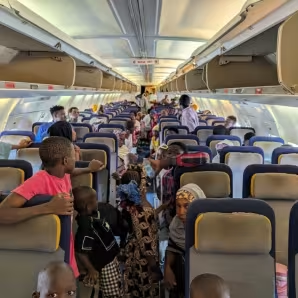
The Future of Labor: Lessons from India in the Global Race for Talent
The global race for Indian talent raises a question that bilateral agreements rarely answer: who benefits when millions of workers cross borders, and on whose terms?
Policy Paradox: How robust host-country support for Ukrainian refugees can foster integration and return
European governments hosting Ukrainian refugees have an opportunity to craft policies that deepen local inclusion while also fortifying Ukrainians if they seek to return home. By prioritizing comprehensive and durable support systems now, leaders can lay the groundwork for a future that benefits both those who stay and those who eventually choose to return, as this MPI Europe short read explains.
