Ukrainians in the EU: What is next after the Temporary Protection Directive?
This transcript was generated using AI and may contain inaccuracies. If you notice an error, feel free to email [email protected].
[00:00:01.11] - Hanne Beirens
Welcome everyone to the webinar Ukrainians in the EU: What is next after the Temporary Protection Directive? My name is Hanne Beirens. I'm the director of the Migration Policy Institute Europe. And we're very pleased to have you to discuss this very important topic alongside our three distinguished panellists who will be reflecting on this very question today. Before we start, I would like to share some housekeeping announcements. If you do have a problem accessing the webinar, please contact [email protected]. You need to know that there will be no voice Q&A, and hence, if you do have a question for our panellists, and we really would welcome any kind of questions that you would like to pose to them, please make sure that you use the Q&A function throughout our webinar, or you write again at this same address, [email protected]. Later on today, the video of this webinar will be available at our website, so the migrationpolicy.org/events. And we'll be drawing on a number of reports that have been published recently at MPI. So there's one on expanding protection options, which looks at flexible approaches to the status for displaced Syrians, Venezuelans, and Ukrainians, and which also explores this particular option of Temporary Protection, what it has done in the past, and what are some of the lessons for the future.
We also have reports on confronting compassion fatigue, understanding the arc of public support for displaced populations in Turkey, Colombia, and Europe. And the director of ECRE in a moment will be speaking as well, and they have published a really interesting report which looks at transitioning out of Temporary Protection Directive. So, there's another link over there. Thank you. So let me first, in the meantime, introduce our speakers for today. We have Nacira Boulehouat. She's the head of the Migration Management Coordination Unit at the Director General for Migration and Home Affairs at the European Commission. In the past, she's taken up a range of positions as head of deputy heads at the European Commission, either at DG Home as well, but also at DG ECHO and also at the external, the European External Action Service. There she, for example, was a deputy head of the Middle East unit, where she was dealing with the Syria crisis and the regional implications from 2011-2015. We're also joined today by Catherine Woollard. She's the director of ECRE, also known as the European Council on Refugees and Exiles, where she's been since 2016. As you may know, ECRE is a network of more than 120 organizations in 40 European countries, which looks at and really promotes the rights of forcibly displaced people in Europe.
And alongside that position, which is already a lot, she's also Adjunct Professor of Law at the VUB, which is the Free University of Brussels. Last but not least, we're joined by Lucia Salgado. She's an Associate Policy Analyst at our institute here in Brussels. She's been with us a few years now, focusing a lot on asylum, but also on integration issues and return and reintegration. And in the past, she took up positions, for example, at UNHCR. Also, well, right, with that, we'll start with the webinar. Thank you again for the audience for joining us today. It's a really important day. We're the 4th of March 2024, and this means about 2 years ago today, the Temporary Protection Directive was activated for the very first time in its history and since it was adopted in 2001. It was a landmark in the sense that it allowed for immediate temporary protection for millions fleeing the Ukrainian war. It allowed them also to, yeah, go in also through the visa-free regime. It was really crucial for them that they could quickly access a safe space, but also through the temporary protection, then they could access the same rights across Europe, whether it was accessing housing, jobs, education for their children, medical care, and alike.
But now, of course, we enter the third year of the war, and also in March 2025, we will reach a crucial moment where the Temporary Protection Status that has been granted to millions of Ukrainians across the EU will come to an end. And hence, the big question that we're engaging with today in our webinar is what will come next? Will there be another EU-wide solution? That was one of the key, of course, endeavours and of the TPD and also of its activation to avoid that we have a national patchwork of different approaches. Or if we don't have an EU-wide solution, how will we make sure that some of the national responses are duly coordinated and does the EU or the Commission have a role in that? Another important question is, of course, the question of return and the question of reconstruction of Ukraine. Ukrainian government has emphasized time and again and has increased also the request to make sure that there are avenues for citizens to return and to contribute to the reconstruction and also the buildup of the economy and like. Or if people do end up staying in Europe, how do we make sure that it's linked and intertwined with the integration policies?
I think that's a really crucial one. And then final one, how do we make sure that there is sufficient support for the solutions we put forward, that citizens and communities that have been hosting Ukrainians for 2 years now and potentially much longer. How can they also be respected, their concerns integrated, and how can we make sure that is reflected in the solutions? Before I hand over to our panellists, maybe a few questions to reflect on as you listen to today's conversation. As we look at the potential solutions, a few questions are, for example, a practical one: Is there sufficient time to adopt the measure? Some of the measures that we can contemplate, like legislative change, may take time and may not be quick enough when it comes to the March 25 deadline. Another one, how capacity-intensive will the proposed solution be? One of the options, of course, that's foreseen in TPD is that those who benefit from it could actually access and can already now access other asylum procedures and protection statuses. But of course, channelling millions into national asylum systems could potentially eventually or very likely result in a collapse of the systems. A third question is, how do we avoid uncertainty for those who are concerned, for the Ukrainians themselves, in terms of the legal status, their continued access to education, to jobs, to housing?
For example, if landowners ask about those kind of questions, and how do we avoid any kind of panic as a result? A fourth question is, how do we make sure that it accommodates the different concerns and needs of the population? We've talked about Ukrainian government, but also the Ukrainians themselves and the host communities. And so how do we really make sure that we allow, maybe final point, allow for that kind of back and forth that we've seen some Ukrainian beneficiaries of protection engage in, going back and forth to their country of origin. And if we really want to make sure that that option of return and reconstruction or contribution to reconstruction is maintained, how do we make sure that that kind of rekindling of ties is maintained. Okay. And with that, I'll turn to our first panellist, to Nacira. Thank you very much for joining us this afternoon. Nacira, I think the question that many people have and will be listening to today is what is next? What kinds of proposals are there currently being considered in terms of the post-March 2025 period? Are there ideas to continue, for example, the temporary protection status, and how would that work?
Are there other options on the table in terms of national asylum systems and— sorry, national statuses? And if that would be the case, what kind of role could the EU take? I think that's the key question maybe to kick us off with.
[00:09:06.05] - Nacira Boulehouat
Thank you. Thank you, Hanne, and good afternoon, everybody. And thank you for having us on this webinar. It's extremely timely, timely above all for the people from Ukraine because they are benefiting from temporary protection, those who benefit from it, until the 4th of March 2025. It may sound, as you say, you know, still in a few months ahead, but nevertheless, for their predictability, it's quite important to give indications of what comes next, but also for the administrations and for the NGOs and everybody that supports them, because only administratively it takes time to take the steps, renew the paper documentation, etc. So, it's timely for that. It's timely also for us as the Commission and also the member states because we are in the midst of discussing exactly the various options. The discussion was kicked off at the ministerial meeting of Justice and Home Affairs Council not long time ago, and so the good news is that the work is on track, it's ongoing. The less so good news is that then I cannot give you definitive answers now until the Commissioner makes it herself and announces it to the ministers of the EU and then to Europeans and then to Ukrainians also at the same So what I can say is that definitely to start with, because the first best option at which we are all looking at is temporary protection because it has provided this uniform framework across the EU for all Ukrainians and people coming from Ukraine.
In fact, not only Ukrainians. And it is indeed has allowed us to have a status that applies across the board. Now, I can start with that and give the reassurance that legally, of course, well, of course, now we can confirm that it is possible to reconduct temporary protection beyond 2025. There is a legal base to be doing so, and the European Union can do so in fact on a yearly basis. And I think it is good to say it quite clearly and to dispel some misconceptions, because a few months back a lot of people read the implementing decision of the Temporary Protection Directive as, you know, 3 years maximum, and it is not the case. So, I think this gives us, uh, uh, a bit of— we can buy time with that. It gives us, uh, space to breathe. Uh, why is that? Because I think none of us, uh, can predict, uh, what will be the situation in 2025. And it's good, uh, if we can have various options. But as I said, I think we all care about giving this predictability and the ability for beneficiaries of temporary protection to make their plans in terms of schooling and housing and contract with the landlords.
I think all what I can tell you is that at the political level and with my Commissioner, it is understood that we have to make this decision in the near future in a reasonable timeframe. If I'm not mistaken, last time when we renewed temporary protection also, we were able to make these decisions before, right after the summer. Yeah, I think it was October. So, the— you can be sure, or what I can say is that you can be sure that Commissioner Johansson will say something in the next months and hopefully before the summer break, then rather before than after. I cannot say more than that, but I think it's a very good— I hope it is a starting point also for us, because analysing the different options and discussing it also, we have had a few rounds of discussions with the member states. There are, as you say, different options. And maybe I will start from that and then give you what are the kind of conclusions that we are taking as Commission services. So, you said, you named it, this temporary— sorry, there is of course when temporary protection ends, if it ends, there is always, as it is the case now, to benefit from international protection.
But what we have heard from member states is definitely that this is not their favourite options because a number of them are really worried to have their asylum system overwhelmed by requests. And if I may also say, it may be well that some of them and some of the beneficiaries would not benefit from the best protection because they are not fleeing persecution, etc. So, there we can see already that it is not the ideal and optimal solution. There are different options that we looked at and what is in fact maybe sometimes already the practice in terms of long-term solutions. And this is about the, the statuses under EU law in terms of residence there. I'm sure that a number of actors and analysts are looking at the long-term Residence Directive, but it is now under discussion, still under inter-institutional discussions. It's not closed yet, and it is not guaranteed that beneficiaries of temporary protection would qualify, or that ultimately the compromise will be in favour of including them in the reading of the recast of the directive. So that is not an avenue that I can say if it is, it could work for beneficiaries of temporary protection.
Then there are also other regimes or statuses under EU, under national law in terms of residence and work permit under the pertinent directives. And what we have understood from member states, and of course you are following that also from very close, a number of member states have already moved to that transition. So, to encourage beneficiaries of temporary protection to move towards other statuses under their national system, you know, like Poland has been encouraging also people to take work and self-employment or work permits and things like that. It has worked in some places and not in others. And what we hear from member states also is that this avenue cannot be either the panacea because the threshold for having such a resident permit sometimes is quite— it's high. So, it will not benefit all the people from Ukraine. So, we have to be careful here. In some other member states, for instance, as you know, in Germany, there's only a small proportion of beneficiaries of temporary protection who are in the labour market. So, we have to see also, you know, the differences that exist between the member states and be mindful that, you know, it is not going to be a one-size-fits-all one-size-fits-all solution.
And so, by going rounds of consultations with the member states, we came to realise 3 things. The first one, and I think this was a strong request from the countries, from the member states like that, they do want to have a European coordinated solution. And as Commission services, we do think that this is really good news that we have an EU-coordinated regime for post-TPD to avoid fragmentation. But also because I hope we all agreed that what matters in this is that I don't think that all Ukrainians equal in terms of their integrability in European societies and European labour market and European schools, etc. So I think what we should care for is to make sure that no one is left behind and that there are also categories of vulnerable people from Ukraine which do not stand the same chance as others who have made their way to the labour market and things like that. So maybe this should be our role to look after that. And then there is another important aspect we think as we are designing these different options is to do that not only in a EU-coordinated manner, but also in discussion with the Ukrainian authorities.
And there comes what you were mentioning earlier, because this is about their people and the rebuilding of their country. And it is very important, as you said, to make sure that the population of Ukraine and its diaspora be able also to make a participation in the reconstruction of the country. For the time being, you know, the system under the Temporary Protection Directive The return is foreseen. It's quite a flexible system where beneficiaries of temporary protection can go back and forth. They can also, without— by retaining their protection status here. So that's possible. And beyond that, there could be also— there are some hooks also in the directive where people can be encouraged already to return with a view to serve their country. There are good ideas around, indeed, encouraging, you know, keeping some sort of protection for the people of Ukraine, but at the same time, making a new support to be able to participate in the reconstruction. Now, What I wanted to say, maybe my time is over, I don't know, but it was the—is it?
[00:22:01.07] - Hanne Beirens
Well, if you can, yeah, make some final comments, that is fine.
[00:22:05.10] - Nacira Boulehouat
Yeah, it is my last sentence because I think this is quite important. So what are the desires of the authorities of Ukraine but of the Ukrainians themselves? And I see that many organizations also from the UN and IOM, a number of member states and also civil society organizations are doing this. They are conducting very interesting surveys on the intention, the mobility intentions of people from Ukraine. And there you can see that there is a proportion of them who do not intend to return, who see that the conditions are not right. And this is also another dimension that we have to factor in, in what we are trying to design here. So I think this was my last observation.
[00:22:59.21] - Hanne Beirens
Thank you. Thank you much, Nacira. I think, yeah, key point maybe that we take away, it's really encouraging to hear that there will be an announcement of the commissioner quite soon because of course it takes time to pursue these different kinds of solutions and that you're emphasizing the need for predictability for all the different kinds of stakeholders. Of course, Ukrainians, I mean, the citizens who are present in our societies, the host communities, but also the Ukrainian government and the like. I think that's really crucial. And also this emphasis or this, there seems to be an agreement on the need for an EU-wide solution. What that then will be concretely, that we'll have to see, I think, but also the need to coordinate with the Ukrainian government, which makes it a particularly unique situation, of course, when it comes to protection-like situations. This kind of, yeah, kind of conversations also with the country of origin is not something that we often see. So it makes for a really particular case, unique case, but also really an interesting one to really reflect on, of course, how do we facilitate return and reintegration for those who want to return or able to return?
And with that, I'll turn to Catherine. Catherine, thank you again for joining us. ECRE has really released a very interesting policy brief that we mentioned at the beginning, which really, you know, gives a very beautiful overview, I think, very nice overview of all the different options that could be on the table. I mean, some of those have already been put forward by Nacira in terms of extending the TPD, but also engaging, I mean, with the options of some of the national statuses. We'd be very interested to hear your views on that or the views of the organization. And maybe some of the kind of key things to reflect upon as we, yeah, explore these different kind of options going forward. Thanks.
[00:24:59.19] - Catherine Woollard
Great. Thank you very much. So I'm going to base my comments on the policy paper that you've just mentioned, and I'll cover firstly the principles that should apply when we look at post-TPD options, and then look in some detail at the options available that we list in the paper with a few comments on the pros and cons of each. Of those options. And then I'll just wrap up with perhaps a comment on what is most likely, the prediction of what's going to happen now. In terms of the first point, the principles that should apply, ECRE has argued that the approach to the long-term support for people displaced from Ukraine needs to be based firmly on the informed consent of the people themselves. The people displaced being Ukrainians, but also third country nationals who've also been displaced from Ukraine. Any options that are coercive or that are poorly understood may lead to a situation of panic, which could lead to both asylum applications and panicked movement within the EU. And secondly, a principle is that the respect for the human rights of the people concerned is important. The response to this displacement has been successful partly because it has prioritised the question of protection.
And that's not always what we see when Europe is responding to situations of mass displacement. Thirdly, we argue that a range of options have to be available. Now, this is perhaps contradictory with the other need, which is for a collective European response. I think we argue that all these options should be kept open. Partly because people's needs are very different. There are very different categories of people here. And above all, it's necessary to avoid this risk of large numbers of people, millions possibly, falling into situations of irregularity or living in, with extreme precarity. So a related principle is that we've said striving for European unity is an important principle, but I think we have to accept that the limits of a collective European response are being reached. And the success of the response at the beginning was because we saw an assertive European Commission leading the way, making sure that the political support was in place to activate the TPD. And things are now starting to unravel somewhat, and states are already going their own ways and time is pressing. So for that reason, we argue that a variety of options should be there so that all people can have protection.
Now, looking at the different options, and I will just go through mentioning a few pros and cons of each without the detail. Option 1 that we saw is assisted voluntary return to Ukraine. Now, this— the pros of this option are that it will be suitable for and preferred by many people. Like with every displacement crisis, most people prefer to return. The EU and other donors could play a significant role in supporting, using the experience of assisted voluntary return programs. The cons of this option, firstly, that it would need to be integrated into the accession process, which is not entirely obvious how that would work. And it would be very useful to preserve the current right to what we call pendulum movement that Nacira mentioned, the back and forth from the country. The biggest con with this option is the question as to how much of the country will be safe for returns. Unfortunately, it seems likely that the violence will get worse before it gets better. There are large-scale offensives from both sides predicted for next year after rearming takes place before then. It may be in the long term that the situation is one of protracted, albeit somewhat lower-level conflict with disputed territories in place, but ongoing violence.
Option 2, the extension of the Temporary Protection Regime, including extension of the TPD. The advantage of this is that in a sense it's the easiest option for the EU at a time of major transition. The cons of this— it was very reassuring to hear from the Commission that the legal advice now says that there is a legal basis for doing this. This wasn't always obvious. If that's the case, then that overcomes one of the problems. An amendment of the TPD would simply take too long, so it has to be done using the existing legal framework. And we had argued, and I'm glad to hear it seems to be confirmed, that using a, how should I say that, a flexible interpretation of Article 42 will allow for an extension. And the question here is the timing. And I understand that there are, of course, political considerations, and not least, I imagine, the pressure from the Ukrainian government of the sign that is that could be interpreted from doing this. But it's something that really has to be done now. And I think from our perspective, we also have in mind the forthcoming Hungarian presidency, which will be an obstructionist presidency in many senses.
And can this decision be taken before going into that period of hiatus, let us say, for EU decision-making? The third option is asylum applications. As others have mentioned, there are a number of disadvantages to this. Most people who currently have TP, Temporary Protection, will not receive either refugee status or subsidiary protection. Some may, but it's uncertain. In addition, the Dublin question arises. Article 18 of the TPD gives no direct indication of which member state will be responsible if somebody moves to an asylum rather than TPD protection. And the question of Article 11 that was suspended, essentially the equivalent of Dublin, will come into play. And the pro, the advantage of the asylum option, is that this remains a right that Ukrainians have. Up until now, the figures we have is about 24,000 applications from Ukrainians in 2022, far fewer last year, somewhere between 5,000-6,000 in 2023. The protection rate is at 90%, but that's because it's a very specific group of people who are applying for asylum. A wider pool of people applying, that would change significantly. The key con disadvantage, of course, is that asylum systems won't manage. Moving down, option 4, protection statuses in national law, humanitarian protection statuses.
Statuses. From ECRE's perspective, this remains an interesting option, and every year somewhere between 60,000 and 70,000 of these national humanitarian protection statuses are granted by states in the EU. In some cases, they will be the most appropriate status for certain of the people fleeing from Ukraine. And the disadvantages are, though, multiple. European-wide coordination is difficult because this is national law, and member states have a variety of such statuses. Their use is often highly opaque. Unfortunately, in recent years there has also been a tendency to limit the use of these statuses and even remove them from statute. For us, this has been extremely misguided approach, which is derived from false theories that these statuses act as a pull factor, for instance. And they are very useful, but they are, are limited. And there's also an administrative challenge linked to managing transfer of large numbers of people to these statuses. And let me wrap up there on the options. New protection statuses in EU law, and the discussion of a reconstruction permit that has been mentioned, a new type of pre-accession permit. The challenge there, I think, is both— they look rather impossible in terms of both the process, given the transition taking place this year at EU level, and the difficulty of passing legislation, but also in terms of the politics.
And then the final option, which we also see as promising, is transition to work-based permits. Now, this is already happening in a number of member states. It can give people more security than a temporary protection status in some cases, and the disadvantage is that it can, on the other hand, be precarious. It creates the risk of exploitation due to dependence on employers. It can be very bureaucratic in many states, um, because just actually accessing a work permit, uh, can be a challenge. And, and if people have protection needs, there is something in law that is problematic about them being on a work-based permit. Nonetheless, from a pragmatic point of view, these options I think will become increasingly important. The reform of the long-term residence directive that would bring temporary protection beneficiaries within its scope would be extremely useful. This has been proposed by the Parliament. We understand that there are 3 or 4 member states that are strongly opposed to it. I don't understand this at all. I think I think it's a self-defeating strategy on their part, and particularly for a country like Poland, but also for a country like France. And let me, my final sentence then to wrap up, of all of these options, what is most likely?
I think up until now we see these millions of people hosted under an EU legal framework using an EU law tool. The TPD. And this has shown the great value of the EU in responding to this crisis. I think nonetheless that we may be at the limits of a harmonised and collective approach. The EU was able to mount a very, a collective and effective response, but that was for a short period of time. It was due to the pressure of the security situation, the proximity of the crisis, and also honestly due to the racial, religious, and demographic makeup of the displaced population. That period may be coming to an end. What happens next could be either what we would call EU max, EU light, or EU zero. How much is at EU level? I think we'll be in a situation that we would call EU light. The most that can be expected is the 1-year extension of the TPD. And this is very important, crucially important, and needs to be arranged as a matter of urgency to give people security. But that is short of an EU max approach where a range of other options are integrated into EU law or supported through EU coordination.
And that's the reality. But it is better than EU zero, where everything fragments and is organised only at national level. There are options at national level. Member States should be ready with all the options that are possible in their legal frameworks in case the TPD extension doesn't work. And those options should be available in addition, but we're hoping that there is the EU light rather than EU zero. Thank you.
[00:37:53.18] - Hanne Beirens
Thanks very much, Catherine. I think it's been really interesting to, to hear about the different kinds of options complementing some of the options that Nacira had also put forward. On the one hand, because as you say, within the current political landscape and what may come ahead, understanding what will be feasible in the next months in terms of adopting a particular solution, but also because what you've been saying, and Nacira as well, is that we cannot treat the Ukrainian displaced population as one group, a homogeneous group, and especially as the conflict continues, but also the realities on the ground change, people with children, with other setups, that it's really important that we can accommodate or at least respond or taking into account the different kinds of interests, whether people want to return or not and the like, but also, as you say, to what extent they'll be able to be seen as eligible for certain kinds of status. I think these have all been really important ones. But now we turn to Lucia Salgado. She has been working on a study, and that's also available on our website, which really looks into the kind of solidarity that has been shared or exposed, or how to say, shown in relation to different kinds of displaced populations, both to Venezuelans in Colombia and Syrians in Turkey, alongside, of course, also Ukrainians in Europe.
And so I'll turn to Lucía now and ask her to start with this first question, whether based on their research, is there a risk of compassion fatigue in the EU, and what can we learn also from responses both in Turkey and Colombia. Thank you.
[00:39:34.20] - Lucía Salgado
Thank you very much, Hanne, and good afternoon to all. And I think this is actually a very important question to consider as well when thinking about the future of Ukrainians in the EU. When the war started, we all saw this incredible public solidarity towards Ukrainian refugees with people opening their houses to Ukrainians, going to train stations to provide support. And polls in general show that a majority, a great majority of EU citizens wanted to welcome Ukrainians. But we need to take into account that public solidarity is something that is fragile, and compassion fatigue in the case of Ukrainians is definitely a risk. We can look at the cases of Turkey currently hosting around 3.5 million Syrians and Colombia hosting around 3 million Venezuelans, which really can serve as a cautionary tale. For instance, Turkey had a strong initial public solidarity attitude towards Syrians at the beginning of the Syrian war. But we saw last year in the national elections that there was a slogan of sending refugees home. And Colombia also opened the doors to what they refer to as the Venezuelan brothers. But since 2015, the attitudes have really deteriorated. In the case of Ukrainians, support is still relatively strong, but we start seeing some signs of solidarity fatigue, also some pressure towards governments to reduce support towards Ukrainians and some governments such as in Poland or Ireland or the Czech Republic, cutting support for Ukrainians.
But it's also important to know that compassion fatigue is not unavoidable. So to address it, we need to understand why it happens. And in our report, we have identified several factors. I'm going to talk about 3 main factors that I think are particularly relevant for the situation of Ukrainians. The first factor that can erode solidarity is the perception of lack of control. We know that public perceptions about migrants and refugees are often not so related to the number of arrivals itself, but more to how arrivals are managed. And this can partly explain why the arrival of millions of Ukrainians in 2022, which was orderly thanks as well to the activation of the TPD, did not generate the same perception of threat such as, than the arrivals of over a million asylum seekers in 2015, and actually instilling this sense of control where migration has been one of the key goals of the new pact, even if it's not linked to Ukraine, but just to emphasize how important it is that people have this sense of control over migration. And this also extends to what happens after migrants settle. So for instance, if there are perceptions that newcomers are not integrating well, there can be more negative perceptions.
We have seen that in Syria, in Turkey, for instance, in terms of the perceptions that Syrians were not integrating well. And in Europe, this has not been so much a concern for Ukrainians, but we have seen sometimes that this is an issue. So for instance, there was a poll in Austria showing that there is an increase now in negative attitudes, and this has correlated with also growing concerns over the integration of Ukrainians. A second factor that I wanted to highlight is the perception of unfairness and also fears of the local population being left behind. So we know that host populations often have existing problems. For instance, in the EU, there is this widespread housing shortages, also capacity problems in the education and healthcare sector. And if host populations think that arrivals exacerbating existing problems, they can feel more negative about refugees. We have seen this in Ireland, for instance, when there has been last year protest also against migrants but also Ukrainians linked to the fact that they were seen as exacerbating the acute housing crisis. And in Colombia, where there is a lot of job insecurity, access to the labour market for Venezuelans has also been more contentious.
And of course, in this sense, negative attitudes can increase if people feel that refugees get more support than locals, especially if some segments feel that resources are a zero-sum game in the sense that resources for refugees are taken away from locals. This is, of course, often not the case. I'm just talking about perceptions and what people think. And this is why measures that provide refugees with benefits that are not shared by the wider populations can be unpopular, such as the provision of subsidized housing for Ukrainians in some countries in Europe. has proved controversial. And the last factor I wanted to highlight here in terms of shaping public support and the impact on public support is the role of uncertainty about the future. We need to consider that usually it is harder for people to give indefinite support compared to a situation that has a known end in sight. For instance, in Turkey, a lot of people were in favour of welcoming Syrians because they were seen as temporary guests. Actually, they were called guests. But after like years, and now we see this protracted situation more than 10 years later, a growing number of people want Syrians to go back home.
And in Ukraine, again, this like in Europe with Ukrainians, it has not been still prominent. But already in '22, there was a poll conducted in Poland, and we saw that while the great majority, almost 90%, of Polish people surveyed wanted to welcome Ukrainians, only one-third wanted to support Ukrainians for the entire duration of the conflict. So I think this is something that we need to consider as well when thinking about future options. So in conclusion, there is definitely a risk of compassion fatigue, and we are seeing some signs of compassion fatigue and some pockets of anxiety. Support for Ukrainians still remains relatively high. This is also important to say. But it's important to identify these factors that can lead to compassion fatigue. Also, if we look at the situations of Turkey and Colombia and address these factors in order to confront compassion fatigue.
[00:45:32.22] - Hanne Beirens
Thank you, Lucia. And just so that we can— that's really, really interesting. Maybe to close this part of the webinar where we share our initial thoughts on this topic, it would be maybe if you can highlight maybe two or so options for policymakers to address this issue and how can they maybe either prevent or help reduce this kind of compassion fatigue. And then we will head into the Q&A session. So also just a warm welcome again to all members of our audience. If you have questions, please do post them in the Q&A session. Thanks, Lucía.
[00:46:07.15] - Lucía Salgado
Thank you, Hanne. And yes, indeed. So there are several strategies that policymakers can follow in order to confront compassion fatigue. The first one is actually addressing the practical concerns that can lead to public anxiety. So often concerns around refugees are linked to concerns such as job insecurity, housing shortages, overburdened infrastructure, and investing in those areas. For instance, if it is a lack of affordable housing, investing in those areas can actually avoid frictions between locals and this. Secondly, it's important for Ukrainians but also for future situations of mass displacement, knowing that policymakers can tap into grassroots solidarity in the short term, but they need to prepare for fatigue in the long term. So in Europe, the role of volunteers, the Ukrainian diaspora proved to be key in terms of providing accommodation and support. But the willingness and ability of citizens to support personally refugees cannot be sustained over the long and also as time passes, funds from donors, for instance, can also dry. So it's important to avoid solidarity burnout, that policymakers put in place support that can gradually replace the support provided by volunteers. Thirdly, it is also very important to invest in integration from day one.
And I know this is difficult because there is always this uncertainty on whether Ukrainians will stay, how many will stay, how many will return, and of course also the goal of support the reconstruction of Ukraine. But it still is very important that policymakers invest in integration because not investing in integration from day one can have very negative consequences down the line. And to strike the right balance between these competing policy aims of integrating Ukrainians but also supporting the return, policymakers can, for instance, try to develop so-called dual-intent policies. It was a long-term point by the OECD to try to develop measures that can support both a potential return but also long-term integration. For instance, investing in training for Ukrainians in sectors that are relevant both for host communities but also for the reconstruction of Ukraine, such as the IT sector. And my last point very quickly is that governments should acknowledge that there are public concerns about welcoming new arrivals, especially when these in the long term, but also they should frame immigration as something that can benefit the whole community and show concrete benefits. So for instance, they can signal that investments in, for example, renovating buildings that we have seen to accommodate new arrivals will actually increase the stock of affordable housing for everyone.
So yeah, I think I will finish there. That's very happy to take any questions.
[00:48:48.14] - Hanne Beirens
Thank you very much, Lucia. And we'll now head into our Q&A of this webinar. In a moment, I'll turn to Nacira, Nacira, there are a couple of questions about the Temporary Protection Directive also. What is its fate in the next— going forward now with the EU Pact? Will it still go on? Will it be replaced by the crisis regulation? So a very— a question about that. Another question is also for you, Nacira. I'll turn to you in a second, but you can in the meantime think about it is, of course, I think you and both Catherine emphasized the need to be able to take account, to account of the differences between, within the population of Ukrainians and how, for example, different types of statuses may accommodate those different needs or interests. But how will that work in practice in terms of how do we inform a Ukrainian population of very different options and how do we make sure that it's coordinated across the EU so that we don't have one member state offering certain kind of status and then others not. So I think maybe, yeah, any kind of ideas on how to coordinate that in the future, I think, could be an interesting one.
But in the meantime, I'll turn to Catherine. Catherine, there's a question on the one hand about questions of consultation of the affected populations. I mean, do you see the role of ECRE with, of course, the network of organizations that you represent or that you, you know, provide an umbrella organization for. Is there a possibility to tap into those networks and actually get a sense of what displaced populations themselves want? I think is a crucial one. And then also, again, yeah, another one is how do we make sure in the current setup What do we do in terms of return options? One of the audience members asked about how do we deal with, for example, in as the conflict goes on, the war, and there's a request for more men to return to the front and the like. How do we deal with return, forced return, those kind of questions? If you have any views on that front, that might be interesting to start with. Thank you.
[[FOR THE Q&A PORTION OF THE TRANSCRIPT, SPEAKERS ARE NOT IDENTIFIED BY NAME. PLEASE SEE THE RECORDING TO IDENTIFY SPEAKERS.]]
[00:51:09.02] - Speaker 3
Okay, thank you for all the questions. I'm just reading through all the very interesting questions. Let me take on those 3, starting with consultation of civil society. From ECRE's perspective, that has happened partly because we have 2 member organizations in Ukraine. So ECRE has members in 40 European countries, which includes Ukraine, and our members there are continuing to work in the country despite the ongoing war, and they've also themselves been displaced and set up offices elsewhere. We then have members in all the countries that have been— have received the largest number of displaced people who are working on a daily with people displaced, and who in many cases are also recruiting people from that population of people displaced. And beyond that, we and others have also tried to find ways to bring the people directly affected into EU policymaking, for instance, to set up briefings, meetings for people displaced from Ukraine with policymakers directly. I mean, I won't say any more about that. I'm sure that other people listening also have examples of that and how to bring people in. I think there could perhaps be more structured ways for direct input, for instance, via the Solidarity Platform, having sort expert group of people displaced from Ukraine feeding directly into policymaking that way, rather than it being kind of via dialog and events that we and others set up.
[00:53:12.05] - Speaker 3
And moving on, in terms of— there's the question of forced returns I'm going to separate it out into the question, the very sensitive question of conscientious objection, and there, this is the basis for which people have applied for asylum and will continue to apply for asylum. It is extremely sensitive, but it's a long-standing principle in international law and in many national legal systems that people who have a moral objection opposition to war as pacifists have the right to express that and to receive sanctuary and support elsewhere. That in practice is happening in a very limited way. And I think there may be concerns from the Ukrainian government, if we look at recent statements from the Ukrainian government, of a more informal form of people not being present to fight. So for instance, people who are going on leave, who are going, taking a respite, break from fighting, who are not returning, who are maybe reuniting with family members and not returning to fight in the country. And the numbers affected are not clear. It's very sensitive issue. But I think some of the questions and speeches from the Ukrainian government in terms of force generation may link, may be related to those kind of concerns.
[00:54:56.03] - Speaker 3
Those are situations that arise in military conflict. So they're not points on which we have any position. It's not Ukraine's business, but I think it adds to the concerns probably of the Ukrainian government when it comes to ensuring firstly the necessary human resources in terms of the fighting, but also in relation to the long-term demographic crisis that the country will be facing, that it was already facing even before the situation of mass displacement. And that creates, I think, a number of dilemmas because the long-term sustainability of the country has also to be balanced against the need to protect people and not to forcibly return people before it's safe. So there are factors pulling in different directions. And a final point on that, on forcible return in response to those questions. And I think there's a lot of evidence available from many displacement crises that once return becomes something forcible, definitive, then people are less likely to choose it. So I think it's counterproductive to be arguing that that if the EU continues to offer protection for some, there will be others who will be forcibly returned. The— there needs to be a way to support return through all the different experience and knowledge about assisted voluntary return programs, the funding that's available, the coordination of different donor support, the linking of that to reconstruction, building that into the accession process is a new dimension.
[00:57:01.06] - Speaker 3
So all of that, but not going to the point where it becomes coerced return. The likely result of that would be mass asylum applications, but also onward movement within the EU where people fear that where they are, they'll be forcibly returned, so they try to go somewhere else, and a general chaos. So the, the balance there is tricky, but I think it's feasible. I mean, not least because the accession process brings with it new forms of cooperation as well.
[00:57:40.14] - Speaker 1
Thanks very much, Catherine. Let me join now to turn to Nacira. Nacira, maybe a couple of things. If we can just briefly confirm There's a question about the extension, the yearly annual extension that you've mentioned of the TPD. Catherine already referred to Article 4(2). That's indeed correct, I understand. Yeah. So the next question, maybe we can— one of the questions I think that might be useful for you to briefly explain is why is it that there wouldn't be a possibility for prima facie recognition if the TPD would finish in March 2025. Catherine already also alluded to that Ukrainians wouldn't, and you had it also, that Ukrainians would not necessarily be eligible for protection linked to the Refugee Convention or subsidiary protection. Maybe if you can briefly explain so our audience understands why it would be the case. And then if you could briefly touch upon the more generally on the fate of the TPD going forward as part of the pact. I mean, there's many more questions, but let's maybe start with that so that we're all clear on why it is and why you were also alluding to the fact that maybe we need different kinds of resident permits for workers, all these kind of things, just to make sure that the population actually has the right to remain in the EU if we need it.
[00:59:05.07] - Speaker 2
So I'm not saying that There won't be the granting of asylum status. No, of the different international protection status, it could be that in some cases and some member states, beneficiaries from Ukraine wouldn't get actually the asylum, the refugee status, but rather the subsidiary protection as this is not a population that is being persecuted by its own authorities when it comes to Ukraine. Now, the situation may be different from one member state to the other. And actually there are, I think the question was, but you mentioned it, Catherine, there are a number of Ukrainians who are under beneficiaries of international protection. So, and then I guess that as in many situations, Member States want to keep the possibility to do a case-by-case examination. Now, I wanted to briefly clarify because it's not the first time we get this question also on, you know, what's the fate of Temporary Protection Directive versus crisis instrumentalization in the— it's a good question. Well, at the end of the day, we will keep everything and we will have a full toolbox. Temporary Protection Directive, well, its activation, sorry. So this is recent. And when we tabled the crisis proposal at that time, there was no— well, we didn't have the experience of the aggression against Ukraine.
[01:00:59.13] - Speaker 2
And we had proposed in fact to repeal TPD and maybe we could leave just with the crisis proposal. But then by the practice and we lived the experience that it's been really a super useful instrument. So we don't repeal it, we keep TPD and we have the crisis and we have this new dimension of also instrumentalization within it. So we have now instruments to cater for unforeseeable events.
[01:01:32.05] - Speaker 1
So, well, thanks, Nacira. In a moment, I just wanted to say we'll run it over a little bit just to be able to tackle a few more questions to our audience. Just wanted to signal that. Apologies for running over. Nacira, in a moment I would like to return to you just because there are a number of questions whether there are other broader developments that are weighing in or affecting the discussions that you mentioned at the start of your intervention earlier, this webinar, about the decision going forward on what the post-March 2025 solution should be for Ukrainian displaced population in Europe. For example, there's a reference to the accession period. I mean, something that's also explored in the ECRE policy brief, how does that weigh in in any way in reflecting on options? Of course, there's broader developments, there's reflection to, yeah, the question of the US contributions to, of course, the war effort on the part of the Ukrainians. Of course, there's been a similar effort on our side following the meeting that President Macron has organised and also that the Czech Republic has initiated. So how are some of these other developments that are occurring affecting in any way the discussions?
[01:02:49.19] - Speaker 1
But I would first like to briefly go to Lucia. Lucia, there's a question also in terms of compassion fatigue and also just making sure there's solidarity. Is there something that Ukrainian population or the diaspora themselves can do in addressing this issue?
[01:03:08.06] - Speaker 4
That is a really interesting question. I think that the diaspora could support the government in having this positive narrative about Ukrainians, the fact that they are actually contributing to society, that investments made for Ukrainians such as renovating buildings are beneficial for all. So societies are just adapting to growing communities, which is positive if there are investments and more capacity. So I think they can support that narrative. I do think though that most measures need to come from government itself in terms of ensuring there is sufficient capacity, for instance, when it comes to housing or education, also in terms of addressing those pockets of anxiety or practical concerns that people have. And yeah, also investing in the integration of Ukrainians themselves. So I think it's mostly up to governments to really confront this compassion fatigue, to put the support structures in place and address these concerns that people might have. But yeah, I think that the diaspora can also help in framing the positive contribution of Ukrainians and the fact that, yeah, it can be really beneficial for host communities to have Ukrainians as well.
[01:04:20.19] - Speaker 1
Thanks, Lucía. We'll turn to Nacira now and then we'll end our webinar. But Nacira, it would be really interesting to hear from you whether there are broader factors that are weighing into these discussions, if you can actually share some of that.
[01:04:35.17] - Speaker 2
Yeah, I think in discussions actually with Ukrainians, citizens and authorities, and I will combine the two questions with one, but with the US non-decision for the time being. I mean, we're all aware that there is a lack of military equipment that Ukraine is suffering from, and I hope decisions will make soon to fill this gap. And the second one, it's not only military equipment, but with the way we see it, it's the manpower. It's Ukraine's human resource. I mean, there is a lot, a big diaspora. It has not started only on the 24th of February of 2022. And we have to be mindful here if we want to help Ukraine, and this has been all the policy of the EU and the member states, but also all the work of non-governmental organizations to continue working on upskilling and reskilling and making sure that while Ukrainians are staying in the EU, they continue to have training, skills, education so that they are able to bring things back home. The same for schooling, for the education of children because they are going to rebuild their own future, etc. So there are many things we can do. So because I like to put, you know, there is the military problem, but there is also the human and manpower problem that Ukraine is facing.
[01:06:26.20] - Speaker 2
So, and also in a scenario or a scheme where we are contemplating the idea of supporting reconstruction, you know that there is a big facility now put on the table by my colleagues in DG NEAR, by the Commission, let's say. And there also it will be very, very important that jobs are creating and businesses are reactivated, etc. So yes, we have to have this in our considerations. So that counts. Yeah. What else did you want me to answer, Hanne?
[01:07:10.10] - Speaker 1
Yeah, I think that's fine, Nacira. I think we'll just, yeah, out of respect of people's time dedicated, I think that's been very helpful. I would like to thank our panellists for the interventions that they provided and also for answering the questions. And I would like to thank our audience for, for joining us. There's been really a lot of interesting questions. What I would also suggest is that you have a look at the reports that we had signalled at the beginning. For example, also the ECRE report gives also an overview of, you know, the degree to which the legal possibility— some of the questions asked are raised about that, but also can member states go at it alone? I think also there, the ECRE paper allows for some really interesting reviews. But also there were questions, for example, about the psychological toll on the refugees, those who receive a temporary protection status versus more long-term ones. So I think I think that's something that our report Expanding Protection Options: Flexible Approaches, there I think you have an interesting overview. And also it shows how that kind of temporary protection, which maybe we view from a particular perspective in the Ukrainian situation, has been applied maybe in different ways in relation to the Venezuelan or the Syrian displacement.
[01:08:31.23] - Speaker 1
So do have a look at those and how populations are responding to that. We just also wanted to reflect finally that reporters can contact Michelle Mittelstadt at [email protected]. And as I've signalled at the beginning, the videos of today's event will be available later today on our website. And if you want to sign up to receive news about new upcoming reports or commentaries, podcasts, or webinars please go to our website and sign up there. Thank you again for joining us today, and thank you again for our panellists as well. And if you do have particular questions that you feel that you would like us to explore further, do send us an email and we'll be very happy to follow up on that. Thanks again.
On the second anniversary of the first-ever activation of the Temporary Protection Directive, this event considered EU support for millions of displaced Ukrainians, the directive's possible 2025 expiration, and other innovative approaches to temporary status.
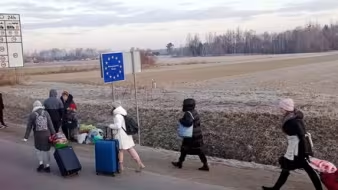
As the war in Ukraine drags into its third year in 2024, European Union (EU) and national policymakers were chiefly focused on how to maintain support for Ukrainian military efforts to repel the Russian invasion. Another crucial question was being overshadowed, though: How to continue supporting millions of displaced Ukrainians after the European Union’s Temporary Protection Directive (TPD) expires on March 4, 2025. Since its first-ever activation in March 2022, the TPD has granted immediate protection to more than 4 million Ukrainians, allowing them to access housing, the labour market, medical care, and education across the European Union, as well as other benefits to varying degrees by country.
Experts discussed what will happen when the TPD expires? Will there be an EU-wide solution put forward, such as the renewal of the TPD? Or will it be replaced by a patchwork of national solutions—a scenario that the TPD was to avoid? How can a post-TPD scenario be linked with potential longer-term integration or return policies and realities? And what will this mean for host societies’ willingness to continue supporting Ukrainians, especially in an election year when migration will be high on the agenda?
Experts discussed lessons that could be learned from experiences with the use of temporary statuses in other regions. On the occasion of the second anniversary of the activation of the TPD, this MPI Europe webinar presented findings from comparative research in Latin America, Turkey, and Europe on approaches to temporary status and the arc of public support for displaced populations.
Speakers:
Nacira Boulehouat, Head of Migration Management Coordination Unit, Directorate-General for Migration and Home Affairs, European Commission
Lucía Salgado, Associate Policy Analyst, MPI Europe
Catherine Woollard, Director, European Council on Refugees and Exiles (ECRE)
Moderator:
Hanne Beirens, Director, MPI Europe
- Region
- Europe
- Country
- Ukraine
- Speakers
-
Lucía Salgado
Former MPI Europe staff

Nacira Boulehouat
Head of Migration Management Coordination Unit,Directorate-General for Migration and Home Affairs, European Commission
Catherine Woollard
Director,European Council on Refugees and Exiles (ECRE)
- Moderator
-
Hanne Beirens
MPI Europe Fellow

Related Content