U.S. Immigration Policy Program

The U.S. Immigration Policy Program provides thought leadership on ways to improve the U.S. immigration system so that it works most effectively in the national interest. To that end, its work focuses on immigration pathways to the United States and immigration enforcement policies and their impacts. It examines the complex demographic, economic, social, political, foreign policy, and other forces that shape U.S. immigration.
Program staff produce data and analyses of immigration trends and the characteristics of U.S. immigrant populations, including unauthorized immigrants. And they conduct original research on the impacts of policy change and the experiences of immigrant populations in diverse parts of the country. This work is frequently informed by private convenings of policymakers and key stakeholders. For more, click here.
The Latest Research
U.S. Deportations and “Self-Deportations” in the First 18 Months of the Second Trump Term
Filling a gap amid a slowdown in official data reporting from the federal government, this analysis offers a window into deportation and "self…

Featured
Physicians in an Era of Changing Immigration Policy: The Case of Nephrology
The care of kidney disease in the United States relies heavily on international medical graduates (IMGs). Recent policy changes could deepen…

Temporary Visa Holders in the United States
The number of U.S. temporary visas plummeted during the COVID-19 pandemic, rebounded, and then fell again in fiscal year (FY) 2025. Preliminary data…

Following Years of High Border Arrivals, the U.S. Unauthorized Immigrant Population Hits New Peak
MPI estimates the U.S. unauthorized immigrant population reached a new peak of 15.8 million as of mid-2024, after holding steady at around 11 million…

More Featured Work
From Counterterrorism to Immigration Enforcement: 25 Years On, Post-9/11 U.S. Changes Have Been Repointed
Post-9/11 national security tools have been repurposed for immigration, expanding the U.S. government’s capacity for surveillance, data sharing, and…

Attacked as "De Facto Amnesty," U.S. Temporary Protected Status Is Abruptly Eroded
The Trump administration moved to terminate most of the 17 Temporary Protected Status (TPS) designations in place when its second term began,…

Though Rare, Birth Tourism to the United States Sparks Outsized Concern
While rare, birth tourism has become a central but contested justification in the Trump administration's push to end the guarantee of birthright…

Key Statistics
Learn more about immigrants and immigration to the United States
14.8%
The immigrant share of the total U.S. population
Learn how this share has evolved (opens in a new tab)50.2 million
The number of immigrants in the United States
Explore Data Profiles by State (opens in a new tab)18.4%
The share of workers in the U.S. civilian labor force who are immigrants
Get the data at U.S. and state levels (opens in a new tab)
Showing 651–660 of 824 results
Recession Breathes New Life into U.S. Immigrant Investor Visa Program
Spurred by the recession, the U.S. EB-5 investor visas nearly tripled in fiscal year 2009.

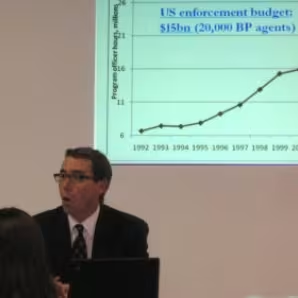
Illegal Immigration's Effects on the U.S. Economy and Policy
Paper release with Gordon Hanson, University of California, San Diego Economics Professor; Jeanne Butterfield, National Immigration Forum Senior Advisor; Marc Rosenblum, MPI Senior Policy Analyst; and Michael Fix, MPI Senior Vice President and Director of Studies.
Side-by-Side Comparison of 2009 House CIR ASAP Bill with 2006, 2007 Senate Legislation
This side-by-side shows the 2009 House comprehensive immigration reform bill offered more generous legalization and less enforcement than its 2006 and 2007 Senate predecessors.
The Economics and Policy of Illegal Immigration in the United States
The net economic impact of illegal immigration is close to zero, evidence shows. Converting unauthorized flows to legal ones delivers stronger gains than enforcement alone.
Senate Avoids Adding an Immigration Wrinkle to the 2010 U.S. Census
A narrowly defeated U.S. Senate amendment would have tied House apportionment to citizen counts alone, threatening representation in high-immigration states.
Denial and Delay: How Terrorism-Related Provisions in Immigration Law Affect Asylum Seekers and Refugees
Discussion on with the Director of MPI's Refugee Policy Program; report co-author and Senior Counsel and Deputy Director of Human Rights First's Refugee Protection Program; Special Advisor for Refugee & Asylum Affairs at the U.S. Department of Homeland Security; and HIAS Senior Director of U.S. Programs and Advocacy.

Tied to the Business Cycle: How Immigrants Fare in Good and Bad Economic Times
Between 1994 and 2008, immigrants' U.S. employment outcomes tracked the business cycle more sharply than native workers', driven by concentration in cyclical sectors.
Immigration Controversy Lands in the Middle of Health-Care Reform Debate
All 2009 health-care reform bills maintained the five-year Medicaid bar for lawful permanent residents, leaving an estimated 4.2 million uninsured.
Paper Citizens - A Book Discussion on the Illicit Market for Citizenship in the Developing World
Discussion with book author Dr. Kamal Sadiq, Assistant Professor of Political Science at the University of California at Irvine, and Susan Ginsburg, MPI Director of the Mobility and Security Program.

With Kennedy's Death, Loss of Major Figure in U.S. Immigration Policy
Senator Edward M. Kennedy shaped nearly every major U.S. immigration law in recent years, leaving a void as Congress faced renewed pressure to overhaul the system.

- General Inquiries
- Media Inquiries
-
Michelle Mittelstadt
202 266 1910 [email protected]