U.S. Immigration Policy Program
The U.S. Immigration Policy Program provides thought leadership on ways to improve the U.S. immigration system so that it works most effectively in the national interest. To that end, its work focuses on immigration pathways to the United States and immigration enforcement policies and their impacts. It examines the complex demographic, economic, social, political, foreign policy, and other forces that shape U.S. immigration.
Program staff produce data and analyses of immigration trends and the characteristics of U.S. immigrant populations, including unauthorized immigrants. And they conduct original research on the impacts of policy change and the experiences of immigrant populations in diverse parts of the country. This work is frequently informed by private convenings of policymakers and key stakeholders. For more, click here.
The Latest Research
U.S. Deportations and “Self-Deportations” in the First 18 Months of the Second Trump Term
Filling a gap amid a slowdown in official data reporting from the federal government, this analysis offers a window into deportation and "self…

Featured
Physicians in an Era of Changing Immigration Policy: The Case of Nephrology
The care of kidney disease in the United States relies heavily on international medical graduates (IMGs). Recent policy changes could deepen…

Temporary Visa Holders in the United States
The number of U.S. temporary visas plummeted during the COVID-19 pandemic, rebounded, and then fell again in fiscal year (FY) 2025. Preliminary data…

Following Years of High Border Arrivals, the U.S. Unauthorized Immigrant Population Hits New Peak
MPI estimates the U.S. unauthorized immigrant population reached a new peak of 15.8 million as of mid-2024, after holding steady at around 11 million…

More Featured Work
From Counterterrorism to Immigration Enforcement: 25 Years On, Post-9/11 U.S. Changes Have Been Repointed
Post-9/11 national security tools have been repurposed for immigration, expanding the U.S. government’s capacity for surveillance, data sharing, and…

Attacked as "De Facto Amnesty," U.S. Temporary Protected Status Is Abruptly Eroded
The Trump administration moved to terminate most of the 17 Temporary Protected Status (TPS) designations in place when its second term began,…

Though Rare, Birth Tourism to the United States Sparks Outsized Concern
While rare, birth tourism has become a central but contested justification in the Trump administration's push to end the guarantee of birthright…

Key Statistics
Learn more about immigrants and immigration to the United States
14.8%
The immigrant share of the total U.S. population
Learn how this share has evolved (opens in a new tab)50.2 million
The number of immigrants in the United States
Explore Data Profiles by State (opens in a new tab)18.4%
The share of workers in the U.S. civilian labor force who are immigrants
Get the data at U.S. and state levels (opens in a new tab)
Showing 641–650 of 824 results
New Arizona Law Engulfs Immigration Debate
Arizona's SB 1070 split opinion sharply: 64 percent of Americans overall supported it, while 70 percent of Hispanic respondents opposed it.

Supreme Court Rules that Attorneys Must Inform Criminal Defendants of the Immigration Consequences of Pleading Guilty
In Padilla v. Kentucky, the U.S. Supreme Court ruled that defense attorneys must warn noncitizen clients of deportation risks from guilty pleas.
Immigrant Legalization: Assessing Labor Market Effects
Public Policy Institute of California researchers Magnus Lofstrom and Laura Hill discuss their research examining the potential labor market outcomes and other possible economic effects of a legalization program. The discussion was moderated by Doris Meissner, MPI Senior Fellow and Director of the U.S. Immigration Policy Program, with comments from MPI Senior Policy Analyst Randy Capps and Sherrie A. Kossoudji, Associate Professor, School of Social Work, and Adjunct Professor, Department of Economics, University of Michigan.

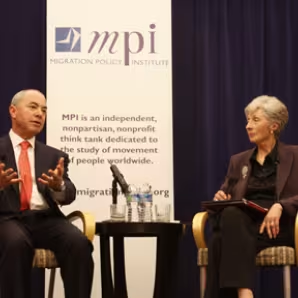
USCIS Director Mayorkas Offers Vision for His Agency
U.S. Citizenship and Immigration Services Director Alejandro Mayorkas details his agenda for his agency, and discusses E-Verify, fees, the transformation initiative, processing of Temporary Protected Status for Haitians, and other top priorities for USCIS.
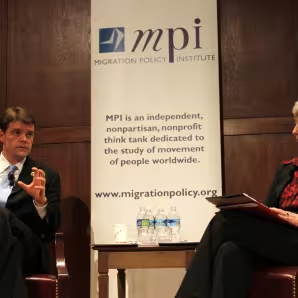
The 30th Anniversary of the 1980 Refugee Act: What the Refugee Program's History Suggests for a Better Future
Briefing with Representative James McGovern (MA), Representative Anh "Joseph" Cao (LA); UN High Commissioner for Refugees (UNHCR); Director, MPI Refugee Policy Program; Vice President, U.S. Programs, International Rescue Committee; and Senior Counsel, Office of Senator Patrick Leahy, Chairman, U.S. Senate Committee on the Judiciary.
Increasing Evidence That Recession Has Caused Number of Unauthorized Immigrants in U.S. to Drop
The U.S. unauthorized immigrant population fell by about 1 million between 2007 and 2009, with the recession widely seen as the primary cause.
A Program in Flux: New Priorities and Implementation Challenges for 287(g)
The 287(g) program faces criticism for poor oversight and racial profiling. A 2009 Obama administration memo refocused it on serious offenders but accountability gaps persist.
Haiti Tragedy Raises Important Immigration Issues for the United States
The 2010 Haiti earthquake prompted Temporary Protected Status for Haitians in the United States.
DHS Assistant Secretary John Morton discusses his vision for ICE
Launch of the MPI Speakers Series - Leadership Visions - Moderated by Doris Meissner, Senior Fellow and Director, U.S. Immigration Policy Program, MPI.
New Immigration Bill Edges Comprehensive Immigration Reform Back on the Legislative Agenda
U.S. House Democrats' 2009 immigration reform bill drew nearly 90 co-sponsors but was not seen as a viable path to comprehensive reform.
- General Inquiries
- Media Inquiries
-
Michelle Mittelstadt
202 266 1910 [email protected]