U.S. Immigration Policy Program

The U.S. Immigration Policy Program provides thought leadership on ways to improve the U.S. immigration system so that it works most effectively in the national interest. To that end, its work focuses on immigration pathways to the United States and immigration enforcement policies and their impacts. It examines the complex demographic, economic, social, political, foreign policy, and other forces that shape U.S. immigration.
Program staff produce data and analyses of immigration trends and the characteristics of U.S. immigrant populations, including unauthorized immigrants. And they conduct original research on the impacts of policy change and the experiences of immigrant populations in diverse parts of the country. This work is frequently informed by private convenings of policymakers and key stakeholders. For more, click here.
The Latest Research
U.S. Deportations and “Self-Deportations” in the First 18 Months of the Second Trump Term
Filling a gap amid a slowdown in official data reporting from the federal government, this analysis offers a window into deportation and "self…

Featured
Physicians in an Era of Changing Immigration Policy: The Case of Nephrology
The care of kidney disease in the United States relies heavily on international medical graduates (IMGs). Recent policy changes could deepen…

Temporary Visa Holders in the United States
The number of U.S. temporary visas plummeted during the COVID-19 pandemic, rebounded, and then fell again in fiscal year (FY) 2025. Preliminary data…

Following Years of High Border Arrivals, the U.S. Unauthorized Immigrant Population Hits New Peak
MPI estimates the U.S. unauthorized immigrant population reached a new peak of 15.8 million as of mid-2024, after holding steady at around 11 million…

More Featured Work
From Counterterrorism to Immigration Enforcement: 25 Years On, Post-9/11 U.S. Changes Have Been Repointed
Post-9/11 national security tools have been repurposed for immigration, expanding the U.S. government’s capacity for surveillance, data sharing, and…

Attacked as "De Facto Amnesty," U.S. Temporary Protected Status Is Abruptly Eroded
The Trump administration moved to terminate most of the 17 Temporary Protected Status (TPS) designations in place when its second term began,…

Though Rare, Birth Tourism to the United States Sparks Outsized Concern
While rare, birth tourism has become a central but contested justification in the Trump administration's push to end the guarantee of birthright…

Key Statistics
Learn more about immigrants and immigration to the United States
14.8%
The immigrant share of the total U.S. population
Learn how this share has evolved (opens in a new tab)50.2 million
The number of immigrants in the United States
Explore Data Profiles by State (opens in a new tab)18.4%
The share of workers in the U.S. civilian labor force who are immigrants
Get the data at U.S. and state levels (opens in a new tab)
Showing 341–350 of 824 results
The Changing Landscape of Interior Immigration Enforcement Under Trump
Marking the release of an MPI study, this discussion examines the operation of today’s interior enforcement system and how state and local governments, civil society, and consulates are responding.

Revving Up the Deportation Machinery: Enforcement under Trump and the Pushback
Interior immigration arrests rose 42 percent during Donald Trump's first eight months, but “sanctuary” policies limited enforcement and created uneven outcomes nationwide.

National Guard Heads to Southern Border Amid Differing Reality from Earlier Deployments
President Donald Trump's April 2018 call to deploy up to 4,000 National Guard troops at the U.S.-Mexico border marked a significant departure from past practice.

Family Immigration Policy and Trends: How the United States Compares to Other Countries
On this webinar, MPI analysts compare U.S. policy on family migration to those in Canada as well as Australia, France, Germany, Italy, the Netherlands, Sweden, and the United Kingdom. This webinar features the findings of an issue brief, focused on these countries' trends and data on immigrant admissions, along with a data tool modeling possible cuts to U.S. legal immigration.

It’s Relative: A Crosscountry Comparison of Family-Migration Policies and Flows
Family admissions dominate immigration across all nine countries studied, and backlogs of up to 30 years show that formal reunification rights often fail in practice.

Even as Congress Remains on Sidelines, the Trump Administration Slows Legal Immigration
Bypassing Congress, which has been silent on changes to the U.S. immigration system for decades, the Trump administration is slowing legal immigration through regulatory change.

Immigration Data Matters: How to Find the Most Accurate Resources
At this release of an updated version of the popular Immigration Data Matters guide, presenters discuss how to navigate and access the increasing number of data sources on immigration and immigrants in the United States and internationally.
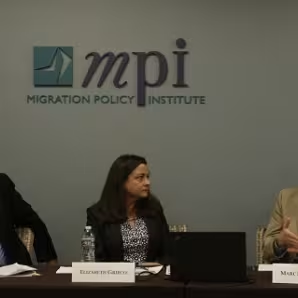
State and Local Labor Standards Enforcement in Immigrant-Dense Industries
Marking the release of an MPI report, this discussion focuses on the dynamics in low-wage workplaces and immigration law that have contributed to systematic violations of labor standards and explores new and effective enforcement strategies that state and local governments across the United States are utilizing.

Strategic Leverage: Use of State and Local Laws to Enforce Labor Standards in Immigrant-Dense Occupations
Immigrants experience labor violations at twice the rate of U.S.-born workers. State and local governments have unique tools to fill the enforcement gap left by federal retreat.

Evolution of the H-1B: Latest Trends in a Program on the Brink of Reform
The H-1B program is far larger than its 85,000-visa cap implies, and a sharp wage and skills gap between dependent and non-dependent employers is fueling pressure for reform.


- General Inquiries
- Media Inquiries
-
Michelle Mittelstadt
202 266 1910 [email protected]