U.S. Immigration Policy Program
The U.S. Immigration Policy Program provides thought leadership on ways to improve the U.S. immigration system so that it works most effectively in the national interest. To that end, its work focuses on immigration pathways to the United States and immigration enforcement policies and their impacts. It examines the complex demographic, economic, social, political, foreign policy, and other forces that shape U.S. immigration.
Program staff produce data and analyses of immigration trends and the characteristics of U.S. immigrant populations, including unauthorized immigrants. And they conduct original research on the impacts of policy change and the experiences of immigrant populations in diverse parts of the country. This work is frequently informed by private convenings of policymakers and key stakeholders. For more, click here.
The Latest Research
U.S. Deportations and “Self-Deportations” in the First 18 Months of the Second Trump Term
Filling a gap amid a slowdown in official data reporting from the federal government, this analysis offers a window into deportation and "self…

Featured
Physicians in an Era of Changing Immigration Policy: The Case of Nephrology
The care of kidney disease in the United States relies heavily on international medical graduates (IMGs). Recent policy changes could deepen…

Temporary Visa Holders in the United States
The number of U.S. temporary visas plummeted during the COVID-19 pandemic, rebounded, and then fell again in fiscal year (FY) 2025. Preliminary data…

Following Years of High Border Arrivals, the U.S. Unauthorized Immigrant Population Hits New Peak
MPI estimates the U.S. unauthorized immigrant population reached a new peak of 15.8 million as of mid-2024, after holding steady at around 11 million…

More Featured Work
From Counterterrorism to Immigration Enforcement: 25 Years On, Post-9/11 U.S. Changes Have Been Repointed
Post-9/11 national security tools have been repurposed for immigration, expanding the U.S. government’s capacity for surveillance, data sharing, and…

Attacked as "De Facto Amnesty," U.S. Temporary Protected Status Is Abruptly Eroded
The Trump administration moved to terminate most of the 17 Temporary Protected Status (TPS) designations in place when its second term began,…

Though Rare, Birth Tourism to the United States Sparks Outsized Concern
While rare, birth tourism has become a central but contested justification in the Trump administration's push to end the guarantee of birthright…

Key Statistics
Learn more about immigrants and immigration to the United States
14.8%
The immigrant share of the total U.S. population
Learn how this share has evolved (opens in a new tab)50.2 million
The number of immigrants in the United States
Explore Data Profiles by State (opens in a new tab)18.4%
The share of workers in the U.S. civilian labor force who are immigrants
Get the data at U.S. and state levels (opens in a new tab)
Showing 221–230 of 824 results
Broad and Blunt, the Trump Administration’s H-1B Changes Miss the Opportunity for Real Reform
The Trump administration's changes to the H-1B visa program are the most significant in three decades, promising to end the practice of replacing U.S. workers with highly skilled immigrants. While the problems the administration has identified and the interest in protecting U.S. workers are legitimate ones, its approach may cripple the H-1B program itself, as this commentary explains.

17th Annual Immigration Law and Policy Conference
This year’s Immigration Law and Policy Conference examines the immigration policy agenda under the Trump administration, including changes in the asylum system; the vast societal upheaval brought on by COVID-19 and the rising racial justice movement; what the future of U.S. immigration may look like; and many other topics in advance of a consequential general election that offers starkly different choices with respect to U.S. immigration policy.
The U.S. Immigration Policymaker-in-Chief: The Long History of Executive Authority over Immigration
This discussion examines the long tradition of the U.S. president as immigration policymaker in chief, the Trump administration’s substantial use of executive power to change the country’s course on immigration, and how the president’s role in immigration policy is a inevitability that should be carefully considered and reimagined in any blueprint for immigration reform or strategy for activism on immigration.
Immigration Enforcement and the Mental Health of Latino High School Students
Surveys of Latino high school students in 2018–19 found widespread enforcement fears, with more than half meeting clinical thresholds for anxiety, PTSD, or depression.

Excluding Millions: How Trump Administration Changes to the Decennial Census Could Leave Out U.S. Citizens and Immigrants
This MPI webinar, featuring a former U.S. Census Bureau director and other top experts, focused on the many challenges facing the 2020 Census could affect the count and representation of immigrant communities, difficulties inherent in data matching to determine legal status, and the legal and constitutional issues surrounding the administration’s actions.
Impending USCIS Furloughs Will Contribute to a Historic Drop in U.S. Immigration Levels
USCIS furloughs, visa suspensions, and presidential bans together likely will drive an unprecedented collapse in U.S. immigration, with long-term demographic and economic impacts.

A Bumpy Path to U.S. Citizenship: A Survey of Changing USCIS Practices
Marking the launch of MPI report on USCIS’s evolving procedures for handling citizenship applications, this webinar focuses on the findings from a national survey of naturalization assistance providers. The discussion also examines the increasing obstacles to citizenship, and the effects the pandemic-related shutdown and USCIS financial turmoil could have on the ability of would-be Americans to take the oath of citizenship.
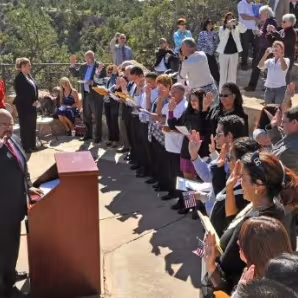
A Rockier Road to U.S. Citizenship? Findings of a Survey on Changing Naturalization Procedures
A 2019 survey found stricter USCIS scrutiny, rising naturalization processing times, and proposed fee hikes made U.S. citizenship harder for immigrants to attain.
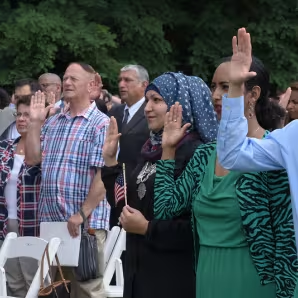
Millions of U.S. Citizens Could Be Excluded under Trump Plan to Remove Unauthorized Immigrants from Census Data
The Trump administration's plan to exclude unauthorized immigrants from the 2020 Census data used to reapportion 435 congressional seats among the 50 states could misclassify as many as 20 million U.S. citizens, as the result of expected data-matching errors. The effects of this exclusion could be most pronounced in low-income urban and rural communities, reducing their voting power relative to more affluent ones, as this commentary explains.

Brain Waste among U.S. Immigrants with Health Degrees: A Multi-State Profile
Some 263,000 immigrants with health degrees are underutilized due to licensing barriers—an untapped U.S. workforce that could help address COVID-19-era health-care shortages.

- General Inquiries
- Media Inquiries
-
Michelle Mittelstadt
202 266 1910 [email protected]