Thinking Regionally to Compete Globally: A New View on Migration and Human Capital for the United States, Mexico, and Central America
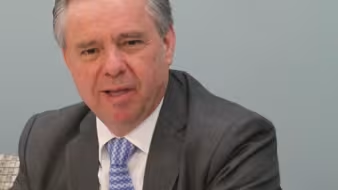
A panel discussion for the release of the Regional Migration Study Group's final report, featuring high-level former U.S., Mexican, and Guatemalan government officials.
Few issues over the last 35 years have shaped and defined the U.S. relationship with Mexico and, increasingly, much of Central America more than migration. Thus, getting migration and the issues that fuel and surround it right is vital to the region’s long-term stability, prosperity, and competitiveness in a fast-changing and unforgiving global economy that increasingly is organizing around regional relationships.
Until now, there have been no systematic conversations about what a collaborative, regional approach to competitiveness, human-capital development, and migration might look like. MPI and the Latin American Program/Mexico Institute of the Woodrow Wilson Center have filled that void by convening a Regional Migration Study Group—co-chaired by former Mexican President Ernesto Zedillo, former U.S. Secretary of Commerce Carlos Gutierrez, and former Guatemalan Vice President Eduardo Stein—and drawing upon the membership of other key former officials, civil-society leaders, and policy experts in the United States, Mexico, El Salvador, and Guatemala.
The Study Group’s primary goal, culminating in the final report released on May 6, was to develop and promote a longer-term vision of how to build a stronger social and economic foundation for the United States, Mexico, and Central America’s Northern Triangle (El Salvador, Guatemala, and Honduras) by enhancing the region’s human-capital infrastructure. Building up the region’s human capital—through education and workforce development reforms that gradually develop common standards in key sectors across the region—should create better economic opportunities for the region’s citizens, creating an engine for growth in each country and strengthening regional competitiveness. Over time, success in this regard will mitigate today’s concerns about the scope and “quality” of regional migration while setting the stage for future regional migration to be more of a genuine choice, rather than a necessity.
Speakers:
Carlos Gutierrez, Former U.S. Secretary of Commerce
Eduardo Stein, Former Vice President and Foreign Minister of Guatemala
James R. Jones, Former U.S. Ambassador to Mexico and former member of the U.S. House of Representatives
Luis Rubio, Chairman, Center of Research for Development (CIDAC)
Demetrios G. Papademetriou, President, MPI
Doris Meissner, Senior Fellow and Director, U.S. Immigration Policy Program, MPI
Andrew Selee, Vice President for Programs, Wilson Center
Ernesto Zedillo, Former President of Mexico and Secretary of Education
Sponsor:

About the Global Program
The Global Program bridges policy advice, research, and candid dialogue to design effective migration policies, drawing on global evidence and anticipating the forces reshaping how people move.