Investing in Alternatives to Irregular Migration from Central America: Options to Expand U.S. Employment Pathways
Related Content
Highlights
Expanding U.S. employment-based pathways could offer legal alternatives to irregular Central American migration while helping address U.S. labor shortages.
- Irregular migration from Central America is fueled by a lack of legal employment options; expanding U.S. work visas—especially in temporary and seasonal programs—could provide safer alternatives and benefit the U.S. labor market.
- Existing channels such as the H-2A and H-2B seasonal worker programs face structural barriers, including employer-only petitions, high costs, and limited portability, which constrain worker access.
- New or expanded visa categories, bilateral labor agreements, and stronger predeparture orientation could better match U.S. labor demand with Central Americans seeking legal migration opportunities.
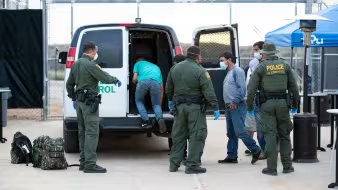
The increased number of Central American migrants arriving at the U.S.-Mexico border has clearly demonstrated that the United States, Mexico, and migrant-origin countries in Central America—particularly El Salvador, Guatemala, and Honduras—face a long-term challenge to promote orderly and managed migration in the region. Given that some Central Americans are fleeing persecution and threats of violence, a well-considered response needs to involve effective humanitarian protection mechanisms. Other Central Americans move primarily for economic reasons, though opportunities to do so legally are out of reach for most.
This policy brief examines how the United States can build employment-based pathways for people in El Salvador, Guatemala, and Honduras who might otherwise migrate irregularly. The United States has one major category of seasonal employment-based visas, the H-2 programs, but to date it has only been used to recruit relatively limited numbers of Central American workers. This brief looks at the components of the H-2A and H-2B visa programs, existing systems to recruit Guatemalan and Honduran workers through these legal channels, and the challenges that have limited the programs’ expansion in Central America. The brief also explores short-, medium-, and long-term policy options for the United States and its regional partners to remedy these issues and to address the needs of both employers and migrants.
Para leer este informe en español, haga clic aquí.
Table of Contents
1 Introduction
2 A Potential Alternative to Irregular Migration from Central America?
3 Challenges to Expanding the H-2 Visa Programs in Central America
4 Policy Recommendations
A. Near-Term Changes to Incentivize the Recruitment of Central American Workers
B. Medium-Term Changes to Create Effective and Safe Recruitment Programs
C. Longer-Term Changes to Create a Safe and Effective Recruitment System
5 Conclusion
Latin America and Caribbean Initiative
The Initiative combines rigorous research with direct engagement of governments, institutions, and stakeholders to help build orderly, rights-respecting migration systems across one of the world's most dynamic migration regions.
About the U.S. Immigration Policy Program
The U.S. Immigration Policy Program provides analysis of U.S. immigration pathways, the impacts of enforcement and other policies, and the characteristics of immigrant populations.
About the Global Program
The Global Program bridges policy advice, research, and candid dialogue to design effective migration policies, drawing on global evidence and anticipating the forces reshaping how people move.



Related Content