All at Sea: The Policy Challenges of Rescue, Interception, and Long-Term Response to Maritime Migration
Related Content
Highlights
Maritime migration policy has shifted from rescue to interception, sharpening the tension between border security and the legal obligation to protect those in distress at sea.
- More than 3,700 lives were lost in the Mediterranean in 2015 alone, yet policy discussions have shifted from rescue to interception, driven by concerns about border protection, national security, and organized crime.
- Case studies across five hotspots—the Mediterranean, the Bay of Bengal and Andaman Sea, the Gulf of Aden and Red Sea, Australia, and the Caribbean—reveal the diversity of national and regional responses to irregular maritime arrivals.
- The central dilemma is how to reconcile interception policies, increasingly favored by destination countries, with states' international legal obligations to rescue persons in distress and refrain from forcible return.
- Sustainable responses require burden-sharing among states, clear lines of responsibility for rescue and disembarkation, and coordinated long-term approaches that address the full migration cycle beyond the moment of arrival.
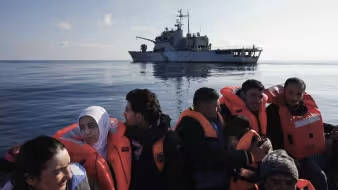
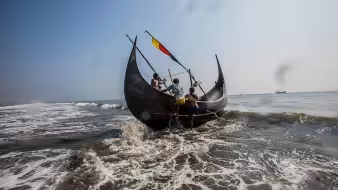
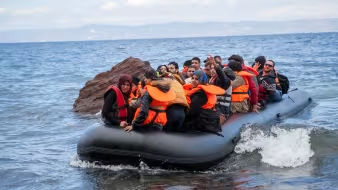
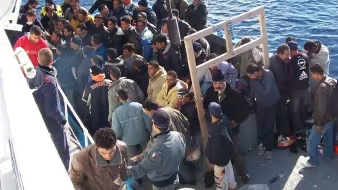
As the world’s refugee and asylum-seeker populations climbed past post-World War II records in 2015, the most dramatic images of migration were of those who travel by sea, typically in dangerously overcrowded and barely seaworthy vessels. A drowned child lying facedown in the sand. Capsized boats. Life jacket-strewn beaches. People huddled on deck, awaiting rescue.
Just a tiny proportion of the world’s international migrants travel by sea without permission to enter their intended destination country. Yet the plight of these migrants—with more than 3,700 lives lost at sea in 2015 in the Mediterranean alone—receives an outsize share of media and policymaker attention. And in certain countries, it absorbs a significant amount of financial and human resources devoted to making and implementing migration policy.
This volume reviews the policy responses to irregular maritime arrivals at regional, national, and international levels, focusing on case studies in five global hotspots: the Mediterranean, the Bay of Bengal and Andaman Sea region, the Gulf of Aden/Red Sea, Australia, and the Caribbean.
While policy discussions once typically focused on rescue at sea, those today are more likely to be framed in terms of interception designed to address concerns of border protection, national security, and organized crime. The current, central dilemma, as explored by Kathleen Newland and her coauthors, is how to reconcile these concerns with international legal obligations and regional or global burden-sharing.
"Kathleen Newland and her co-authors… have put the challenges and the dilemmas of maritime migration starkly in perspective in this compelling volume."
Table of Contents
Foreword
Peter Sutherland
Preface
Kathleen Newland
Chapter 1: Maritime Migration: A Wicked Problem
Kathleen Newland
Chapter 2: Unauthorized Maritime Migration in Europe and the Mediterranean Region
Elizabeth Collett
Chapter 3: Maritime Migration in the Bay of Bengal, Andaman Sea, and Straits of Malacca
Kathleen Newland
Chapter 4: Unauthorized Maritime Migration in the Gulf of Aden and the Red Sea
Kate Hooper
Chapter 5: The Maritime Approaches to Australia
Kathleen Newland
Chapter 6: Maritime Migration in the United States and the Caribbean
Kathleen Newland and Sarah Flamm
About the Global Program
The Global Program bridges policy advice, research, and candid dialogue to design effective migration policies, drawing on global evidence and anticipating the forces reshaping how people move.
About the Moving Europe Beyond Crisis Project
As the systems designed to process migration flows to Europe buckled in 2015-16, this project offered new ideas to manage mixed flows and create sustainable long-term solutions for refugees.





Related Content