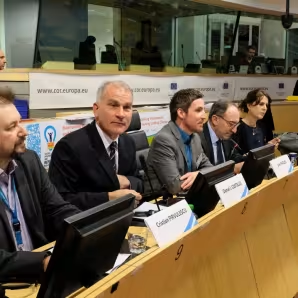
Moving Europe Beyond Crisis
Europe faced its worst refugee crisis since the Second World War, with more than 1 million people applying for asylum in 2015 and 2016. As the systems that were designed to manage these flows were under intense pressure—not least the Common European Asylum System (CEAS)—the international community needs new ideas to manage mixed flows and create sustainable long-term solutions for refugees.
To address these knowledge gaps, MPI Europe invested in a series of research and data reports, commentaries, data tools, and multimedia primers to shed light on ongoing policy debates and offer innovative solutions.
Showing 1–10 of 49 results
Greece’s Moria Tragedy: The crash test for the EU Pact on Migration and Asylum
The fires that devastated the Moria refugee camp on the Greek island of Lesbos have further raised the stakes for the soon-to-be unveiled EU Pact on Migration and Asylum. If Moria persists as a concept—with asylum seekers prevented from onward movement elsewhere in Europe—this becomes an integral pillar of future EU asylum practice, whatever is written on paper, as this commentary explores.
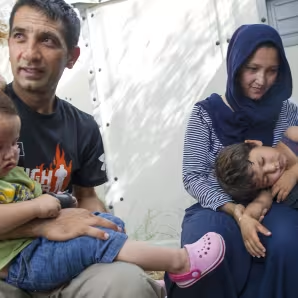
Measuring Up? Using monitoring and evaluation to make good on the promise of refugee sponsorship
COVID-19 disruptions offered policymakers a timely opening to build monitoring and evaluation systems to strengthen and scale refugee sponsorship programmes.

The COVID-19 Pandemic Suggests the Lessons Learned by European Asylum Policymakers After the 2015 Migration Crisis Are Fading
As European asylum systems are tested again by the COVID-19 pandemic, which has injected the need for social distancing during processing and in reception centers, it appears lessons learned during the 2015-16 migration and refugee crisis may be fading. Chief among them: A number of Member States have phased out their buffer capacity. This MPI Europe commentary explores the diametrically different approaches taken to asylum during the pandemic.
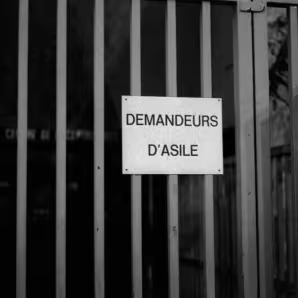
Chasing Efficiency: Can operational changes fix European asylum systems?
Since Europe's 2015–16 migration crisis, EU countries have tested operational asylum reforms, yielding mixed but instructive results.
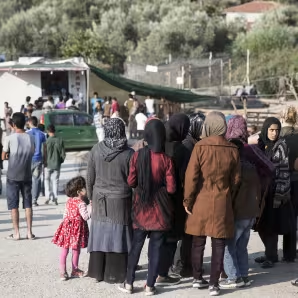
Preparing for the Unknown: Designing effective predeparture orientation for resettling refugees
Well-designed predeparture orientation builds refugees' confidence and practical skills, laying a foundation for integration. But it cannot replace postarrival services.
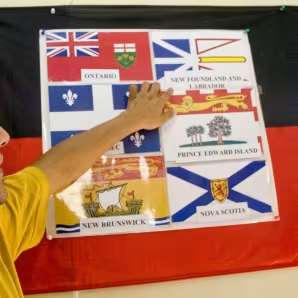
Money Wise: Improving how EU funds support migration and integration policy objectives
EU funding for migration and integration remained faulty ahead of the 2021–27 budget cycle, with the 2015-2016 migration crisis exposing gaps in inclusion, coherence, and evidence use.
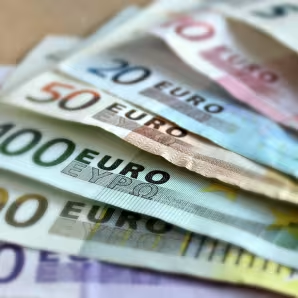
Deciding Which Road to Take: Insights into how migrants and refugees in Greece plan onward movement
Migrants and refugees hold strong, relatively fixed destination preferences—and EU relocation plans that ignore these preferences are likely to fail.
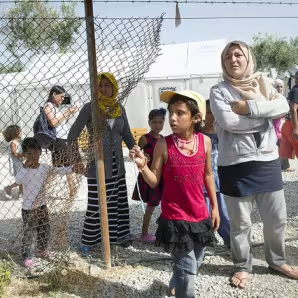
A Needed Evidence Revolution: Using cost-benefit analysis to improve refugee integration programming
European refugee integration policy relies too often on political pressure rather than evidence, and cost-benefit analysis can help policymakers quantify its long-term social value.

After the Storm: Learning from the EU response to the migration crisis
The European Union made real gains in crisis coordination after the 2015-16 crisis but still lacks permanent mechanisms to manage future emergencies—and risks losing the progress made.
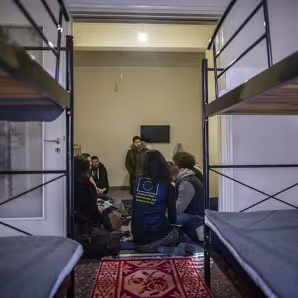
Social Innovation for Refugee Inclusion Conference Report: Maintaining momentum and creating lasting change
Social innovations for refugee inclusion are maturing in Europe, but they need sustainable financing, better evaluation, and government and employer engagement to scale.