Top 10 Migration Issues of 2024

iStock.com/Bet_Noire
The Migration Information Source's annual list of the Top 10 migration issues of the year takes stock of 2024’s key developments.
International migration trends, politics, and policies felt more frenetic perhaps than usual in 2024. They were punctuated by worsening and new displacement crises, faced a relentless public glare as more than 2 billion people went to the polls in dozens of countries, and were enmeshed in the ongoing economic recovery from a global pandemic. As a result, people on the move and destination, transit, and origin societies repeatedly found their paths shaped by fast-moving forces.
Crises in the Middle East, sub-Saharan Africa, Ukraine, and elsewhere sent millions fleeing to safety in 2024, where they often encountered increasingly complex or inaccessible protection systems. Worldwide, an ascendant new cohort of politicians is poised to reshape global norms—some in radical ways. And legal immigration, meanwhile, faced countervailing winds, as the post-pandemic influx of migrants seen in some high-income countries prompted a backlash, though elsewhere foreign-born workers remained in high demand.
We take stock of 2024’s key developments in our annual list of the Top 10 migration issues of the year.
Click on the titles below to navigate to each issue:
2. Denying Access to Asylum Goes Mainstream
3. Amid the Blame Game over Affordable Housing Crises, Immigration Cited as Cause
4. New Externalization Plans Push the Envelope for Asylum Management Abroad
5. In Sudan, Displacement Reaches New Heights
6. In Search of Foreign Workers to Boost Countries' Labor and Demographic Outlook
7. Countries Seek to Reduce or Change the Mix of Their Immigrant Populations
9. Misinformation Stirs Anti-Immigrant Sentiment
10. Free Movement within the European Union Grows—and Shows New Fractures
1. Populists and the Far Right Ride Immigration Fears to Political Victory, Paving the Way for Sharp Policy Change

(Photo: Gage Skidmore)
Across Europe, the United States, and elsewhere, once-fringe figures and populists notched remarkable political successes in 2024 national elections to determine the leadership for countries that are home to almost half the world’s population. The results suggest a global anti-incumbency bias amid high inflation and other post-pandemic economic challenges, as well as concerns over perceived weaknesses in migration management in some countries. Political leaders from the United States’ Donald Trump to France’sFrance’s Jordan Bardella and Panama’s José Raúl Mulino almost uniformly called for significant limits on various types of immigration, particularly irregular and humanitarian migration. Combined, the electoral outcomes will have far-reaching repercussions for migration worldwide, auguring a new era in which leading immigrant destinations collectively pull back from international humanitarian efforts, erect bars to protection, enact punitive enforcement measures, and in some cases limit legal immigration.
Trump’s comeback was perhaps the most seismic and far-reaching event given the status of the United States as host of the world’s largest immigrant population and its unparalleled ability to set global norms and shape international institutions. Trump will likely seek to end or allow the expiration of many “twilight” protections held by nearly 3.4 million immigrants through programs such as Temporary Protected Status (TPS), Deferred Action for Childhood Arrivals (DACA), and various forms of humanitarian parole. The incoming Trump team has also promised, among other things, to deport millions of unauthorized immigrants in a campaign that would be unmatched in modern history; impose border restrictions such as by reviving the Migrant Protection Protocols (also known as the Remain in Mexico policy); and seek to end birthright citizenship, which mainstream legal scholars agree is protected by the Constitution.
Meanwhile in Europe, elections brought to the fore several politicians proposing policies that are explicitly anti-immigrant, anti-Muslim, or otherwise restrictive. The election of the Freedom Party in Austria and the ascension of the Patriots for Europe bloc to become the European Parliament’s third largest party followed a trend set with the 2023 election of Geert Wilders’s Dutch Freedom Party (PVV) and the 2022 election of Giorgia Meloni's Brothers of Italy. Far-right victories underscored how the bloc collectively and Member States individually have embraced restrictive migration policies, including by seeking to outsource enforcement and asylum management to neighboring transit countries and doubling down on border controls. The elections may lead to further support for the notion of creating “return hubs” in places such as Uganda, where Member States could send asylum seekers whose claims had been unsuccessful.
Notably, France’s National Rally did not secure a majority in the National Assembly in 2024 (although it came startlingly close, and in December teamed up with leftist lawmakers to oust Prime Minister Michel Barnier), and the Alternative for Germany’s (AfD) stunning successes were only in state elections (although it is poised to make major gains at February federal elections). Still, even in the opposition the far right’s ascendancy can influence policy, as centrist leaders of these countries pushed for restrictive migration changes (including within the European Union; see Issue No. 10). And while the United Kingdom’s center-left Labour Party notched a landslide victory, it did so in part because the new Reform UK Party cut into votes of the incumbent Tories. New UK leaders have meanwhile promised to keep prior limits on legal immigration (see Issue No. 7), halt asylum seekers’ arrival on small boats crossing the Channel, and increase removals of migrants without legal status.
In South Africa, the continent’s largest immigrant hub, the African National Congress (ANC) lost its parliamentary majority for the first time since the end of apartheid, in an election where migration featured as a key issue. The new coalition government has cracked down on irregular migration, including by increasing workplace raids.
In Latin America, elections portended less seismic shifts but nonetheless generally rewarded politicians with a hard line on migration. Mulino rode into Panama's presidency in part on a promise to slow irregular migration through the Darien Gap, the strip of jungle on its southern border that has become a major thoroughfare for U.S.- and Canada-bound asylum seekers and other migrants. Just hours after taking office, Mulino’s government signed a memorandum of understanding with the United States to “close” the route; authorities erected barbed wire fences and shuttered border posts, and migration plummeted in subsequent months. In the Dominican Republic, President Luis Abinader won re-election in what was interpreted as endorsement of his tough restrictions on migration from neighboring Haiti (see Issue No. 8). At the same time, watchers anticipated that the re-election of Venezuelan President Nicolás Maduro in July, in a campaign widely denounced for irregularities, would lead to a new exodus from the country, though a major outflow had not materialized by December.
Of course, results were by no means uniform. Pre-election debate in Ireland, for instance, featured many concerns about high immigration and limited housing (a common connection in 2024; see Issue No. 3), but voters in December nonetheless returned to leadership the ruling coalition that has led the country since 2020. While Botswana’s ruling party was replaced for the first time in more than 50 years, the new government’s plan for unauthorized migrants was a contrast to that of neighboring South Africa: it planned to offer legal status, rather than restrictions (see Issue No. 6). Still, the year’s general trend was clear and unmistakable: A new political order is being formed, with opposition to irregular migration a key element.
2. Denying Access to Asylum Goes Mainstream

(Photo: Glenn Fawcett/CBP)
Amid publics restive over migration management failures, multiple governments imposed sweeping new restrictions on territorial asylum in 2024, refusing to allow access to humanitarian protections or increasing enforcement of people citing flight from desperate situations. Many restrictions, notably, came from centrist leaders, potentially as part of bids to stave off the growing power of the populist right (see Issue No.1).
For instance, the Biden administration in the heat of the election year further narrowed access to asylum to most people crossing the U.S.-Mexico border without authorization. Instead, the government encouraged would-be asylum seekers to make appointments at ports of entry, in the hopes of creating a more orderly process, and also pushed migrants towards humanitarian parole programs (granting a temporary right of stay and eligibility for a work permit) and other more regular immigration pathways. The policy was instrumental in rapidly reducing the number of migrants arriving at the U.S.-Mexico border without permission to enter, after two years of record levels, but was quickly met with lawsuits and criticism from rights groups claiming it flouted the law and humanitarian responsibilities. And it did little to appease conservative critics or lessen the power of the Trump campaign’s relentless focus on “Biden’s border crisis.”
Across the Atlantic, Poland’s centrist government temporarily suspended consideration of asylum for migrants arriving via its border with Belarus, in response to what it has described as weaponization of migration by Minsk and Moscow. In recent years, Belarus and Russia have been accused of luring migrants and directing them to Poland and other EU Member States in order to frustrate those governments and galvanize far-right parties. EU leaders backed Poland’s move, lending international support and tacitly acknowledging the bloc-wide destabilizing role of irregular migration. Still, the policy has come under fire from rights advocates. Earlier in the year, Finland enacted a controversial law giving the government the ability to block asylum seekers and turn them back, months after closing its border with Russia. Poland had previously narrowed access to asylum in similar ways, as had Latvia and Lithuania.
The European Parliament’s April approval of the New Pact on Migration and Asylum was a landmark moment for the bloc’s unified asylum response, seeking to divide the burden for asylum processing among Member States while also quickly and efficiently processing claims and returning those found ineligible. But the moment was tempered by persistent criticism from countries including Hungary and Poland, which said they would not accept relocation of asylum seekers under the new rules (governments can also provide financial support in lieu of accepting asylum seekers, but details have also been contested). Combined with anxiety about new internal border controls imposed by some Member States, the region showed itself to be at an ambivalent moment (see Issue No. 10).
Amid the hardening across the globe, Venezuelans seeking to flee their troubled country amid President Nicolás Maduro’s putative re-election encountered new barriers, including increased border controls in Chile and Peru. Home to more of the nearly 8 million internationally displaced Venezuelans than any country other than Colombia, Peru also imposed new entry requirements on Venezuelans, including for the first time since 2019 requiring a valid passport and visa. Caracas severed diplomatic ties with neighbors including Argentina, Chile, and Peru, making it more difficult for migrants there to obtain necessary documents. And in Colombia, host of a world-leading 2.8 million Venezuelans, the government has in recent years increased barriers to integration, eliminated the Border Management Office, and closed applications for its landmark ten-year temporary protection permits.
As open doorways narrowed in some places, they slammed shut in others. Millions of Afghan refugees and other migrants in countries such as Iran and Pakistan faced increasing deportations back to their Taliban-controlled homeland in 2024. Iran in September said it planned to deport 2 million Afghans lacking legal status, after an election in which opposition to Afghans played an unusually large role. And more than 800,000 Afghans were believed to be at risk of deportation in Pakistan, following the removal of more than 500,000 in a previous enforcement phase. The deportation campaigns came amid prolonged economic troubles and three years after the Taliban reclaimed power.
The moves were not a clear abandonment of an international territorial asylum system under significant stress. Rather, they represented a slew of ad hoc policies and one-off actions to withhold protections outright or simply raise the bar to granting them. In some ways, the changes may foretell an interest less in ending asylum as it currently exists, but in fashioning a new model in which applications are reviewed and protections are granted (or not) outside a national territory (see Issue No. 4). All the same, for many asylum seekers and other people fleeing crises and disaster, the trend amounted to more barriers and less access to protection.
3. Amid the Blame Game over Affordable Housing Crises, Immigration Cited as Cause

(Photo: iStock.com/tigerstrawberry)
Leaders in countries such as Canada, Australia, and the United States claimed in 2024 that rising immigration was the cause of affordable housing crises, linking two issues hot on the minds of publics. While the connections are much more nuanced that politicians often claimed—research suggests that immigration might be a strain on housing in the short term, but tends to lead to more housing and other economic gains over time, and impacts can vary by region—the narratives were often used to justify efforts to reduce legal immigration or impose new enforcement measures. The focus on immigration also diverted attention from other drivers of global housing tightness, including rising costs and labor shortages, urbanization, regulatory barriers, and speculation by institutional investors and private equity firms.
In Canada, housing is less affordable than at any point since 1990; meanwhile, the government had embarked on a plan to admit nearly 1.5 million new immigrants—accounting for about 4 percent of the country’s population—from 2023 to 2025. The public bristled at the possibility that new arrivals might push up home prices even higher, ultimately forcing the Trudeau government to backtrack on its prior commitment (other factors were also at work; see Issue No. 7). The brake on immigration will reduce the demand for new housing by hundreds of thousands of units by 2027, the government said.
Leaders of Australia, where immigration is also at record highs, made a similar argument, calling for lowering legal immigration caps, in part to increase housing affordability. Opposition leader Peter Dutton has also called for a temporary ban on home purchase by foreign investors and temporary residents, in a move similar to Canada’s policy prohibiting foreign homeownership, which has been in place since 2022.
Ireland’s 2024 election was similarly shaped by concerns that immigration was driving up housing costs and demand for public services, as the country is adapting to its newfound status as an immigration hub. Still, Irish voters bucked the global trend of turning to populists pitching migration restrictions as a solution to economic concerns (see Issue No. 1).
On the other hand, a key plank of the on-the-rise National Rally led by Marine Le Pen was its call for a “national preference” policy prioritizing French citizens for housing and other benefits. And the far-right government in the Netherlands also often sought to tackle housing challenges with proposals to reduce immigration and limit benefits.
At the same time, high housing costs were a challenge for refugee resettlement groups and others working with humanitarian migrants arriving over short periods. Across Europe, limited housing stock posed a problem for the reception of people fleeing the war in Ukraine, prompting governments to develop programs such as the 2022 UK Homes for Ukraine program, placing displaced Ukrainians to stay with British families.
While leaders in some countries raised concerns about the effects of legal immigration on housing shortages, the campaign of U.S. President-elect Donald Trump claimed that it was unauthorized immigration pressuring housing markets, and that mass deportations would provide relief by bringing prices down. Given the outsized role of unauthorized immigrants in the construction sector, experts tended to disagree.
Limits to affordable housing also had an impact on reception of humanitarian migrants arriving in record numbers at the U.S. border. In expensive cities such as New York and Denver, for instance, the large numbers of migrants sleeping on the streets or in government housing—many of them arriving direct from the border after receiving free rides on buses sponsored by the state of Texas—transformed the border crisis into a nationwide phenomenon and inflamed public anxieties across the country.
4. New Externalization Plans Push the Envelope for Asylum Management Abroad

(Photo: ©UNHCR/Alessandr Penso)
Governments especially in Europe sought to push the envelope in 2024 with new policies to redirect and outsource responsibility for asylum seekers. Key details of the policies varied greatly, including where those who receive asylum are allowed to settle and which authorities are responsible for resolving applicants’ claims. The approaches share a further intensification of efforts to process asylum seekers someplace outside national territories.
Italy’s slow-to-start asylum arrangement with Albania marked a new chapter in this story, although court orders swiftly ensured the policy’s rollout was bumpy. Under the terms of the deal, which went into effect in October, male asylum seekers intercepted in international waters by Italian authorities are taken to an Italy-run facility in Albania (which is outside the European Union) where they are processed for possible protection in Italy. Only nationals of certain “safe” countries are eligible to be detained in Albania, however, and just days after the first transfers began a court in Rome ruled that those migrants’ origin countries—Bangladesh and Egypt—did not meet that standard, forcing the government to bring them back to Italy. As of this writing, a legal battle over the policy was ongoing before Italy’s supreme court.
The agreement has been closely monitored by all sides. Humanitarian groups have generally condemned it as an abrogation of Italy’s legal responsibilities, while European Commission President Ursula von der Leyen previously tacitly endorsed it as “an example of out-of-the-box thinking” that could be a model for other EU Member States. Her center-right European People’s Party (EPP) endorsed a seemingly similar plan to process asylum seekers in “safe” third countries outside the European Union.
The Italy-Albania deal has often been compared to the United Kingdom’s now-scuttled proposal to resettle asylum seekers to Rwanda, but there are key distinctions. Importantly, people relocated under the UK proposal would have remained in Rwanda if their protection was granted, whereas those approved by the Italian system would go to Italy. London axed its plan in July, as one of the first orders of business by the incoming Labour government.
Still, the ghost of the UK-Rwanda deal lived on. Leaders of Austria and Denmark have contemplated similar proposals. Members of the German government have even suggested re-using the Rwandan facilities funded by the UK government, although the proposal under discussion appears to be to process asylum cases for resettlement in Germany rather than to relocate migrants in Rwanda permanently.
Externalization is not always about deterring migration; in some instances, it projects a country’s processing capacity for immigration benefits outward in hopes of forestalling difficult journeys involving smugglers. The relatively new Safe Mobility Offices (SMOs) in Colombia, Costa Rica, Ecuador, and Guatemala aim to process migrants for refugee resettlement and other legal immigration pathways to the United States, Canada, and Spain. In part because of these SMOs, a record number of refugees from Latin America were resettled in the United States in fiscal year (FY) 2024, as the U.S. government recorded the most resettlements in 30 years.
5. In Sudan, Displacement Reaches New Heights

(Photo: IOM/François-Xavier Ada)
The civil war in Sudan, largely overlooked amid conflicts elsewhere, entered its second year in April, cementing its status as one of the world’s largest and most complex displacement crises. More than 12 million people in Sudan were displaced as of early December, approximately three-quarters of them internally. Overshadowed by conflicts in Gaza, Ukraine, and elsewhere, the brutal civil war between the Sudanese army and the paramilitary Rapid Support Forces (RSF) has displaced not only millions of Sudanese but also forced the departure of approximately 680,000 refugees who had been living in Sudan after fleeing war in their origin countries (mostly South Sudan). As of November, an estimated 20,000 people were being forced to move in Sudan every day.
The RSF and its allies have been accused of crimes against humanity, including rape and sexual slavery. Because of the conflict, Sudan was also the world’s worst hunger crisis, with famine declared in a camp for displaced people in North Darfur in August. As of early December, approximately 755,000 people were at risk of famine. Within Sudan, displaced people face “a living nightmare,” International Organization for Migration (IOM) Director General Amy Pope said in October, with many forced to flee multiple times and lacking access to shelter and other basic necessities.
Internationally, Sudanese have tended to flee to Chad or Egypt, where they often settle in remote areas that lack the resources and infrastructure to support them. Humanitarian agencies have worried about overcrowding and limited funding. They have received about two-thirds of the $1.8 billion needed for the humanitarian response. Approximately 71 percent of new arrivals in Chad reported suffering human-rights violations while fleeing Sudan, according to the UN High Commissioner for Refugees (UNHCR). Egypt’s response has been particularly restrictive, with the government requiring a visa to enter in 2023 and authorities reportedly engaging in large-scale arrests and deportations of Sudanese without legal status.
Famine and conflict in Sudan have forced South Sudanese refugees to return to the world’s newest country, which only recently itself emerged from years of civil war. The influx of returnees has added to the strains on South Sudan, which has seen more than 1.4 million refugees come back since a revitalized peace deal was signed in 2018.
Elsewhere in the region, a combination of environmental disaster and conflict forced the internal displacement of 3.9 million people in Somalia in 2024 and pushed about 926,000 out of the country as of October. In recent years, refugee camps in neighboring Kenya have hosted a rising number of people fleeing climate-related crises, such as floods in 2023 and 2024 that followed prolonged drought and destroyed buildings and other infrastructure.
6. In Search of Foreign Workers to Boost Countries’ Labor and Demographic Outlook
(Photo: Deependra Bajracharya/ILO)
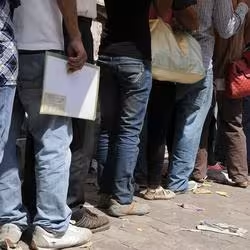
Demographic shifts and economic headwinds prompted multiple countries around the globe to show a new willingness to increase labor immigration in 2024. Even as some major immigrant destinations looked to actively reduce their foreign-born populations (see Issue No. 7), several others took steps to open new pathways or even legalize hundreds of thousands of unauthorized migrants to facilitate integration and avoid economic or demographic peril.
Increasing immigration has long been discussed in East Asia, where greying societies this year pushed countries including Japan and South Korea to take new steps to recruit more foreign workers and others. Korean President Yoon Suk Yeol declared a "demographic national emergency” in June and erected a new Ministry for Population Strategy and Planning, which will be responsible for addressing birth rates and aging issues as well as immigration strategy. The country planned to issue a record 165,000 temporary worker visas. Meanwhile, South Korea’s foreign-born population climbed to an all-time high of nearly 2.5 million, accounting for about 5 percent of the population, and international student enrollment climbed above 200,000 for the first time.
Japan similarly reported a record high migrant population—more than 3.3 million foreign nationals as of January—even as its overall population continued a 15-year trend of decline. Among them were approximately 2 million foreign workers, also a record high, and in March the government expanded some of its worker visa categories to increase immigration and encourage foreign workers to remain. Notably, the country took concrete steps towards ending its much-maligned Technical Intern Training Program (TITP), which critics say has enabled workers to be exploited and abused, and transitioning to a new system that makes it easier for immigrants to stay long term.
The government of Thailand meanwhile approved a policy granting Thai citizenship to more than 483,000 migrants and ethnic minorities, in what was hailed as a historic move towards ending statelessness. The policy was in part an effort to stimulate the economy by allowing hundreds of thousands of long-resident immigrants, their Thai-born children, and others to work legally.
Several EU Member States made changes to streamline or expand immigration processes for workers, on both temporary and permanent bases. Spain’s changes were most dramatic, and involved offers of residency and work permits to as many as 900,000 immigrants lacking legal status. The rules, unveiled in November and set to take effect in May, were largely driven by economic concerns and an effort to combat the country’s persistently low birthrate. This year, the country’s central bank predicted it would need around 25 million immigrant workers over the next 30 years. The government also simplified visa application processes and signed new circular labor migration deals with The Gambia and Mauritania to bring in needed workers.
Similarly, a new law in Greece offers legal status and work authorization to approximately 30,000 immigrants who previously lacked it, so long as they hold a job. As with Spain, the move was designed to address labor needs, particularly in the agricultural sector.
Italy’s new “flows decree,” meanwhile, increased quotas for work visas, allowed temporary workers more time to find new employment after their prior job ends, and took measures to reduce wait times for applicants, even while aiming to crack down on irregular migration by imposing stricter rules on organizations that aid asylum seekers and other migrants at sea. And Germany made tweaks to smooth applications and arrivals of skilled foreign workers.
In Botswana, where voters in 2024 voted out the incumbent Botswana Democratic Party for the first time since independence in 1966, the new government planned to provide temporary legal status and work authorization to an estimated 13,000 unauthorized Zimbabweans who “do jobs that would otherwise not get done,” according to President Duma Boko.
Targeting a slightly different set of migrants, several countries expanded the options for wealthy individuals looking to secure legal residence by making investments. Middle Eastern countries in the Gulf region have long-in-the-works efforts to attract wealthy and well-educated foreign nationals, and Saudi Arabia this year expanded the avenues for immigrants to obtain long-term residence under its “golden visa” scheme. Countries including Hungary and Indonesia also launched golden visa programs in 2024. And a range of nations including Italy, Japan, Kenya, South Africa, and South Korea all rolled out new “digital nomad” visas, in a sign that the pathway is becoming a mainstream policy option.
Several countries, however, have pulled back on their golden visas and the more expansive “golden passport” (also known as citizenship-by-investment) programs in recent years, amid concerns about security risks and the impact on local housing markets (see Issue No. 3). In March, the European Council moved towards being able to suspend visa-free travel for countries offering golden passport programs.
7. Countries Seek to Reduce or Change the Mix of Their Immigrant Populations

(Photo: iStock.com/Motortion)
Several countries in the Asia Pacific region, Europe, and North America pushed new rules to shrink all or parts of their immigrant populations in 2024. In some cases, the moves were driven by explicit aims to reduce immigration, after a post-pandemic surge in arrivals swelled immigrant populations to historic sizes. In other places, tweaks to legal immigration systems were meant to prioritize long-term settlement by people with higher levels of skills, rather than low-wage temporary workers and international students.
Perhaps no place were the moves more dramatic than in Canada, where the government publicly backtracked on its 2022 commitment to accept up to 500,000 new immigrants per year through 2026. “We didn’t get the balance quite right,” Prime Minister Justin Trudeau said in October, in the face of significant public backlash to rising immigration. Instead, the government proposed keeping the number of annual new arrivals below 400,000 and declining to 365,000 in 2027. Ottawa also planned to reduce the number of temporary immigrants to 5 percent of the total population, down from nearly 7 percent mid-year. Earlier in the year, it capped the number of international student applications for the first time. The changes, which were in part precipitated by public anxiety over housing costs (see Issue No. 3), are expected to lead to a small population decline in 2025 and 2026.
The shift was similar to the transformation of Australia’s immigration system, which involved less of a policy whiplash. The government has committed to more than halving net immigration from a record high of 548,000 in the year ending September 2023, to 250,000 in 2025. The high numbers were something of a bounce-back after borders reopened following the pandemic and were largely driven by international students and temporary workers. A new cap for international students, unveiled in August, has a special focus on trimming enrollment at institutions that critics allege offer low-quality education and enroll students only to provide them legal right to enter and work in Australia.
Neighboring New Zealand, where migrant workers on temporary visas have come to play a crucial economic role, also tightened its rules for work visas. The government introduced English language requirements and shorter legal stays for applicants with low skill levels.
The UK government introduced a range of measures to restrict work immigration in early 2024, such as by limiting the types of immigrants able to bring dependents and raising salary thresholds for foreign workers in most sectors (industries such as health and social care are excluded). The changes contributed to a decline in net migration by nearly one-fifth from the year ending June 2023 to the following year.
The Netherlands similarly took aim at international students, who comprise about one-fifth of the country’s undergraduate population, and sought to limit the number of classes taught in English, which account for a significant share. The government has said that by reducing spending on international students, the changes will save approximately 300 million euros in the near term.
Still, the immigration-limiting moves were not emulated everywhere. While many governments fretted about too many new arrivals in the post-pandemic period, others have grown increasingly anxious about workforce demands and sought to increase immigration or offer legal statuses (see Issue No. 6). Changes in East Asia and Southern Europe have been particularly notable, as countries such as Japan, South Korea, and Spain—all of which have for years reckoned with demographic imbalances due to their aging societies—took new steps to make immigration easier.
8. In Gaza and Haiti, Longstanding Crises Spiral in New Ways, Leaving Few Options for Forcibly Displaced People

(Photo: IOM/Antoine Lemonnier)
On opposite sides of the globe, refugees and other displaced people suffered grave new threats in 2024, yet often found themselves forced to remain in place or pushed back to their crisis-struck homelands. The situations of people suffering from Israel’s sprawling war and Haiti’s expanding power vacuum differ in many ways, but what they share is desperate people unable to flee to safety.
More than one year after Israel launched its war in Gaza in response to violent Hamas-led attacks on Israelis, its mission had spiraled to include ground operations in the West Bank, Lebanon, and Syria and an exchange of rocket fire with Iran. Approximately 1.9 million people in Gaza—approximately 90 percent of the population—most of whom have long been deemed refugees, were internally displaced as of November. Humanitarian organizations describe the devastation as nearly total, with risk of famine across the territory, and UN experts and rights groups said a genocide was likely taking place.
The Israeli government in October banned operations of the UN Relief and Works Agency for Palestine Refugees (UNRWA), which could have profound long-term consequences for the 5.9 million Palestinian refugees under the group’s mandate. The organization is the primary provider of a range of aid and services throughout the occupied territories, and cessation of its operations “could have devastating consequences,” warned UN Secretary General António Guterres. The United States has long been the agency’s primary financial backer, but funding has been cut off since allegations were made that some UNRWA staff participated in the 2023 Hamas attacks against Israel. The election of Donald Trump may quash the odds that funding is restored (see Issue No. 1), likely crippling the agency’s operations around the region.
As the war dragged on, many Gazans had no place to go. Authorities in neighboring Egypt closed the border to most Palestinians, fearing that allowing refugees to cross could overwhelm the country’s systems and effectively cede territory to Israeli control entirely, upsetting decades of regional ambitions to secure an independent Palestine. Those who were able to flee Gaza often paid high costs to do so or benefitted from an international passport.
Meanwhile, thousands of people were also displaced in the West Bank and more than 800,000 were displaced within Lebanon. Additionally, around 557,000 people were pushed from Lebanon into Syria as of November, of whom nearly two-thirds were Syrians, in a reversal of previous movement during the Syrian civil war. Some Syrian refugees who fled the fighting have faced abuse and arrest by Syrian authorities, according to Human Rights Watch. While thousands of displaced Lebanese returned soon after Hezbollah and Israel signed a ceasefire in late November, many Syrians returnees have expressed anxiety about their future and whether they would be able to cross back over again. The abrupt early December overthrow of Syrian President Bashar al-Assad raised a new set of questions about refugees’ long-term future and whether Syria is considered safe for return. Refugee-hosting countries around the region and elsewhere have increasingly sought to encourage Syrians to go back, and multiple governments were adopting a wait-and-see approach as of this writing.
On the other side of the planet, the April resignation of Haitian Prime Minister Ariel Henry cleared the way for a fragmented transitional council to take control and underscored the country’s near-total government collapse. Large swaths of Haiti have descended into gang warfare that has killed thousands, displaced 703,000 as of September, and prompted severe humanitarian needs. Nearly 1 million Haitians had sought or been granted asylum across Latin America. In 2024, primary destinations were the Bahamas, the United States, and Turks and Caicos.
But many Haitians who tried to flee found few options. The Bahamas ramped up maritime border security this year, in partnership with the United States and others. In October, the neighboring Dominican Republic began a campaign to deport 10,000 unauthorized Haitian immigrants per week, although authorities had been deporting Haitians long before that. And after a months-long pause, the United States resumed deportations to Haiti in April. Many Haitian migrants also faced discrimination and stigma in other countries. Those in the United States, for instance, were also subjected to abuse and scorn after Trump said falsely that they were stealing and eating pets (see Issue No. 9).
Still, destination-country policies were not uniformly restrictive. Nearly 211,000 Haitians arrived in the United States via a new parole process in fiscal year (FY) 2024, although the status is not set to be renewed and many now face the prospect of losing their temporary legal protections. The Biden administration also significantly expanded use of Temporary Protected Status (TPS) for Haitians already in the country, allowing about 300,000 to apply to legally work and avoid deportation for the time being.
Together, crises in the Middle East and Haiti demonstrated the variety of complex factors that can force people to flee but also underscored the challenges many face in trying to do so.
9. Misinformation Stirs Anti-Immigrant Sentiment

(Photo: iStock.com/gorodenkoff)
Demonstrably false claims about asylum seekers and other migrants in 2024 raced across the internet and prompted riots, threats, and other episodes with tangible impacts on immigrant and minority communities. This type of misinformation often exploits underlying anxieties about immigration, economics, and crime.
The spread was facilitated by social media, where unverified rumors can spread unchecked. Most destructive were social-media-spread claims in the United Kingdom the suspect in a tragic stabbing attack on young girls in July was a Muslim asylum seeker who had arrived on a small boat across the Channel. In fact, the alleged killer was a British national born to a church-going family in Wales. Incited by the false news, mobs launched attacks on mosques, a hotel housing asylum seekers, and other facilities, injuring several police officers and bystanders and leading to more than 100 arrests.
In August, similar rumors spread in Spain that the killer of an 11-year-old boy was an asylum seeker. In fact, authorities arrested a Spanish national for the crime.
The viral nature of the misinformation is particularly the case on platforms such as X, which has become notably more tolerant of extremist voices since its acquisition by Elon Musk, a close ally and important financial backer of U.S. President-elect Donald Trump. Social media is also allegedly used by governments such as Russia, which have been accused of sowing migration-related lies to cause instability and undermine geopolitical opponents. The rise of artificial intelligence is also a factor, blurring the line between legitimate news organizations and websites that generate pure fiction. And the dynamic reflects a distrust in institutions globally, which can create fertile ground for untruths to blossom.
Irregular immigration was a major theme of the U.S. presidential election, where false claims featured prominently and regularly. Trump claimed falsely during a debate that Haitian immigrants in a small city in Ohio were “eating the dogs” and “eating the cats” of local residents. In the following days, schools and other institutions received dozens of bomb threats, causing many residents to live in fear and prompting the city to cancel an annual cultural event. Trump’s running mate, Ohio Senator and Vice President-elect JD Vance, repeated the claim despite multiple denials by local authorities that any such activities were taking place. Trump and his allies also seeded fears that large numbers of noncitizens would vote in the November election. It has been illegal for noncitizens to vote in U.S. federal elections for a century and there is no evidence that any meaningful number do so.
Many false claims hinged on the notion that migrants were disproportionately likely to commit crimes. A version of this line was linked to attacks on migrants in Portugal this year, which was also reflected in protests calling for stricter immigration laws. Similar narratives underpinned restrictive policies in countries such as Peru, where authorities began monitoring remittances that Venezuelan migrants send back to their homeland as part of an effort to crack down on crime and extortion. As elsewhere, evidence suggests that Venezuelan migrants commit less crime than the native born—particularly violent crime—relative to their population size.
10. Free Movement within the European Union Grows—and Shows New Fractures

(Photo: iStock.com/uskarp)
The European Union’s unified front on migration both strengthened and weakened in 2024. The visa-free Schengen Area grew but saw more division as new barriers were erected. Meanwhile the bloc notched a major victory by crafting a unified migration and asylum strategy, even as certain Member States issued murmurs of dissent. The diverging trends suggested the European Union was at a delicate moment on migration, as it continued to recover from the twin events of the 2015-16 migration and refugee crisis and the more recent influx of millions of Ukrainians fleeing Russia’s invasion.
In April, the European Parliament approved the New Pact on Migration and Asylum, clearing a final hurdle to allow the European Union to speak with one voice and turn the page on a decade of in-fighting and tension over migration and asylum responsibility. While not without controversy and criticism from rights groups and countries including Hungary and Poland (see Issue No. 2), the pact marks a landmark moment in coordinated EU migration policy, following several years of concerns that migration issues might tear the bloc apart. Through thousands of pages of regulation that now must be implemented, it seeks to share the burden of responding to asylum claims by speeding review, more equitably distributing those whose claims are approved, and making it easier to return migrants whose claims are denied.
Bulgaria and Romania joined Europe’s Schengen Area after Austria lifted its veto on the countries’ full accession in November (border checks for EU travelers arriving at land and sea had dropped in March), the last in a line of opposition by the Netherlands and others. The Schengen expansion, which brings the number of countries in the free-movement zone to 29, came after increased efforts in Sofia and Bucharest to curb irregular migration and tackle asylum claims. Leaders say the change will have a noticeable impact on the economic growth of Bulgaria and Romania, amounting to billions of euros per year. With the new accessions, the only EU Member State still seeking to join Schengen is Cyprus.
At the same time, a new crisis emerged in 2024. Germany’s decision to temporarily reinstate border controls with its nine neighbors posed a profound test to the free-movement area. The restrictions were enacted amid a series of violent attacks believed to be linked to Islamists, including migrants, and are set to remain in place at least until March. The bloc’s largest economic power, Germany shares borders with more other EU countries than any other Member State. Several neighboring countries protested Berlin’s move, worrying that it would increase pressure on other governments to accommodate asylum seekers and others turned away at the German border. A chain reaction followed; in subsequent weeks, eight other Member States imposed temporary border controls, including Austria, France, and the Netherlands.
Temporary imposition of internal border controls is allowed in the Schengen system but is supposed to be used only in exceptional circumstances, including around major events such as this summer’s Olympic Games in France. Still, the use of internal controls has been on the rise in recent years, both because of the COVID-19 pandemic and terrorism or security-related concerns. The new measures in 2024 were seen to be at least partly a response to the changing political winds, as far-right and Euroskeptic leaders have made gains in recent elections (see Issue No. 1). All the same, the moves had economic costs. Analysts suggested the border controls could shrink Germany’s trade balance by up to 1.1 billion euros per year.
The trends might appear to be in contrast but could also point to a deeper underlying dynamic: The bigger the free-movement zone becomes, the more fragile it seems.