How the Rebuilt U.S. System Resettled the Most Refugees in 30 Years

A refugee from Uganda in Chicago. (Photo: © UNHCR/Jeoffrey Guillemard)
Highlights
A tripling of funding, expanded refugee officer corps, and processing innovations boosted the United States to its highest refugee resettlement numbers in 30 years in fiscal 2024.
- The United States resettled 100,034 refugees in fiscal year (FY) 2024—the most in 30 years and nearly nine times the historic low of 11,400 in FY 2021—reclaiming its position as the world's top resettlement destination.
- Funding for the U.S. refugee program nearly tripled to $2.8 billion in FY 2024, while refugee interviews surged to more than 141,900.
- From FY 2005 through FY 2019, refugees and asylees contributed $123.8 billion more to government coffers than federal, state, and local governments spent on them, according to the Department of Health and Human Services.
- Safe Mobility Offices opened in Colombia, Costa Rica, Ecuador, and Guatemala in 2023; more than 40,400 applicants were approved for U.S. refugee status as of September 2024.
The 100,034 refugees resettled in the United States in fiscal year (FY) 2024 represent the largest resettlement number in 30 years and a remarkable rebound from the approximately 11,400 admissions three years earlier—the lowest in the U.S. refugee program’s history. The turnaround re-cements the United States’ role as the top global resettlement destination, far surpassing other major resettlement countries in Europe and Canada.
The sea change was the result of a large-scale investment in people and processes that support the refugee system, the streamlining of systems, and a willingness to experiment with policies such as establishing gateway facilities closer to refugees’ origin countries and allowing groups of private individuals to sponsor refugees. It was made possible by the bolstered operations of hundreds of resettlement offices nationwide, run by the ten nonprofit organizations that are authorized to help resettle refugees (one of which is a new addition). In the process, the Biden administration fulfilled a Joe Biden campaign promise and the result may stand as one of the few immigration-related legacies that has avoided becoming a political liability during this presidency.
Admissions for the recently ended fiscal year were the highest since FY 1994, when nearly 113,000 refugees were resettled in the United States. While a significant increase over recent years, the number was still far off the historic highs of the initial stages of the modern U.S. refugee program. Meanwhile, the number of refugees worldwide was 31.6 million as of 2023, according to the UN High Commissioner for Refugees (UNHCR), precisely twice as many as in 1994. In the Western Hemisphere, crises such as those occurring in Venezuela and Haiti have led to very sizeable numbers of migrants seeking entry to the United States, often by crossing irregularly at the southwest border. Importantly, the refugee resettlement program is different from the asylum system, which processes individuals seeking protection at the border or from within the United States (see Box 1).
Box 1. Refugees versus Asylum Seekers and Asylees
The United States has two major processes for granting humanitarian protection: the refugee resettlement and asylum systems. Both offer protection to people fleeing their country due to a well-founded fear of persecution on the basis of race, religion, nationality, membership in a particular social group, or political opinion.
The major difference between refugees and asylees is the location of the person at the time of application. Refugees and asylees also differ in admissions process used and agencies responsible for reviewing their application.
Refugees are outside the United States when they are screened and processed for resettlement, before being resettled in the country with government assistance.
Asylum seekers submit their applications while physically present in the United States. They are often able to remain in the United States while their case is reviewed and, if granted, they gain asylee status.
In response to the rising displacement, the Biden administration has sought to disincentivize irregular arrivals by restricting access to asylum for migrants arriving without authorization at the southwest border and incentivize use of lawful pathways such as new humanitarian parole processes and increased refugee resettlement—including from Latin America. While the U.S. Refugee Admissions Program did not hit the administration’s target of 125,000 resettlements in FY 2024, the nearly 25,400 refugees from the Western Hemisphere were the most in its history and a quadrupling from 6,300 the previous year. Still, accommodating parolees and other new arrivals diverted resources and attention away from refugee resettlement. This article reviews the measures that the Biden administration took to rebuild the resettlement program and the network of agencies that facilitate U.S. refugee resettlement.
Rebuilding the Resettlement System
The United States admitted nearly 3.7 million refugees from FY 1975 (the earliest year for which data are available) through FY 2024, with levels varying greatly over the years. More than in other areas of immigration, in which Congress sets caps on the number of annual visas and admissions, the president has wide latitude to determine the maximum number of refugees admitted each year (and from where), in consultation with Congress. The year with the most refugee admissions (207,100) was FY 1980, under President Jimmy Carter, when the U.S. Refugee Act became law and the modern U.S. refugee system was established (resettlement was previously capped at 17,400 refugees per year, which presidents could choose to increase). The fewest ever admitted (11,400) was in FY 2021, after President Donald Trump’s administration in its final year set the lowest ever refugee ceiling (15,000) and amid sharp COVID-19 pandemic-linked halts to overall mobility (see Figure 1).
Figure 1. U.S. Refugee Admissions and Ceilings, FY 1980-2024
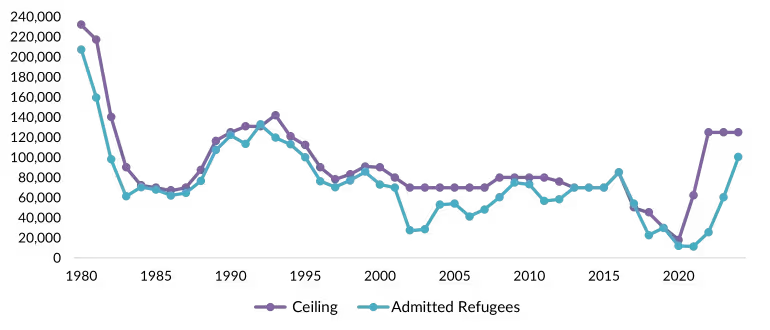
Notes: Figure includes Amerasian immigrants except for fiscal years (FY) 1980-88. Data from the State Department’s Worldwide Refugee Admissions Processing System (WRAPS) on refugee arrivals differ slightly from the Department of Homeland Security’s (DHS) Yearbooks of Immigration Statistics due to a different data collection approach. Based on the terms of the settlement in Doe et al. v. Trump et al., No. 17-0178, certain refugees arriving in FY 2020 and future years are counted toward the FY 2018 refugee admissions ceiling.
Source: Migration Policy Institute (MPI) tabulation of WRAPS data from the State Department's Bureau of Population, Refugees, and Migration (PRM), available online.
Over the course of his term, Trump reduced the annual refugee admission ceiling and imposed substantial restrictions on resettlement. When he entered office, the target had been set at 110,000 by the outgoing Obama administration; by FY 2021, it had been slashed to 15,000. The Trump administration suspended all refugee travel to the United States from June-October 2017 and then limited refugee admissions from some predominantly Muslim countries. It also required states and localities to affirmatively consent to refugee resettlement, implemented “extreme vetting” of refugee applicants (which included increased data collection and more and slower security checks), and ceased providing resettlement authorization to affiliate offices expected to handle fewer than 100 refugees, forcing many to shut their doors. From FY 2017 to May 2020, 134 affiliate offices around the United States closed due to this restriction or because of insufficient funding, representing a 38 percent decrease in the country’s resettlement capacity.
Box 2. Refugee Resettlement Agencies
There are ten nongovernmental agencies that play a major role in facilitating U.S. refugee resettlement: Church World Service, Ethiopian Community Development Council, Episcopal Migration Ministries, HIAS, International Rescue Committee, U.S. Committee for Refugees and Immigrants, Global Refuge, U.S. Conference of Catholic Bishops, World Relief, and Bethany Christian Services.
Upon taking office, the Biden administration set ambitious goals for rebuilding the resettlement program. Especially given the ongoing pandemic, which shuttered government offices for months, increasing resettlement proved much harder than it had been to make cuts. In May 2021, in the middle of the fiscal year, the Biden administration raised the refugee admission cap to 62,500, although this was largely aspirational and followed initial criticism by fellow Democrats for the administration’s inaction. Admissions ramped up over the subsequent three years, and from FY 2021-24 the United States admitted nearly 197,000 refugees, compared to 118,000 during the Trump administration (FY 2017-20). Still, this total is the third lowest for a single presidential term since the U.S. Refugee Admissions Program was created (see Table 1).
Table 1. U.S. Refugee Admissions by Presidential Term, FY 1977-2024

Notes: The contemporary U.S. refugee resettlement program began in 1980. Based on the terms of a settlement in Doe et al. v. Trump et al., No. 17-0178, certain refugees arriving in FY 2020 and future fiscal years are counted toward the FY 2018 refugee admissions ceiling.
Source: State Department, PRM, “Refugee Admissions Report,” updated September 30, 2024, available online.
Capacity Constraints Eased, but Not Quickly
To rebuild the refugee program and the resettlement network that supports it, the Biden administration focused on increasing resources, hiring more refugee officers, and making the system more efficient through technological innovation. Overall, funding nearly tripled from $932 million in FY 2020 to almost $2.8 billion in FY 2024 (see Figure 2).
Figure 2. Funding for the U.S. Refugee and Admissions Program, by Component, FY 2017-24

Note: Data for FY 2017 and FY 2024 are estimates.
Sources: MPI analysis of multiple years of U.S. Refugee Processing Center reports to Congress, available online.
The Department of Homeland Security (DHS) similarly nearly tripled the size of its refugee officer corps—which interviews applicants and makes determinations on admissions—by hiring more than 300 new staff as of June. Additional personnel allows the government to dispatch more officers to do on-site determinations in dozens of countries (see Figure 3). Still, it takes time to hire, train, and deploy refugee officers, and then further time to interview refugees, make determinations, and admit them to the United States. As of March 2023, it took approximately four years to process the average case. Especially when the pandemic was in full swing and deployment was difficult or impossible, these steps further slowed the system’s turnaround.
Figure 3. USCIS Staff Authorized to Process Resettled Refugees and Number of Refugee Processing Trips, FY 2020-24*

* Data for FY 2024 are as of early September 2024.
Notes: Data for Authorized Staff refer to the number of authorized positions and may not reflect the actual number of employed staffers at a particular moment.
Source: USCIS, Refugee Processing National Stakeholder Engagement (Washington, DC: USCIS, 2024), available online.
To reach applicants in areas where on-site interviews are not feasible, the Biden administration increased the use of video teleconference interviews. As of August, USCIS had conducted more than 3,000 video interviews in FY 2024, two-thirds of which involved applicants in Africa and the Middle East. The resettlement program has also digitized its case system, meaning that cases are now processed entirely electronically, increasing efficiency. Combined with the expanded refugee officer corps, this system modernization dramatically increased the number of interviews conducted, from approximately 1,200 in FY 2020 to more than 141,900 in FY 2024.
Figure 4. USCIS Refugee Interviews, FY 2020-24*

* Data for FY 2024 are as of September 5, 2024.
Source: USCIS, Refugee Processing National Stakeholder Engagement.
Refugee Vetting
Box 3. The U.S. Refugee Resettlement Process
1. A person comes into contact with the UN High Commissioner for Refugees (UNHCR) or an approved nonprofit organization, which screens and identifies them and refers applicants to the U.S. government for potential resettlement.
2. Applicants are pre-screened abroad by U.S. Resettlement Support Centers.
3. Refugee status determination interviews are conducted by U.S. Citizenship and Immigration Services (USCIS) officers, either in person or via teleconference.
4. Those who pass the USCIS interview undergo further medical and security checks.
5. The International Organization for Migration (IOM) provides cultural orientation.
6. IOM and U.S. resettlement agencies arrange travel loans that refugees must repay.
7. Refugees are assigned to one of ten nonprofit resettlement agencies (see Box 2) that determines where in the United States they will be received.
8. They travel to the United States, where the resettlement agency welcomes them, and then assists them with initial needs such as housing, job placement, and school enrollment for children.
Refugees are one of the most intensely screened populations admitted to the United States, with applicants rigorously vetted by DHS as well as other law enforcement, intelligence, and counterterrorism agencies. The Biden administration streamlined this vetting process by integrating it into the National Vetting Center, an interagency effort that conducts security checks of other applicants for U.S. immigration benefits.
Concurrent processing is another change that has dramatically increased efficiency. First deployed at the U.S. military’s Camp Al Sayliyah in Qatar during the evacuation from Afghanistan in 2021, concurrent processing allows multiple steps—such as medical checks and security screening—to occur in parallel instead of sequentially. This shortened screening times from years to months, or even weeks, and by September 2023, the U.S. Refugee Admissions Program had expanded the use of concurrent processing to 14 sites globally. As of late 2023, more than half of interviewed refugees went through concurrent processing.
Together, these changes allowed the resettlement program to scale up its decision-making. In FY 2024, officers decided more than 149,600 cases, up from a low of 7,000 in FY 2020.
Figure 5. USCIS Refugee Decisions Issued, FY 2020-24

Source: USCIS, Refugee Processing National Stakeholder Engagement.
Safe Mobility Initiative in the Western Hemisphere
In Latin America and the Caribbean, the Biden administration has used concurrent processing and new Safe Mobility Offices (SMOs) to dramatically increase refugee processing, in keeping with its focus on addressing record migration from the region and high arrivals at the U.S.-Mexico border. In 2023, the United States opened SMOs in Colombia, Costa Rica, Ecuador, and Guatemala, in partnership with UNHCR and the International Organization for Migration (IOM). The offices provide information about immigration pathways to the United States, Canada, and Spain, as well as counseling about local integration assistance in host countries. With the SMOs, the Biden administration sought to provide access to protection closer to migrants’ home countries to disincentive dangerous journeys to the U.S.-Mexico border.
Migrants register with the SMOs online and answer a questionnaire about their need for humanitarian protection and eligibility for other legal pathways. While the initial idea was to facilitate access to U.S. labor pathways as well as refugee processing, the SMOs currently only process refugee cases, with UNHCR referring applicants to the U.S. Refugee Admissions Program. As of September, more than 245,000 people had registered with the SMOs online and more than 40,400 had been approved for U.S. refugee status.
Migrants deemed ineligible for humanitarian protection receive counseling from IOM about the humanitarian parole processes for Cubans, Haitians, Nicaraguans, and Venezuelans, which allow some of these migrants with U.S. sponsors to fly at their own expense to the United States and receive temporary permission of stay and work; family reunification parole processes for migrants with approved visa applications; and other U.S. visa options such as for temporary agricultural work. Uptake of these pathways has been much lower than refugee admissions because many migrants do not meet the eligibility requirements both under U.S. law and those set by host countries, and because only Congress can change U.S. employment and family-based visa limits.
Nevertheless, efficient refugee processing at the SMOs and a broadened network of nonprofit organizations that refer migrants for refugee screening enabled the U.S. government to resettle more refugees from the Western Hemisphere in FY 2024 than ever before.
Figure 6. Number and Share of Refugees Admitted to the United States, by Region, FY 2024
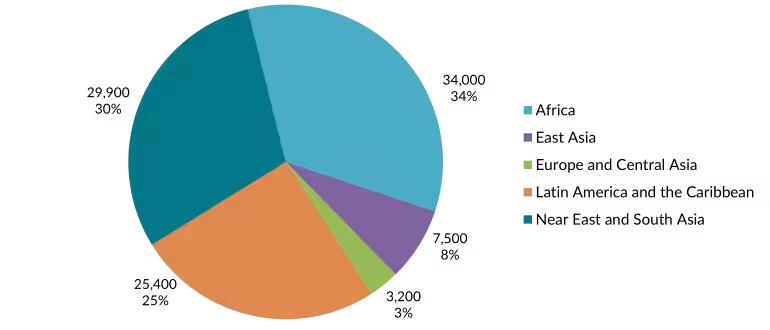
Source: PRM, “Refugee Admissions Report.”
Strains on Domestic Resettlement Agencies
Once refugees are admitted to the United States, a network of resettlement agencies welcomes them. These nonprofit organizations have long played a critical role resettling and integrating refugees into local communities, such as by offering resources to find housing, enroll children in school, access medical care, and seek employment. They rely on a network of local affiliates which receive funding from the State Department.
After being hollowed out under the Trump administration, resettlement agencies have been slowly but surely rebuilding their capacity, with support from the Biden administration. The administration in 2022 added a tenth national voluntary resettlement agency to the network, Bethany Christian Services. These ten agencies have opened or reopened more than 150 local offices, bringing the total to more than 350.
Still, more refugees were approved by the U.S. resettlement program in FY 2024 than actually arrived, reflecting ongoing challenges with domestic capacity. Although resettlement agencies have opened or reopened offices and hired or rehired staff, they have been strained by also serving the hundreds of thousands of migrants paroled into the United States through various temporary programs: Operation Allies Welcome for Afghans; Uniting for Ukraine; and the Cuba, Haiti, Nicaragua, and Venezuela parole processes. The country’s housing affordability crisis has also hampered resettlement, prompting the Office of Refugee Resettlement (ORR) to increase the duration of refugee cash assistance from eight months to 12 months, and to increase the amount given refugees in certain states.
The Biden administration has also emphasized its Welcome Corps initiative, which is modeled after a Canadian program allowing private individuals and groups to sponsor refugees. Launched in January 2023, Welcome Corps allows groups of U.S. citizens and lawful permanent residents (also known as green-card holders) to sponsor refugees, providing support for the first three months after arrival, which would otherwise be handled by resettlement agencies. (Privately sponsored refugees undergo the same vetting and screening procedures as other refugees.) More than 100,000 people across the United States have signed up to be sponsors, but arrivals have been slow due to a number of program requirements. Official Welcome Corps data are not publicly available. Officials have stated they hope to have 10,000 arrivals in FY 2025.

An Uncertain Future
The U.S. refugee resettlement program has in many ways been an extraordinary win-win situation for the United States and the refugees it welcomes. A generous refugee resettlement policy has long bolstered the United States’ moral standing globally, and also has fiscal benefits. From FY 2005 through FY 2019, refugees and asylees contributed $123.8 billion more than federal, state, and local governments spent on them, according to a recent study from the Department of Health and Human Services. Admitted refugees are eligible for lawful permanent residence, eventual citizenship, and the opportunity to be reunited with immediate family. This leads to stability and a commitment to their new country.
Yet critics claim that the refugee system has been expanded to include people who do not merit protection and may also present a burden to the government and the communities that receive them. As such, support for refugee resettlement has become heavily politicized. History has shown that the refugee system, more than any other U.S. immigration policy, is highly susceptible to the will of individual administrations. Biden has set the FY 2025 refugee admission target at 125,000. If Vice President Kamala Harris, the Democratic nominee, wins the presidential election, it is a good bet that the United States could hit that target. By comparison, Trump, the Republican nominee, has promised to once again cut resettlement. As the last several years have shown, resettlement and other immigration systems are much easier to halt than start or resume.
In addition to gearing up refugee resettlement, the Biden administration has also introduced humanitarian parole policies that have allowed a much larger number of people to enter the United States. As impactful as these protections may have been in the short term, they lack the permanence of refugee resettlement. A potential Harris administration is likely to follow the footsteps of the Biden administration, but Trump has indicated he would end all such programs. Thus, the results of the November election will likely determine much about the future of the U.S. refugee and other protection streams—not only for the next four years, but for many more after that.
Disclosure: The Migration Policy Institute (MPI), in partnership with Pathways International, serves as the Secretariat for the State Department’s Resettlement Diplomacy Network, a multilateral government forum that drives high-level strategic and diplomatic engagement among resettlement states.
Sources
Bethany Christian Services. 2022. Bethany Christian Services to Expand Refugee Resettlement Programs after New Designation as Voluntary Resettlement Agency. Press release, November 16, 2022. Available online.
Bolter, Jessica, Emma Israel, and Sarah Pierce. 2022. Four Years of Profound Change: Immigration Policy during the Trump Presidency. Washington, DC: Migration Policy Institute (MPI). Available online.
Dunn Marcos, Robin. 2024. Refugees in U.S. Have Contributed Nearly $124B to U.S. Government Budget, New HHS Study Reveals. U.S. Department of Health and Human Services (HHS), Administration for Children and Families (ACF) blog post, February 15, 2024. Available online.
Gibson, Irene. 2023. Annual Flow Report Refugees and Asylees: 2022. Washington, DC: U.S. Department of Homeland Security (DHS), Office of Homeland Security Statistics (OHSS). Available online.
Hinkle, Lillie. 2023. The Unmet Potential of Community Consultations in U.S. Refugee Resettlement. Washington, DC: MPI. Available online.
International Organization for Migration (IOM), U.S. Refugee Admissions Program (USRAP). N.d. Understanding Travel Loans. Accessed October 16, 2024. Available online.
International Refugee Assistance Project (IRAP). 2024. What We Know about the Biden Administration’s Safe Mobility Initiative. Washington, DC: IRAP. Available online.
La Corte, Matthew and Claire Holba. 2024. Rebuilding the U.S. Refugee Program: A Case Study in How to Increase State Capacity. Niskanen Center commentary, October 2, 2024. Available online.
Margesson, Rhoda. 2022. Global Refugee Resettlement: Selected Issues and Questions. Washington, DC: Congressional Research Service (CRS). Available online.
Migration Policy Institute (MPI) Migration Data Hub. N.d. U.S. Annual Refugee Resettlement Ceilings and Number of Refugees Admitted, 1980-Present. Accessed October 15, 2024. Available online.
Refugee Council USA. N.d. Resettlement Process. Accessed October 11, 2024. Available online.
Roy, Diana, Claire Klobucista, and James McBride. 2024. How Does the U.S. Refugee System Work? Council on Foreign Relations, March 26, 2024. Available online.
U.S. Citizenship and Immigration Services (USCIS). 2024. Refugee Processing National Stakeholder Engagement. Washington, DC: USCIS. Available online.
---. 2024. Refugee Processing National Stakeholder Engagement: Questions & Answers Sept. 12, 2024. Washington, DC: USCIS. Available online.
U.S. Customs and Border Protection (CBP). 2024. National Vetting Center. July 17, 2024. Available online.
U.S. State Department. 2023. Announcement of Safe Mobility Office in Ecuador. Press release, October 19, 2023. Available online.
U.S. State Department, Bureau of Population, Refugees, and Migration (PRM). 2024. Proposed Refugee Admissions for Fiscal Year 2024: Report to the Congress. Washington, DC: PRM. Available online.
---. N.d. Reception and Placement. Accessed October 16, 2024. Available online.
---. N.d. Strengthening the USRAP. Accessed October 16, 2024. Available online.
U.S. State Department, PRM, Refugee Processing Center. 2024. Refugee Admissions Report. Updated September 30, 2024. Available online.
White House. 2024. Fact Sheet: Biden-Harris Administration on World Refugee Day Celebrates a Rebuilt U.S. Refugee Admissions Program. Fact sheet, June 20, 2024. Available online.
About the U.S. Immigration Policy Program
The U.S. Immigration Policy Program provides analysis of U.S. immigration pathways, the impacts of enforcement and other policies, and the characteristics of immigrant populations.


Related Content


