New Zealand: From Settler Colony to Country Reliant on Temporary Immigration

Women walk by the Sky Tower in Auckland. (Photo: carlycanfield/iStock.com)
Highlights
New Zealand has shifted from permanent settler immigration to a system reliant on temporary labor migration, generating workforce gains but also reports of exploitation.
- New Zealand's 1.4 million immigrants made up 29 percent of the population as of 2023; net immigration has outpaced that of countries including Australia, Germany, and the United States.
- Work visa approvals surged to nearly 242,400 in fiscal year (FY) 2019, as policy shifted decisively from permanent settlement toward temporary labor migration.
- A 2022 government inquiry found that Māori, who comprise about 20 percent of the population, had not had an opportunity to present views on immigration policy since 1840.
- New Zealand's refugee quota was 750 per year from the 1980s through 2018—among the world's lowest per capita—before rising to 1,000 in 2018 and 1,500 in 2023.
Immigration has been enmeshed in the character and fortunes of New Zealand since the country’s modern formation in the mid-19th century. Immigrants historically were primarily British and Irish, and arrived as permanent settler colonists, in a process that involved the marginalization of the Indigenous Māori people. The pattern of generally long-term immigration by Europeans remained until the late 20th century, at which point government policies began to pivot. Over the last several decades, immigration has become much more economically oriented. It is also more diverse in terms of origins, with larger shares of immigrants from Asia, and policy has come to favor temporary labor and educational migration over permanent settlement.
Both major political parties now embrace using immigration policy to maintain population growth and address labor shortages. Immigration and growing ethnic diversity since the 1990s have nonetheless been contested, including with instances of racism, often in regards to concerns about housing and the job market. New Zealand has also experienced very high net immigration since the mid-2010s, averaging ten new arrivals per 1,000 population from 2015 to 2024, which is notably higher than many major immigration destinations such as Australia, Canada, Germany, Ireland, the United Kingdom, and the United States.
The high levels of temporary labor immigration in the 21st century have also been associated with extensive reports of workplace exploitation and abuse. Increasingly, immigration policy is contested by Māori intellectuals and leaders. They question the continued marginalization of Indigenous perspectives, given the country’s complex relationship with Indigenous people, who make up about one of every five residents.
The country’s 1.4 million immigrants accounted for 29 percent of New Zealand’s 5 million people as of 2023. The top countries of origin were England (208,400 people, or approximately 14 percent of the foreign born), China (145,400, or 10 percent), India (142,900 or 10 percent), the Philippines (99,300, or 7 percent), South Africa (95,600, or 7 percent), and Australia (86,000, or 6 percent). At the same time, an estimated 1 million New Zealand citizens live abroad as of this writing, primarily in Australia.
This country profile offers an overview of New Zealand’s migration trends, tracing transformations from the 19th to the 21st centuries and addressing key themes in contemporary immigration policy and patterns. In particular, the article highlights the reliance on temporary migration, concerns about exploitation, the relationship between emigration and immigration, refugee resettlement, and Indigenous perspectives.
Immigration History
Immigration has been foundational for New Zealand. Māori discovered and settled the lands they know as Aotearoa in journeys from the eastern Pacific in the 13th century. Māori are the Indigenous people of New Zealand. European contact occurred in 1642, when the Dutch explorer Abel Tasman anchored offshore, and heightened following the arrival of James Cook from Great Britain in 1769. In the following decades, mariners, missionaries, whalers, sealers, traders, and settlers would arrive in increasing numbers.
Settler Colonization and the Treaty of Waitangi
The year 1840 is pivotal in New Zealand’s immigration history. That year, the Treaty of Waitangi (known in Māori as Te Tiriti o Waitangi) was signed by the British Crown and many Māori rangatira (tribal chiefly authorities). The treaty was premised on growing British immigration. The Māori-language version, signed by around 500 rangatira, granted London the right to govern British subjects in New Zealand; Māori would retain independence and sovereignty. The English-language treaty, use of which has dominated to date, was signed by just 39 rangatira and granted complete sovereignty to the British Crown. Protections for Māori in were largely ignored until the late 20th century.
In the following years, immigration from the British Isles increased significantly. Immigration was facilitated by the private New Zealand Company and the colonial government, which established programs to promote, facilitate, and at times subsidize the immigration of tens of thousands of people primarily from the British Isles. Immigration led to pressure on land, and in the 1860s war broke out between the colonial government and some Māori tribes who refused to cede sovereignty. In addition to bringing new immigrants arriving as imperial troops, the New Zealand Wars also led to the mass confiscation of Māori land that was later distributed to new settlers. Public works schemes initiated in the 1870s borrowed from London’s financial markets to fund infrastructure developments, creating large-scale demand for labor and allowing for the funding of immigrant passage to New Zealand. Between these and other developments including disease, war, and loss of resources that reduced the Māori population, British settlers came to be demographically and politically dominant by the end of the century. In 1840, an estimated 2,000 Europeans and 80,000 Māori lived in New Zealand; by 1901, the European population reached 770,000 while the Māori population had declined to approximately 46,000 (see Figure 1).
Figure 1. Population of New Zealand, by Ethnicity, 1840-1901

Source: T. Papps, “Growth and Distribution of Population,” in Population of New Zealand / Economic and Social Commission for Asia and the Pacific 12, Vol 1. (New York: United Nations, 1985); Ian Pool, Te IIwi Maori: A New Zealand Population, Past, Present & Projected (Auckland: Auckland University Press, 1991).
Restrictive Policies into the 20th Century
Immigration ebbed and flowed into the first half of the 20th century, but new arrivals remained overwhelmingly British and Irish due in part to policies excluding potential immigrants of other nationalities. Most notable was a series of laws beginning in the 1880s that excluded Chinese immigrants, echoing similar developments in Australia, Canada, and the United States. Other European immigrants—including small populations of Germans, Scandinavians, and Southeastern Europeans—also faced restrictions. And while Irish immigration was not limited, Catholics were often subjected to discrimination in day-to-day life. While New Zealand’s system was not as explicitly racist as the White Australia Policy, its restrictions aimed for a similar effect, with a widely held view that the country ought to be the “better Britain of the South Pacific,” as leading political figures professed at the time.
After World War II, the desire to continue population growth through immigration posed challenges to the notion that New Zealand could be solely White. Emigration from Britain and Ireland declined after the war, and New Zealand’s government started to look for potential settlers from elsewhere in Europe, notably the Netherlands. There was also a demand for workers during the post-war economic booms, and labor schemes were established with South Pacific countries including Fiji, Samoa, and Tonga. Immigrants from the Cook Islands, Niue, and Tokelau could meanwhile arrive freely as member countries of the New Zealand Realm.
During the 1970s economic recession, government agendas shifted and deportation campaigns targeted Pacific Islanders, even though similar if not greater numbers of Europeans and North Americans also likely lacked legal status. While overall there had been some shift from solely White immigration, policies through the 1970s prioritized arrivals from the United Kingdom and Ireland. The makeup of the national population in 1986 reflected these policies: 15 percent of residents were born overseas and 94 percent of the country identified as either European (82 percent) or Māori (12 percent).
Modern Trends: Multiculturalism, Neoliberalism, and Temporary Migration
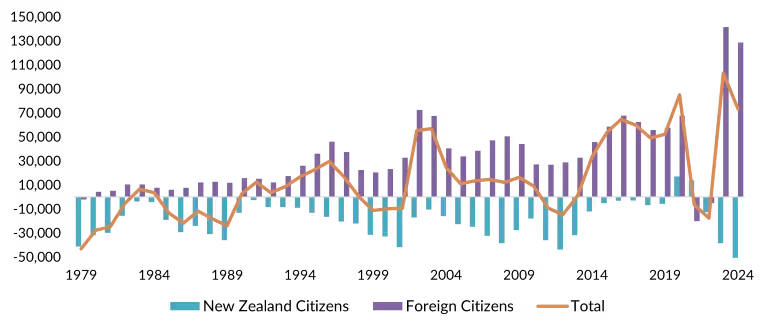
Since the mid-1980s, the government has embraced a much more expansive and diverse immigration policy framework. The 1986 Immigration Policy Review and the subsequent Immigration Act 1987 led to the removal of traditional source-country criteria as the principal mechanisms for selecting immigrants. Instead, the focus shifted to purportedly race-free measures of human capital and, in 1991, a points system for assessing immigrant applications focused on skills and other largely economic characteristics. The effects of this shift were significant. Annual net immigration grew from an average of approximately 7,500 during the 1980-84 period to 32,000 in the 1995-99 period (see Figure 2). Just as importantly, the share of arrivals from places other than Australia, the United Kingdom, and Ireland increased from 21 percent in the early 1980s to more than 70 percent throughout the 1990s. Immigration from East and Southeast Asia was particularly notable, as regional economies opened up and demand for migration increased generally. From the late 1990s through the early 2000s, an increasing share of arrivals also came from South Asia and South Africa.
Figure 2. Net Migration in New Zealand, by Citizenship, FY 1979-2024
Note: The New Zealand government fiscal year covers the year ending June 30.
Source: Statistics New Zealand, “Permanent and Long-Term Migration Key Series (Annual-Jun),” updated August 13, 2024, available online.
These policy shifts were simultaneously multicultural and neoliberal. On the one hand, the government argued that immigration should not be determined by nationality but rather should relate to individuals’ “potential personal contribution to the future well-being of New Zealand,” in the words of the 1986 Immigration Policy Review. Led by the traditionally left-leaning Labour Party (in power from 1984-90), the reforms of the 1980s spoke to notions of fairness, equality, diversity, and anti-discrimination. Importantly, however, these shifts were also part of the wider neoliberal transformation of New Zealand society that was also initiated by the Labour government in the 1980s. Immigration became viewed as a way to attract and retain highly skilled people and to more broadly embrace globalization through reworking geopolitical and trade relations that pivoted New Zealand from its Britain- and Europe-facing orientation towards the emerging economies of Asia. Within this framing, immigrants were cast as having economic value in labor markets, for their potential to introduce new entrepreneurial activity, and for their links to their origin countries and wider diasporic networks.
The transformation did not go unquestioned. Most notably, Māori intellectuals and leaders made the point that, despite the emerging recognition of the rights enshrined in the Treaty of Waitangi, Māori had not been consulted on these changes or their implications for people and society. Instead, as activist and academic Ranginui Walker put it at the time, immigration policy represented a continuation of colonial forms of government that prioritized the Crown’s interest over Indigenous concerns. In a different manner, the growing number of people from Asia triggered anxiety that manifested as racism, questions about their ability to integrate, and framed immigration as a challenge to societal norms.
Throughout the 1990s, the conservative National Party (in power from 1990-99) sought to assuage the latter concerns by emphasizing the value of globalization. Policymakers also continued to tweak immigration policy to prioritize English language ability and added extra steps in assessing immigrants’ skills. These shifts somewhat reduced immigration from Asia, but by the late 1990s the neoliberal and multicultural model of immigration policy had effectively become orthodoxy.
From Settlement to Temporary Migration
Reforms of the 1980s and 1990s shifted the emphasis towards a model of immigration that privileged human capital rather than race and national origin. However, they largely continued to encourage immigrants’ long-term settlement. Through the 1990s, immigrants were usually granted a residence visa or permit from abroad, effectively granting them near-total rights upon arrival. In other words, so long as they met the criteria on human capital or family reunification, immigrants could easily arrive, settle, and eventually become New Zealand citizens.
In the first two decades of the 21st century, this shifted; immigration policy is now predominantly focused on managing temporary migration. A key element of this transition was the creation of a two-step process for residence applications, whereby applicants first submit an expression of interest before they can make a full application. The criteria for residence applications were also refined, making it increasingly necessary for applicants to gain New Zealand work experience and thus hold work visas for periods of time before gaining residence rights. In addition, the government promoted new forms of temporary migration including working holiday visas (available for young adults to work, study, and travel for one to three years, depending on nationality), allowing international students to work legally, and offering post-study visas for graduating international students. In 2007, a new seasonal work program, the Recognised Seasonal Employer (RSE) scheme, was introduced to facilitate short-term circular labor mobility from Pacific countries (discussed below).
The effects of these and subsequent changes have been enormous on the volume and composition of immigration to New Zealand. Overall, there has been a significant growth in the number of work and student visas issued since 2000, a relative stagnation in the number of residence visas, and a large population of people holding temporary status. In fiscal year (FY) 1999, 43,100 work visas were issued; in FY 2019, there were nearly 242,400 (see Figure 3). Student visas initially rose much more rapidly, from 27,500 in 1999 to 119,300 five years later, although numbers subsequently declined to 103,900 in 2019. Over the same period, the number of residence visas issued annually increased from 28,400 to a peak of 52,900 in 2002, but then remained between 38,000 and 52,000 until the late 2010s. The trend for naturalizations has generally followed that of permanent residence approvals. The shift contributed to high net immigration in the mid-late 2010s, nearing or exceeding 50,000 in every year from 2015 until 2020. In February 2020, just before borders closed amid the COVID-19 pandemic, 306,900 immigrants held temporary legal status, accounting for more than 6 percent of the total population.
Figure 3. New Zealand Approvals of Work, Student, and Residence Visas, FY 1998-2024

Note: The New Zealand government fiscal year covers the year ending June 30.
Sources: Data for fiscal years (FY) 1998-2009 are from the author’s files and were previously available from Immigration New Zealand but removed out of potential privacy concerns; data for FY 2010-24 are from New Zealand Ministry of Business, Innovation, and Employment, “Migration Data Explorer,” accessed October 10, 2024, available online.
Pandemic Shutdown
The government’s response to the pandemic was amongst the world’s strictest. The border was nearly completely closed from March 2020 until a staged reopening beginning in mid-2022. Net migration plummeted, from a gain of 84,800 in FY 2020 to a loss of 17,700 in FY 2022. While most working holiday visa holders and international students departed, nearly all work visa holders remained. In the context of a tight labor market and with a significant temporary immigrant population, the government repeatedly issued universal six-month visa extensions. Then, in 2021, it announced a one-off residence pathway for work visa holders who had been in the country for three or more years, which eventually led to the granting of 211,400 new residence permits between 2022 and 2024.
In effect, the vast majority of temporary immigrants either left or were granted legal residence in what amounted to an amnesty, although the initiative was never officially described as such. In the post-pandemic era, however, there has been an effective reset towards reinvigorating temporary migration programs alongside further restrictions to residence rights. Work visa approvals exceeded 200,000 in FY 2023 and FY 2024, new work visa schemes have been introduced, and quotas for seasonal work have been increased. In other words, New Zealand’s focus on managing large temporary migrant populations appears to have intensified.
Temporary Migration, Labor, and Exploitation
Since the early 2000s, the government has increasingly ordered migration by creating new criteria for entry, differentiating migrants’ statuses and rights, and managing the transition between temporary and permanent residence. The growth in work visas, for example, was a response to shifting labor market gaps which the government tried to fill with new or modified migration schemes. Both work and student visas have also been viewed as pathways to residence, although only for those immigrants seen as being highly skilled or who earned high incomes. Thus, temporary migration programs have operated as a filter that outsources responsibility for successful outcomes to immigrants themselves.
The RSE scheme introduced in 2007 represented a particularly emblematic example of this logic. This program facilitates the seasonal labor mobility of people from Pacific countries, restricting them to seven- or nine-month visas and to work only in specified jobs in horticulture and viticulture. The program’s cap has increased annually from 5,000 at inception to 20,750 in 2024. There are also national-level quotas, an accreditation system for employers, and specified conditions for migrants. It is highly managed, in other words, and is oriented towards reducing risks that migrants fall out of legal status or that employers fail to maintain minimum standards of employment.
The RSE is also the government’s most restrictive migration program. Aside from its very short visas, the scheme does not permit RSE workers to apply for another visa; the workers also are precluded from access to residence rights, cannot be accompanied by family, and have no access to publicly funded health care or other social benefits. Supporters claim the program can spur economic development in Pacific countries, though critics suggest that argument is paternalistic. The program is also widely lauded by New Zealand employers that have been able to achieve significant export profits through access to short-term migrant labor. Despite criticism, it has been seen as a global best practice model for managing circular labor migration and was notably emulated by the Australian government. In recent years, however, there have been increasing reports of employers exploiting RSE workers, including what the New Zealand Human Rights Commission has described as systemic human-rights abuses. Political leaders in the Pacific have also questioned the program’s impacts (and those of the similar program in Australia), claiming workers need more liberal mobility schemes.
Exploitation of migrants in workplaces and housing and instances of fraud against migrants have become common in New Zealand since the 2010s and appear to have intensified since the pandemic. Media organizations and researchers have documented patterns of underpayment or nonpayment of wages, income tax, and holiday pay; coercive workplace practices; employer noncompliance with employment contracts; and denial of leave. In addition to the leverage employers can exercise on workers who need sponsorship to renew a work visa or apply for residence, there are reports of employers promising immigration assistance in exchange for wages or large sums of money (described as job or visa premiums). Two key features of immigration policy have enabled these forms of exploitation: the need for employer sponsorship of skill-tested work visas and the mismatch between the number of work visas issued and the number of residence visas available.
An additional dimension of migrant exploitation has been via links to international education. Throughout the 2010s, the number of international students enrolling in sub-degree private training establishments grew, as result of implicit or explicit promises by education providers, the government, and agents that enrollment could lead to legal residence. Often facilitated by personal or family debt, graduating international students have been made particularly vulnerable to workplace exploitation and fraud as they seek to achieve their migration aspirations of finding work and gaining legal residence.
The government has focused on combatting migrant exploitation, especially following the election of the Labour-NZ First coalition government in 2017. There have been numerous government reviews, research publications, and policy proposals for addressing exploitation and, more broadly, modern-day slavery. These actions have led to some additional resources to enforce labor standards; increased information for migrants; and the 2023 introduction of the Migrant Exploitation Protection Work Visa, a six-month stopgap visa so immigrants can quickly leave exploitative workplaces without falling out of legal status. The government has not, however, addressed two key policy drivers of exploitation: employer-sponsored visas and the discrepancy between temporary visas and the availability of residence rights. In fact, the Accredited Employer Work Visa (AEWV) scheme introduced in 2022 appears to have intensified vulnerability to exploitation, according to the New Zealand Human Rights Commission. The AEWV replaced existing skill-tested work visas and created a situation wherein some employers and migration agents were able to illegally charge fees to potential migrants without guaranteeing work. Extensive reports emerged in 2023 of indebted migrants arriving in New Zealand without jobs or accommodation and with little recourse. In this regard, while the post-COVID-19 immigration reset has prompted some attention to exploitation, addressing it remains subordinate to the government’s desire to maintain high levels of temporary labor immigration.
Emigration and Its Links to Immigration
New Zealand is also a country with high levels of emigration. The New Zealand Productivity Commission has estimated approximately 1 million New Zealand citizens lived outside the country as of 2022, which constitutes the equivalent of 20 percent of the resident population. A pattern of cyclical emigration emerged in the 1970s, when the country’s economy started to lag behind that of Australia. The 1970s oil shocks and consequent recession were also associated with significant outflows, which contributed to a three-year period (1979-81) where net emigration caused the country’s population to shrink. In the decades since, more New Zealand citizens have consistently left than returned, with peaks during economic downturns. The only exception to this pattern was during the two years of COVID-19 border closures, during which many New Zealand citizens returned and relatively few departed, leading to small net gains of 17,100 in FY 2020 and 13,600 in FY 2021, which quickly reverted to a record net loss of 55,300 in FY 2024. Cumulatively, a net of nearly 919,000 New Zealand citizens left the country from FY 1979 to FY 2024.
Around two-thirds (670,000) of New Zealand emigrants lived in Australia as of 2024, according to the Australian government. The two countries have a shared colonial history and close political and economic relationships. The 1973 Trans-Tasman Travel Arrangement (TTTA) formally facilitates migration between them, enabling citizens to visit, live, and work in either country without restrictions. New Zealand citizens have typically used this right more than Australians, especially during economic booms in Australia and declines in New Zealand. While the New Zealand population in Australia has grown markedly over the last two decades, Australian immigration to New Zealand has been relatively low, often below an annual net gain of 1,000 people and peaking at 3,300 in 2016. This imbalance has created tensions between the countries at times, not least as Australia has unilaterally revoked benefits for New Zealand citizens, including in 2001 removing the automatic right to access Australian citizenship. Other issues have emerged in recent years as the Australian government has deported New Zealand citizens with criminal records, some whom have lived their entire lives in Australia.
Emigration has been a recurrent concern for political leaders and the general public due to worries over brain drain, the fact that emigration tends to increase amid domestic economic downturns, and the extent to which emigration reflects inequality in New Zealand. Emigration has also been influential in shaping immigration policies, as was apparent in the 1980s when negative net migration and demographic decline prompted an approach to immigration that would sustain population and economic growth. This relationship between emigration flows and immigration policy has continued, even if rarely acknowledged. Immigration is viewed as an important offset to New Zealand’s aging population, but consistent emigration is another demographic hurdle to overcome.
Refugee Resettlement
New Zealand has maintained a modest refugee resettlement program for several decades, beginning with small numbers of European refugees following World War II. By the 1970s, this expanded to include people displaced by conflicts and upheaval in Southeast Asia and then from other parts of the world. From the 1980s through 2018, the government set a cap of 750 refugees per year, which was one of the lowest per capita in the world. Following public campaigns, the quota was increased to 1,000 in 2018 and 1,500 in 2023. The quota scheme is run in collaboration with the UN High Commissioner for Refugees (UNHCR), which identifies refugees for resettlement before final decisions are made by Immigration New Zealand. Refugees’ major countries of origin over the past decade were Syria, Myanmar (also known as Burma), Afghanistan, Colombia, Pakistan, and Somalia. In addition to the refugee quota, there are mechanisms for resettled refugees to sponsor family members, including partners and dependent children.
The government has also experimented with small, novel humanitarian protection programs, including a 2017 visa specifically for people in the Pacific region fleeing impacts of climate change. This visa was quickly abandoned, partly due to Pacific people indicating that a “climate refugee” status was not appropriate.
Small but Growing Asylum Claims
New Zealand has typically received relatively few asylum claims. There were fewer than 500 claims in most years over the last decade, of which 35 percent or less were typically approved. These small numbers partly reflect asylum seekers’ challenges reaching New Zealand by sea (due to its geographic isolation) or air (due to border securitization).
In recent years, however, there has been a noted increase in asylum claims; 780 were filed in FY 2023 and 2,345 the following year (of which only 704 have had decisions as of this writing); just 22 percent and 20 percent of applicants, respectively, were approved. Notwithstanding the relatively little irregular immigration that might lead to asylum claims, the government has followed the trend of policymakers in Australia, the European Union, and North America in intensifying border security. This includes participating in the Migration Five information-sharing network (alongside Australia, Canada, the United Kingdom, and the United States); maintaining close relationships between police, intelligence services, and immigration authorities; and developing legislation designed to prevent and manage “mass arrivals” of more than 30 people irregularly by sea, even though no such event has ever occurred. Until 2022, asylum seekers were also sometimes detained in criminal justice facilities while awaiting decisions on their cases, during which some faced significant human-rights violations, advocates have reported.
Indigenous Perspectives on Migration
A hallmark of settler colonialism in New Zealand—as in Australia, Canada, and the United States—is that Indigenous people are almost completely absent from the debate about immigration policy and its implications. This is particularly notable in New Zealand because it is the only one of these Anglophone countries where Indigenous people comprise the largest minority group, with Māori making up about 20 percent of the total population as of 2023. Moreover, since the 1970s New Zealand has placed a growing focus on redressing colonial wrongs in domains including health, education, economic development, and resource management. A significant part of this focus has involved recognizing the constitutional significance of the Treaty of Waitangi and the role of Māori in decision-making and governance.
In contrast, immigration policy is an area where there has been almost no engagement with Māori, despite its wide-ranging impact on Māori people. Indeed, an extensive government-directed inquiry into immigration in 2022 found that “tāngata whenua [people of the land, or Indigenous people] have not had an opportunity to present their views on immigration policy since 1840.” The report recommended the government consider the role of the Treaty of Waitangi in immigration policymaking and what Māori perspectives might bring to the issue. While the Labour government at the time committed to some work in this area, the right-wing coalition that took power after the 2023 election has seemingly abandoned the push.
Māori scholars and political leaders have advocated for different approaches to immigration. The 2016 Report of Matike Mai Aotearoa – The Independent Working Group on Constitutional Transformation, for example, outlined how Māori notions of authority and sovereignty involved the ability to make decisions about who could enter territory. Tikanga (traditional law) also identifies particular processes for building relationships with newcomers and sustaining the mana (or authority) of the people of the land. Others highlight Māori worldviews that may be particularly relevant for immigration, including concepts such as manaakitanga (hospitality), which binds mana with enhancing the well-being of others, and whakawhanaungatanga (relationship-building), which involves processes for building relationships that are reciprocal and mutually beneficial. The scholars Tahu Kukutai and Arama Rata have suggested that an immigration system based on manaakitanga might shift policy away from primarily economic objectives to give greater attention to family, potentially reducing the focus on temporary labor immigration and emphasizing newcomers’ inclusion. They have also suggested that immigration policy be more oriented towards the Pacific region, given the existing cultural and social relations. Central in these framings is a push for immigration policy to recognize Māori authority; their right of self-determination; and role contributing to the country’s social, cultural, and economic future.
To the Future
New Zealand’s prioritization of temporary migration has created a complex situation in which immigrants comprise a relatively large share of the overall population, yet a substantial proportion have little prospect of permanent residence. Unlike many major immigrant destinations, the relationship between the foreign and native born in New Zealand is further complicated by the country’s efforts to reconcile historical injustices against the Māori. Centering Māori perspectives in policymaking may provide a framework for challenging the dominance of economic priorities in immigration policy.
Looking forward, the post-pandemic reset suggests the government remains interested in temporary immigration to fill labor market gaps and offset demographic challenges. Whether this system can be reformed to prevent exploitation of migrant workers is unclear. The country may also face future challenges from ongoing emigration of citizens, population aging, persistent socioeconomic inequality, and the impacts of climate change. Still, what is clear is that the immigrants who arrive in years to come will almost certainly shape New Zealand as much as those of previous eras.
Sources
Amnesty International. 2022. NZ to Stop Imprisoning People Seeking Asylum. Press release, May 2, 2022. Available online.
Australia Department of Foreign Affairs and Trade (DFAT). N.d. New Zealand Country Brief. Accessed October 8, 2024. Available online.
Beaglehole, Ann. 2013. Refuge New Zealand: A Nation's Response to Refugees and Asylum Seekers. Dunedin, New Zealand: Otago University Press.
Bedford, Richard. 1994. Pacific Islanders in New Zealand. Espace Populations Sociétés 12 (2): 187-200. Available online.
Bedford, Richard, Charlotte Bedford, Elsie Ho, and Jacqueline Lidgar. 2002. The Globalisation of International Migration in New Zealand: Contribution to a Debate. New Zealand Population Review 28 (1): 69-97.
Bedford, Richard, Charlotte Bedford, Janet Wall, and Margaret Young. 2017. Managed Temporary Labour Migration of Pacific Islanders to Australia and New Zealand in the Early Twenty-First Century. Australian Geographer 48 (1): 37-57. Available online.
Burke, Kerry. 1986. Review of Immigration Policy, August 1986. Appendices to the Journals of the House of Representatives G.42. New Zealand Parliament, Wellington.
Collins, Francis L. 2020. Legislated Inequality: Provisional Migration and the Stratification of Migrant Lives. In Intersections of Inequality, Migration, and Diversification, eds. Rachel Simon-Kumar, Francis L. Collins, and Wardlow Friesen. Cham, Switzerland: Palgrave Pivot.
---. 2023. Relational Ethics, Settler Colonialism, and the Transformation of Migration in Aotearoa New Zealand. In Transforming the Politics of Mobility and Migration in Aotearoa New Zealand, eds. Jessica Terruhn and Shemana Cassim. London: Anthem Press.
Collins, Francis L. and Christina Stringer. 2023. The Trauma of Exploitation: Emotional Geographies of Temporary Migration and Workplace Unfreedom. Environment and Planning A: Economy and Space 55 (2): 303-19. Available online.
Curtin, Jennifer and Dominic O'Sullivan. 2023. Legacies of a Trans-Tasman Relationship: The Evolution of Asymmetry between New Zealand and Australia. In Asymmetric Neighbors and International Relations: Living in the Shadow of Elephants, eds. Ian Roberge, Nara Park, and Thomas R. Klassen. London: Routledge.
Dalziel, Raewyn. 2013. Julius Vogel: Business Politician. Auckland: Auckland University Press.
Gamlen, Alan. 2019. Human Geopolitics: States, Emigrants, and the Rise of Diaspora Institutions. Oxford, UK: Oxford University Press.
Hartog, Joop and Rainer Winkelmann. 2004. Comparing Migrants to Non-Migrants: The Case of Dutch Migration to New Zealand. In How Labor Migrants Fare, eds. Klaus F. Zimmermann and Amelie Constant. Berlin: Springer.
Immigration New Zealand. 2024. Refugee and Protection Statistics Pack. Wellington: Immigration New Zealand. Available online.
Ip, Manying. 2003. From White New Zealand to Open Door. In The Chinese Diaspora: Space, Place, Mobility, and Identity, eds. Laurence J. C. Ma and Carolyn Cartier. Oxford, UK: Rowman and Littlefield.
Kukutai, Tuhu and Arama Rata. 2017. From Mainstream to Manaaki: Indigenising Our Approach to Immigration. In Fair Borders? Migration Policy in the Twenty-First Century, ed. David Hall. Wellington: Bridget Williams Books.
Larner, Wendy. 1998. Hitching a Ride on the Tiger's Back: Globalisation and Spatial Imaginaries in New Zealand. Environment and Planning D: Society and Space 16 (5): 599-614.
Liu, Liangni Sally, Guanyu Jason Ran, and Xiaoyun Jia. 2022. New Zealand Border Restrictions amidst COVID-19 and Their Impacts on Temporary Migrant Workers. Asian and Pacific Migration Journal 31 (3): 312-23. Available online.
Marlowe, Jay. 2021. New Zealand Has One of the Lowest Numbers of Refugees per Capita in the World — There Is Room for Many More. The Conversation, June 17, 2021. Available online.
McCarthy, Angela, ed. 2022. Narratives of Migrant and Refugee Discrimination in New Zealand. London: Routledge.
Mythen, Samantha. 2024. Is New Zealand's Immigration 'Set Up' to Take in Climate Migrants from the Pacific? Radio New Zealand, September 3, 2024. Available online.
New Zealand Productivity Commission (NZPC). 2022. Immigration – Fit for the Future. Wellington: NZPC. Available online.
O'Malley, Vincent. 2019. The New Zealand Wars | Ngā Pakanga o Aotearoa. Wellington: Bridget Williams Books.
O'Malley, Vincent, Bruce Stirling, and Wally Penetito. 2011. The Treaty of Waitangi Companion: Māori and Pākehā from Tasman to Today. Auckland: Auckland University Press.
Ongley, Patrick and David Pearson. 1995. Post-1945 International Migration: New Zealand, Australia and Canada Compared. International Migration Review 29 (3): 765-93.
Poot, Jacques. 2010. Trans-Tasman Migration, Transnationalism and Economic Development in Australasia. Asian and Pacific Migration Journal 19 (3): 319-42.
Rata, Arama and Faisal Al-Asaad. 2019. Whakawhanaungatanga as a Māori Approach to Indigenous-Settler of Colour Relationship Building. New Zealand Population Review 45: 211-33.
Sachdeva, Sam. 2024. The Movement for ‘Free Movement’ in the Pacific. Newsroom, February 10, 2024. Available online.
Simon-Kumar, Rachel. 2015. Neoliberalism and the New Race Politics of Migration Policy: Changing Profiles of the Desirable Migrant in New Zealand. Journal of Ethnic and Migration Studies 41 (7): 1172-91.
Skilling, Peter. 2012. Immigration Policy in New Zealand: Divergent Narratives, Shared Assumptions and National Identity. Critical Policy Studies 6 (4): 363-78.
Spoonley, Paul and Richard Bedford. 2012. Welcome to Our World? Immigration and the Reshaping of New Zealand. Auckland: Dunmore.
Statistics NZ. 2024. Census 2023. Updated October 3, 2024. Available online.
---. 2024. New Zealand Net Migration Rate Down from Peak. September 11, 2024. Available online.
Stringer, Christina, Francis L. Collins, and Snejina Michailova. 2022. Temporary Migrant Worker Exploitation in New Zealand: A Qualitative Study of Migrants' and Stakeholders' Views. New Zealand Journal of Employment Relations 47 (1): 3-16.
Te Kāhui Tika Tangata, the New Zealand Human Rights Commission (HRC). 2022. The RSE Scheme in Aotearoa New Zealand: A Human Rights Review. Wellington: HRC. Available online.
---. 2024. New Review: Migrant Workers Being Exploited in AEWV Work Visa Scheme. Wellington: HRC. Available online.
Walker, Ranginui. 1994. New Zealand Immigration and the Political Economy. The Social Contract 4 (2): 86-97. Available online.
Wynyard, Matthew. 2023. When Worlds Collide: Māori and Immigration. Transforming the Politics of Mobility and Migration in Aotearoa New Zealand, eds. Jessica Terruhn and Shemana Cassim. London: Anthem Press.

Related Content