The World Is Going Greener. What Role Can Immigrants Play?
This transcript was generated using AI and may contain inaccuracies. If you notice an error, feel free to email [email protected].
CHAPTERS
[00:01:10]: The potential role of immigrants in supporting the green transition
[00:08:00]: Workforce shifts from high-emissions industries to green jobs
[00:09:45]: Labor shortages, training gaps, and challenges in credential recognition
[00:12:31]: The role of immigration policy in national climate and workforce strategies
[00:14:42]: Labor market dynamics between immigrant and native-born workers
[00:17:46]: Global competition for green skills and implications for origin and destination countries
TRANSCRIPT
[00:00:03.13]
The world needs more workers. That's true in general and it's particularly true for high income countries trying to make their economies greener. Companies in places such as the United States, Australia and Germany are all facing challenges staffing up the kinds of sectors that are necessary to reduce carbon emissions amid a rapidly heating globe. In the next few years, there could be a global shortage of millions of workers trained for solar, wind and other green energy jobs. There are economic repercussions of that shortfall, but it could also prevent the planet from meeting its carbon emissions goals. If a lack of workers prevents countries from moving away from burning fossil fuels and other high emissions activities, immigrants could help fill the gap. These high income countries already rely on some number of foreign born workers to build out renewable energy sectors. But maybe there's more work to do. From the Migration Policy Institute, this is Changing Climate, Changing Migration. I'm your host, Julian Hattem. Instead of focusing on how climate change is affecting migration, today we're asking the questions from the opposite end. Can immigrants help stop climate change? I'm speaking today with Kate Hooper. Kate is a senior policy analyst with MPI's international program where she leads our work on labor migration.
[00:01:21.17]
She's been doing some research with our colleague Lawrence Huang about the role of immigration in facilitating the green transition and, and I am very excited to have her here on today to talk about the workers who can help us make the leap. Kate, thanks so much for your time. It's great to have you.
[00:01:37.04]
Hi Julian, thanks for having me on.
[00:01:39.08]
So let's start by laying out the big picture. How many workers are needed to help high income countries move to a place where their economies are at net zero carbon emissions? Where are those mismatches and why have they occurred?
[00:01:53.04]
So countries are setting these really ambitious targets for reducing emissions and working towards a net zero economy. So you've got these very, very big headline pledges and targets over the next five, 10, 15 years. But delivering on these ambitions is going to require huge investments and in turn lots of workers to do the things, whether that's installing solar panels or heat pumps or upgrading the electricity grid. So that's where we're seeing an emerging shortfall of workers. We know that employers in renewable energy are already really struggling to find enough workers. There was a survey in the US in 2022 which said that 80% of employers in renewables were already struggling to find enough workers for open jobs. And this is just going to get worse. We're seeing more and more countries commit to these targets. We're seeing the number of green jobs growing in different sectors. And we also know that domestic workforces are getting older and more and more people are retiring. So even now we're seeing some of these shortages emerge and we know that they're just going to get bigger and bigger. There was a BCG study which tried to put a number on that, which is obviously a very challenging exercise.
[00:03:08.24]
But they reckon that by 2030 there's going to be a shortfall of 7 million green workers. So we're talking about potentially a really huge gap.
[00:03:18.13]
And that's internationally or that's just in the US?
[00:03:20.15]
That's internationally. That's internationally.
[00:03:23.04]
And so eventually, I assume the goal or a goal is to have native born workers who can fill these roles. Is immigration seen as kind of a temporary stopgap measure that can help us get to that bridge place, or what is the role of immigration and immigrants in that situation that you described?
[00:03:42.23]
So training local workers is going to be key and that really needs to be at the heart of efforts to plan for the green transition. But I think immigration fits into the picture in a couple of different ways. So one is just volume of workers. In most high income countries, workforces are shrinking because more and more people are getting older and they're retiring. And so the overall workforce is getting smaller and smaller. And so there's a question just about where you source all of the workers. So even as you invest in training programs to help local workers upskill reskill, there's still that shortfall of trainees. And that's one place where I think immigration may come into the picture, especially for some high income countries. Another place is just sort of timeline and urgency. The challenge with this is that some of these green jobs don't actually have a very long lead time to train workers for. So taking the example of someone installing solar panels, that actually only takes a few weeks to learn how to do that. So that's actually a very short lead time. But some of these other jobs require a much longer lead time.
[00:04:49.17]
And if you're a country that say, has pledged to reduce your emissions by 2/3 by 2030, you've got a lot of work to do over the next six years. And so even as you're investing in training local workers for some of these jobs, you may need to source trained workers from other countries to help fill immediate chalk shortfalls, even as you're sort of investing in training. So I think it's partly a numbers game. It's also partly a finding skills and time game. And so I think immigration needs to happen alongside these really important investments in training.
[00:05:21.02]
That brings me to something I'm very interested in, which is that you, I mean you research labor migration in general and the need for foreign workers to meet labor force demands in high income countries is not new. That we can see a similar story in software engineers and health care and lots of other sectors. But I guess I'm curious about what is different or unique about the green transition. And it seems like, I mean, the urgency you talk about is, is one, right? Is that just the product of these kind of deadlines of, you know, we have to get. We've committed to reduce carbon emissions by x percent by 2030. And so there's time is running out. What's unique about the green transition? Green jobs compared to other sectors that you also look at.
[00:06:03.20]
So you're right in it. It's not the only sector that's experiencing shortages or the only sector that we expect demand to grow. I mean, that's the case for example, in health care. Lots of different sectors across the economy. But I think it's marked out by the scale and also the urgency. You know, we're just seeing the demand for green jobs taking off and over a very, very short timeline. So I think that's sort of what makes this, this sector fairly unique. I also think it's an interesting illustration. So it's a scenario where the green transition is creating a lot of new jobs, but it's also potentially leading to a number of job losses at the same time. So while we're seeing green jobs being created, the sort of flip side of that is that some jobs in more polluting sectors are going away. And so there's a sort of tension between needing to invest in training and source workers with a green transition, while also making sure that workers who get displaced from brown jobs is the shorthand for those jobs in more polluting sectors. Making sure that workers in brown jobs who might lose their employment in the next few months, few years also have a way to access decent green jobs as well.
[00:07:17.24]
So it's a really challenging situation where there's going to be a lot of flux, there's a lot of demand, there are a lot of workers who will potentially also be looking for opportunities. And so making sure that there's an effort to connect up immigration discussions with investments and training with support for immigrant integration to make sure that new arrivals can access these jobs and connecting all the pieces of the puzzle together.
[00:07:43.15]
And so it sounds like you're saying also that there is some number of immigrants who work in these, you know, brown jobs, quote unquote, which I guess is what heavy, heavy industry, like you know, natural resources fracking, like oil and gas, and that there's a concern about them losing their jobs too. It's. And kind of transitioning there as well. Is that a fair description?
[00:08:01.18]
Yeah, yes. I mean not just immigrants, we, we don't have great data on the, on the share of foreign born nationals working in brown jobs for a number of fairly technical reasons. We certainly know sort of anecdotally that there are immigrants working in sectors like oil and gas, mining, all these different areas that will potentially be phased out as countries move towards clean energy sources. Yes, that's a really big part of the puzzle is how do you help this workforce also access opportunities in the green economy and how do you make sure that opportunities for training are open to all? That includes people from other countries who are now living in their destination country. It also includes people who might have been out of the workforce for a while, various different advantaged communities. So thinking about ways that training to help, you know, meet green economy needs are open to as many workers as possible and have lots of different on ramps to help different people, you know, access this training at different stages of their career.
[00:09:06.05]
So I, I guess I wonder to what extent is the problem here either A, a shortage of workers, just not enough people, B, a shortage of training like we have the people but we need to puts them in the right direction, or C, a failure to kind of adequately recognize and credential workers who have the training in their origin country, but it doesn't transfer over, I guess, in other words, is that, to what extent is there a concern about so called brain drain that might lead, you know, engineers to be working as rideshare drivers and to lift that up, can you, can you talk about the mix of those three kind of different subsets of the problem, if that makes sense.
[00:09:45.13]
So I'm going to cop out and say I think it's all three. Sorry. So I do think that it's a bit of a mixture. Like I think that there are shortages of workers. I think that in some cases, you know, training is just not at the scale needed yet. So that's another dynamic. And then as you say in more regulated professions there's a dynamic where immigrants don't have all their skills, skills and experience recognized and so they can't put it to use. I mean, to sort of give you a concrete example, one area where we do have fairly good data on is Australia's engineering workforce. And it's something like a third of all foreign born workers there felt that they didn't have their experience fully recognized and that they were underemployed. So they had all this training, all this experience, but they weren't able to fully use it in their job. We know that immigrants are already an important part of the clean energy workforce and the engineering workforce, but if you're missing that opportunity to really help immigrants put their skills to use, there's a sort of wasted potential there that is really important.
[00:10:55.10]
So I think it's a sort of combination of all three when it comes to green jobs. Some of these jobs are regulated, so would need a license to practice and some aren't. So for the former group, that's really important to get your credentials recognized because you'll then need to sort of sit an exam, get a local license to practice. Without that, you just can't do your job. So when we're talking about green jobs that require that license, so it might be an electrician, a plumber, an engineer, that sort of thing, without that process in place, an immigrant can't take up that job. So even if you're an engineer with 20 years of experience, experience, unless you go through the formal process to get your credentials recognized, you just can't apply your skills in the same way. But there are lots of other green jobs where you may not need that license to practice. And so that's where there may be a little need for local experience or training to sort of appeal to local employers, but that's a bit more flexible. So some of these jobs will be regulated and have that sort of that barrier.
[00:11:54.07]
And then others, the barriers might be a little bit more subtle, it might be a language barrier, it might be a difficulty, you know, sort of convincing an employer that your previous experience correlates to what they need now. But it's a little bit more so discretionary.
[00:12:08.24]
What, if anything, are governments and perhaps trade organizations, credential organizations doing? I mean, are there efforts to do this kind of credentialing, expansion of credentialing that you talk about? Are there new visas for various green energy jobs? I don't know what policies have government sought to tackle this labor force need?
[00:12:29.22]
So I think that the answer is that immigration and immigrant integration has been a bit overlooked in the green transition so far. So the UK had a green transition document from a couple of years ago that went through the green workforce, identifying needs and shortages, and there was not a single mention of immigration in the entire thing. And I think that just speaks to how these responses are a bit segmented by different ministries. So I think you have the climate ministries working on the green transition. They're thinking about the workforce. But I think that immigration and immigrant integration is still a bit overlooked. There's some evidence that that's beginning to change. We know, for example, that Australia has a national energy workforce strategy that they're working on and skilled immigration is part of that discussion. You're seeing sort of piecemeal responses from. I mean, one example is South Korea has just expanded a visa program for workers and power line transmission, but that's a few hundred people. So there's sort of little bits of action here and there. But I don't think we've fully seen that sort of whole of government thinking about the green transition where immigration is thought of as part of the sort of workforce strategy and in turn the immigrant integration is thought of as part of the workforce strategy.
[00:13:48.20]
Because if you're trying to source local workers, you need to be making sure that all of your workers already in the country are working, that they're being able to put their skills to full use. And I'm not sure yet that that's really happening on the scale that it needs to be happening.
[00:14:04.06]
That's a great segue to my next question, which is about this kind of interaction and intersection between foreign born workers and native born workers, which is basically often, as you know very well, when you talk about bringing a demand for foreign born workers in various industries, you very quickly get to a concern from some corners that immigrant workers will undercut the native worker, the native born workforce, and drive down wages and that that hurts native workers. Is that a discussion here? And so is that a factor in this discussion, either politically or in reality? What's that dynamic like?
[00:14:42.23]
I don't think it's a big framing yet, which is interesting. I think one element is that there's such a clear need for workers in the green transition that you don't have that same sense of competition for scarce opportunities that occurs in other sectors. But I do think that it's a risk that governments need to be aware of and manage proactively going forward. So I think one challenge, as we've been discussing, is that governments have to, on the one hand, think about ambitious migration pathways that can meet immediate needs while also investing in large scale training programs for local workers. And so I think governments need to make sure that they're doing both and that they're communicating effectively that they're doing both at the same time. Especially as we see some people potentially losing their jobs as part of this green transition towards cleaner energy sources as well. So I think that that's something that we know tensions can flare if there's a push for immigration while local workers are losing their jobs or, you know, unable to access new opportunities. So I think that's something that governments need to be very aware of, bit very proactive about as well.
[00:15:51.15]
I also think that as we're seeing these new green jobs being created, it's really an opportunity for governments to be proactive in working with civil society on creating decent jobs. Another element that often comes to the fore is that there are concerns about downward pressure on pay, on working conditions in these sort of essential but low paid jobs. And I think that government can work with unions, with civil society to get out ahead of this and, and sort of work with the private sector and say, well, if we're going to proactively work towards decent working conditions, higher pay, that dynamic becomes a bit less important. I think it's where we see that sort of downward pressure, poor regulation, poor oversight, that's often where that dynamic comes out because workers are being played off against each other. Whereas if this is part of a conversation about how to make sure that these jobs offer decent working conditions, that, you know, contract jobs are able to connect up and there's oversight to make sure that, you know, workers still have benefits, those sorts of things, you know, this is an area where there's so much innovation and so much job creation happening.
[00:16:57.24]
I think that it's another example where getting out ahead of this potential risk is really important to make sure that some of the tensions that are played out in other sectors don't happen here.
[00:17:07.20]
I'm also curious about the impact on origin countries. I mean, if, for example, if all of India's solar engineers leave India and come to Australia, the UK, the US, then who will be left behind to help build solar panels in India? You see similar versions of this story playing out with sectors like health care, where, you know, people from the Philippines or the Caribbean or whatever are trained to become nurses. They go abroad. But then there's a concerns about a hollowing out of the local health care sector, what's referred to as brain drain often. Is that something that we should worry about too? Especially because fighting climate change is not just a concern for high income countries, although high income countries tend to be disproportionate climate emitters.
[00:17:46.18]
I think it's definitely a risk. As you say, governments are all trying to achieve these ambitious green transition goals on similar timelines. And so there is a risk that a solar panel technician knows that they can earn 10 times the salary in another country. That's hard to compete with or argue with. So I think we have to be aware of the fact that there probably are going to be some tensions around where workers go, making sure that immigration efforts don't come at the cost of other countries as well. I think there are a couple of different steps that can be taken. I think one is having good oversight of where workers are being recruited from and having those sort of intergovernmental conversations as they go. So, you know, there might be ways to sort of put safeguards in place. If we know that all of these solar panel technicians, for example, are leaving a country, you know, are there ways to sort of slow down that flow or to sort of encourage recruitment from a number of different countries? So I think on the demand, sort of end of the spectrum, that's one step that could be explored...
[00:18:54.10]
Which happens in other sectors now. I mean, that's not a brand new idea. Yeah, like healthcare in particular, nurses.
[00:18:59.12]
Yeah, it happens in healthcare, for example. It's not perfect. We've seen these negotiations happen around healthcare. But the reality is that with some private recruiters, some nurses still slip through. But it is an example of how governments can work together on ethical standards around recruitment practices and trying to tackle this issue of brain drain when it does happen. I think that's something to explore. It's certainly more complicated when it comes to green jobs, because green jobs are quite a fluffy category. I mean, for our conversation, we're often actually talking about sort of clean energy. But green jobs are across the economy. So there are lots of definitional questions about which green jobs are we talking about? Does that definition in one country line up with how another country thinks about green jobs? So I think it's quite a tough exercise, but I certainly think it's something worth exploring, especially because we know that demand is just going to shoot up and up. But I think it's also sort of other end of the scale. I think it's also potentially an opportunity. You know, I think that while discussions around brain drain sometimes think about limiting opportunities, another way to frame it is that this might be an opportunity to sort of think about investing in a global talent pool for some of these jobs.
[00:20:14.01]
You know, there's a lot of money being funneled into the green transition. And so what happens if some of that goes into training workers in lower income countries to access green jobs either at home or in another country? You know, there aren't great guidelines yet around training standards, but that's an opportunity to potentially develop international standards. So, you know, for some of these new green jobs that are emerging, can you develop training modules that employers are willing to recognize across multiple countries? And so you're investing in a talent pool that may move for work, may come back and work in their country of origin, but you're training at a scale and you're investing at a scale that, you know, you're increasing the overall supply of workers. It becomes less about a competition for finite workers and more about sort of saying, well, let's work together to invest in workers at home and overseas, acknowledging that some of those workers will move for opportunities across different countries, but that this doesn't actually have to be as much of a zero sum game as some fear it might be.
[00:21:12.24]
And that's you're talking about a complementarity there, both of origin and destination countries and also between destination countries. Right. So that like the us, Canada, Germany, whatever, are not outbidding each other or undercutting each other for the same exact workers.
[00:21:27.07]
Exactly. I think that with some cooperation and with some sort of, you know, lined up investment, there's an opportunity to think about this as a way to sort of expand the talent pool and expand opportunities to move in a way that isn't simply one country trying to undercut another country at their expense.
[00:21:45.24]
We probably have to wrap things up there, but this has been a great conversation. Kate, thank you so much for your time. I really appreciate it.
[00:21:52.07]
Thanks for having me, Julian.
[00:21:53.16]
Kate Hooper is a Senior Policy Analyst with MPI's International Program. Her policy brief with Lawrence Huang on this topic is called The Role of Immigrant Workers in the Green Transition. You can find it on MPI's website at migrationpolicy.org. Thanks for tuning in to Changing Climate, Changing Migration. Catch every one of our new episodes as soon as they are released by subscribing to the podcast wherever you get your audio content. We're on Apple Podcasts, Spotify, YouTube, and all the other major services. If you might have missed an episode, you can check out our archives online at migrationpolicy.org/podcasts. While you're there, subscribe to the Migration Information Source newsletter to get fresh updates about migration trends and data from all over the world. You can also follow MPI on social media to stay on top of the newest publications or short reads and events. Feel free to reach out to me directly by sending me an email. I'm at [email protected] and I'm always happy to hear feedback and ideas for new episodes. This episode was produced by Daniella Espacio, with editorial oversight from Michelle Mittelstadt and assistance from Lisa Dixon. Our theme music is Touch by Patrick Patrikos. I'm Julian Hattem and I'll see you next time.
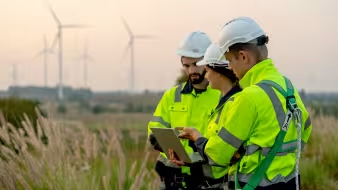
What does the global push for net-zero emissions mean for the workers — and the immigration systems — that make it possible?
Many countries need more workers to fill jobs in clean energy and other sectors that are critical in the fight against a warming planet. Immigrants may be one part of the solution to the challenges posed by climate change. But governments have been slow to ramp up responses to recruit, train, or accredit foreign-born workers necessary for the green transition, with one model estimating a shortage of 7 million green workers globally by 2030. This episode discusses the labor picture and global trends in green sectors with Kate Hooper, a Migration Policy Institute senior policy analyst who focuses on global labor migration.
- Keywords
- Workforce & Vocational Training International Cooperation Economy Credential Recognition Climate Migration
- Region
- Europe
- Countries
- Germany United Kingdom
- Speakers
-
Kate Hooper
Senior Policy Analyst

Julian Hattem
Senior Editor, Migration Information Source