What Does It Take to Increase Refugees’ Access to Education and Work? Insights from Ethiopia
Part of The World of Migration
This transcript was generated using AI and may contain inaccuracies. If you notice an error, feel free to email [email protected].
CHAPTERS
[00:00:00]: Ethiopia's refugee inclusion pledges’ strides and shortcomings
[00:02:14]: The education gap between refugees and host communities
[00:05:52]: Why Ethiopia moved to integrate refugee schools into the national system
[00:13:38]: Why refugees still cannot work despite a law granting them the right
[00:17:39]: Why the industrial park initiative failed to deliver jobs
[00:27:24]: What international actors should prioritize to improve refugee inclusion
TRANSCRIPT
[00:00:03.01]
Hi. Welcome back to World of Migration, a podcast from the Migration Policy Institute that delves into interesting topics on immigration integration and humanitarian protection with some of the world's big thinkers, policymakers and researchers. My name is Camille Le Coz. I'm your host today and a Senior Policy Analyst at MPI International Program and an Associate Director at MPI Europe. And in this episode we'll take a dive into the refugee situation in Ethiopia, looking more specifically at refugees' access to education and livelihood and what has changed in the past decades. In 2016, Ethiopia was one of the countries that made new pledges regarding the social and economic inclusion of refugees, committing to improve access to the formal labor market and to facilitate refugees economic inclusion. With my guest Abis Getachew, we'll discuss how this has played out and what recommendations we can draw for Ethiopia for other refugee situation around the world. Abis is a researcher on forced migration and has been working this field for over 10 years. He's a Research Associate at the German Institute of Development and Sustainability as well as a researcher at Meraki Labs and also at the Refugee-Led Research Hub Abis.
[00:01:21.22]
Welcome.
[00:01:23.00]
Thank you Camille.
[00:01:24.01]
Thanks. So Abis Ethiopia hosts over 800,000 refugees and asylum seekers, mainly from South Sudan, from Somalia, from Eritrea, and the vast majority lives in refugee camps spread across the country, while around 70,000 have settled in the capital Addis Ababa. I should also say that Ethiopia counts around 4.2 million internally displaced people known as IDPs. But today will be focusing specifically on the refugee situation and not this broader issue of IDPs. And first I wanted to talk about the access to education for refugees. Children account for a large proportion of the refugee population in the camp. And I wanted to ask you what is the situation there? Do refugee children have access to schools in the camps or outside the camps?
[00:02:14.09]
Thank you, Camille. Maybe we have to divide this question into different subcategories of school like preschool, primary school and secondary school. And in the preschool there is a more access and in the primary there is-as it goes to primary and secondary school it gets lesser and lesser, especially with the girl students. Now when we see access to education for the refugees in general, in primary school and secondary school, it is almost less than 50%. And when it comes to the host community which is closer to 97%. So when we see this gap between the access of education.
[00:02:57.21]
So just to specify abyss, when you say host communities, you're talking about Ethiopians who are living next to these camps, right?
[00:03:05.19]
Correct. Yeah, yeah, exactly. So now the refugees have less than 50% of access to education, Whereas Ethiopians who are living next to the refugee camps have access to education more than 97%, which is close to 100%. So in order to bring this gap, in order to close this gap, the government, even the East African countries, governments of East African countries have came together with a Djibouti declaration, which is a declaration that states education of refugees should be handled by the government. So Ethiopia is one of the East African countries that had a parallel system. A parallel system is a system in which refugee education governance is separate to that of the national education governance.
[00:04:02.04]
So Abis, in other words, on the one hand, you had schools in the refugee camps for refugee children, and then you had schools outside for like Ethiopian school with an Ethiopian curricular.
[00:04:12.11]
Exactly. The curriculum is the same. However, the governance is different. The Ministry of Education that goes to the regional, to the provincial education bureaus, and that goes all the way to the local administration education bureaus. They are responsible to handle Ethiopians' education. And refugee education is not included in the governance of the Ministry of Education, whereas the refugee education is handled by the UNHCR and other international and local non-governmental organizations.
[00:04:45.13]
So we had these two systems. And now you're saying that there was this Djibouti declaration and that the government of Ethiopia committed to do something else.
[00:04:53.23]
Correct. So the government of Ethiopia decided to bring the refugee education under the governance of the Ministry of Education. So this was clearly stated by the Djibouti declaration, a declaration in which East African governments have decided that refugee education should be handled by the national government. And Ethiopia is one of the signatories of this declaration. So now this declaration started to be implemented in 2017. So after 2017, of course, there are so many changes in Ethiopia, especially with progressive legislation that passed as a refugee proclamation. So according to this proclamation, what has happened is refugee education was handled by the government and it has given more access to refugees, especially for the refugees, right to education and work.
[00:05:52.00]
Can you explain a little bit, what was the incentive? You know, what you're describing is a major change in the policies rolled out by the Ethiopian government. Why did the authority take the steps to better include refugees in education?
[00:06:06.19]
Exactly. Because the number itself speaks. The access to refugee education was less than 50%, whereas the access to education for the Ethiopians in general, it is more than 100%. So even access to education for the Ethiopians who are living close to the refugee camps was way more than that of the refugees. That's why the government had a plan and had initiative to bring the governance of refugee education to the national, to the national system-to the governance, o the national system (of) governance.
[00:06:46.11]
But, but so the idea was to improve the education situation for both refugees and the Ethiopians living nearby, right?
[00:06:55.10]
Correct. Exactly. That was the plan.
[00:06:58.02]
And, and how...
[00:06:58.22]
How's this work?
[00:07:00.06]
When it comes to the ground, it brought that component of quality because refugee education and in the camps was well known by quality and not by access. So the access is less, but the quality was better.
[00:07:15.21]
Why was the quality better?
[00:07:18.13]
It's a good question. First, it's because the fund that was coming was not coming through the government. It doesn't pass through bureaucratic systems. However, it goes directly to the INGOs and it goes directly to the local NGOs. So there was less bureaucratic path for the firms, and that was the reason for the quality of education. And the reason why access was less has also several reasons of the cultural issues of the communities of the refugee communities, especially not allowing some children to send to schools and rather to keep them to work at home. So there were actually different reasons for that.
[00:08:05.10]
All right, so you were saying the quality of the school in the refugee camps was better, but then have they merged with the local school managed by the Ethiopians?
[00:08:18.02]
Exactly. Now when the government starts taking care of the schools, now the funds are not coming from the donors directly or from the NGOs directly to the schools, but now it's coming from local, immediate local administrators or to the lower level of administrations, that is, that are called Woreda's. So from the Ministry of Education, funds go to the regional education bureau, which is a provincial education bureau. From the provincial education bureau, it goes to the lower administration, which is a zonal. From the zonal it goes to the Woreda. So it passes all these bureaucratic. Exactly through that long journey, the fund gets less and less. And normally there is an attitude from the refugee students that the quality of the host community schools is not as good as the refugee schools, because the refugee teachers, teachers who are teaching the refugees, were getting a better payment compared to the host community because the funds are coming directly from the donors. And also the monitoring of the teachers in the schools was much better compared to that of the host communities, to the schools that are managed by the government. So now this action to bring schools into the hands of the government became less popular, both by the host community, by the Ethiopians and by the refugees.
[00:09:56.12]
What was a critique on the side of the Ethiopian? What was the concern on their part-
[00:10:01.11]
from the Ethiopians point of view? There are so many gaps into the education system of the Ethiopians that the government should take care of the Ethiopian education instead of adding up into the education of the. Instead of handling refugee education. So there is a politics, it's a political question that why aren't we get, you know, the, you know, the right attention or the right focus compared to that of the refugees? So that is a question from the Ethiopian side and from the refugee side. There is a, an attitude that whenever the government is taking the management of the schools, then the quality of education is going to decline like the host community's. So, because of this attitude, both the host communities and the refugees, so
[00:10:56.24]
a lot of tension around this issue. And I mean, you've seen this program, as you've said, since the implementation of this Djibouti Declaration. How have international actors like the World Bank or their development agency been helpful in this process or try to promote this integration?
[00:11:17.05]
The international organizations such as the World Bank is one of the key stakeholders in the implementation of the Djibouti Declaration, especially in supporting the government to bring, like, to add. To support the refugee education and to handle the refugee education as its own project. So the international community has supported. And at the same time, when the schools that were taken care by the government, because so far there are about four schools that are being administered, are being transferred from the NGOs to the government. So now when these schools are taken care of by the government, now the donors are getting, are neglecting these schools and are neglecting in general the refugee education. So, that, you know, as the government is taking care of the schools.
[00:12:13.04]
So you would say there is a sense that one, you know, once the school have transitioned, then they don't get as much support and attention that they had previously. And this is creating this type of mistrust that the international community donors are here to support.
[00:12:32.02]
Exactly, exactly. Now all the support is coming through the World Bank channel and the World Bank is communicating at the federal level. And when it comes at the grassroots level, the impact is not seen who is supporting which education and so on. So this creates a grief amongst the grassroots level of the community, both in the Ethiopians and the refugees.
[00:13:00.00]
Thanks for that. And I want to move also, you know, there is this pledge to expand access to education. We've talked about some of the tension around it. But at the time, you know, in 2016, the Ethiopian government had also made (a) big commitment in another area, which was to increase refugee access to the labor market. And on paper, refugee have the right to work, but in practice, again, we've seen it's been much more challenging. So first, can you explain us Abis, what is the actual policy for refugees in Ethiopia when it comes to working in the formal sector?
[00:13:38.24]
One of the difficult things, actually, let me take you back to the education. One of the difficulties in the education system, especially in the refugee education system, is a lack of role model or lack of having a role model amongst refugee students. This is because refugees are not allowed to work. Even if the 2019 Proclamation 1110 Proclamation clearly mentions that refugees are allowed to work. But the directive following the proclamation doesn't allow them, allow refugees to work.
[00:14:15.24]
So.
[00:14:16.07]
So under this, there seems to be
[00:14:18.21]
a disconnect between different text issued by by the government. Is that, is that correct? And how do you explain it?
[00:14:26.03]
Exactly. Like, the most governing law of the country is the constitution in Ethiopia. So following the constitution, there is a proclamation. So this proclamation shouldn't be in conflict to that of the constitution. And following the proclamation, there is a regulation and a directive. Now, following the Refugee Proclamation of 2019, there is a directive for the refugees right to work. But this directive is in contradiction to the Proclamation of 2019. So the 2019 Proclamation clearly mentions that refugees are allowed to work. But the directive mentions that the employer of the refugees should have to bring an evidence that the position should not be filled by an Ethiopian. And this is simply saying you cannot work because refugees came come to Ethiopia fleeing conflict and crisis, different crisis. And Ethiopia had an encampment policy for more than a decade.
[00:15:35.09]
Can you just explain what is an encampment policy? Well, what does that mean concretely?
[00:15:39.18]
Encampment policy is keeping refugees within the camp and not allowing refugees to go out of the camp, which makes it difficult and look for a job. To look for a job and also to have an experience of the outside world out of the camp. So in order to go out of the camp, there was a strict policy for the refugees. So initially the idea was to protect the refugees, that they will not go out and will be attacked. And also nobody will come in and will attack them. So initially it was for the sake of protection, but at the same time it is harming them, not to expose them. Exactly.
[00:16:19.09]
Abis, allow me to interrupt you is that I didn't make a mistake. The 2016 pledges, there was a pledge to allow refugee to work, right? I did not get that. -- In 2016 Ethiopia was committing. Right?
[00:16:34.22]
Exactly.
[00:16:35.10]
Okay.
[00:16:35.18]
In 2016, Ethiopia was committing to include refugees.
[00:16:41.11]
--A right to work
[00:16:44.01]
into the industry park. But that pledge was included into the proclamation in the 2019 Proclamation. So Ethiopia adopted that as a law by the parliament. By the national parliament.
[00:16:55.20]
Okay, okay. As with education, there's been a role for international actors to support refugee labor market integration. And we've seen how challenging this has been with this legal framework. And this has involved the small scale initiatives, vocational training, but also more ambitious project like the Ethiopia Compact that establish industrial zones where refugees, Ethiopian workers, can find opportunities. But here again it seems like the promise has exceeded reality so far. Just a small number of refugees started to work in this factory. Can you tell us about what this initiative was and what have been why it has had so limited results?
[00:17:39.02]
Number one, Ethiopia is a country of, a country with structural unemployment. So it's hard to find employment. We can tell, we can say that unemployment is an issue of not only refugees, but also for the Ethiopians. That's something that has to be noted. But when it comes to refugees access to work into the industrial parks, mainly the pay, the compensation that the industry parks were paying, were very low.
[00:18:15.09]
Can you explain?
[00:18:16.14]
Ethiopia has also-
[00:18:17.21]
Sorry Abis, can you just explain what was the idea with this industrial park? It was to set up industrial park where exactly?
[00:18:25.20]
For example, some of the industrial parks were about like 250km out of Addis and very far away from the camps. So number one, refugees should have to get access to these camps to go out of the camp. Access out of the camp and they have to relocate to the to these parks. And they were allowed to work but the compensation is not enough in which, when they are out of the camp, they do not have access to food ration, they do not have access to housing. So they have to finance themselves. So, the money that they are getting paid doesn't allow them to fulfill these basic necessities of food and house rent. And so because of this, and-were people aware-it's simply filled.
[00:19:18.03]
We're also people aware of this opportunities where and you know, did they have those skills? How you know, how could they get recruited?
[00:19:26.19]
Exactly. The recruitment was taking place even from the camps. So when refugees were relocated. Actually, the Ethiopian government has also been advertising for the like inviting foreign investors by saying that Ethiopia is a country of cheap labor so that you can come to the country and you can get an access of cheap labor. Which was under a question. So refugees were also victims of this advertisement and it didn't sustain because they had access to these jobs. But after two months, three months, four or five, then they know that they are not, they are not financing themselves with their basic necessities, leave alone saving and changing their lives in, you know, going to their dreams. So this was almost getting impossible. So most of them, they went back to the camps in which they have access to food ration and housing as well.
[00:20:31.06]
We've seen the limitation of this compact, of this initiative with this industrial zones. Is there any place that labor market integration project are working in terms of vocational training, entrepreneurship support? What has worked for refugees but also for host communities?
[00:20:50.15]
Yeah, for example, the agricultural projects that were taking place in the Somali region in Dollo Addo zone were very effective. This is a project that was financed by the IKEA foundation and it brings the host communities and the refugees communities together to farm, to engage into the farming projects. And that is a project that is very successful.
[00:21:22.21]
Why were they so successful then?
[00:21:24.23]
Yeah, the reason why they were successful is, number one, they have been highly supported by international NGOs and by UNHCR. And that support was strategic support and that strategic, in a sense they were highly engaged and they were highly together. And there has been a daily, almost a daily follow up between the INGOs, experts from the INGOs and the farmers themselves. So this was a very effective one. And the other examples that we can take is also the electricity grid project that refugees are working on. So that is also a demand-driven project.
[00:22:13.01]
And why, why was it successful? Ben?
[00:22:15.13]
Yes, both the electric grid and the agricultural projects were demand-driven. So they were demanded by the community and primarily they were demand driven. And at the same time there was a close relationship between experts from the international NGOs and local NGOs or with the engineers that are working on the electric grids, solar electric grids. So such collaborations and such follow ups and trainings, like on the job trainings, allowed, allowed the, allowed the refugees to be successful in these projects, both the refugees and the host communities, successful host communities living around the camps.
[00:23:02.10]
So here, there was a good relationship between the refugees and the communities living around. But as we know in many countries, labor market integration is often like the one, the top divisive--divisive topic. And it can create tensions. And here I want to zoom in on the situation in Gambela, which is a region where there has been this conflict between host and refugee community. And here I want to maybe if you can tell us a bit about what these experience show about the viability of livelihood program and what, what other types of intervention are needed.
[00:23:45.09]
Thank you for raising this question, Camille, because the successful projects that I was telling you earlier are both in the Somali regions. When we come to the Gambela region now the story is a bit different. Even when the proclamation in 2019 comes that allows refugees access to land and access to work, primarily the rejection comes from the Gambela region. The reason why it came from the Gambela region is because it has its own history. During the Cold War period during the Derg region, while Ethiopia was has been under the Derg region. Ethiopia has been supporting the freedom fighters of the SPLA and has been hosting John Garang army, John Garang's army in Gambela region.
[00:24:35.14]
Can you just explain what is the SPLA?
[00:24:37.20]
SPLA is Sudan, Sudan People's Liberation Army. So it is a South Sudanese Liberation Army.
[00:24:47.24]
What have been the effect on, on the situation in Gambela between. How is that having an impact on the relationship between refugees and communities in Gambela today?
[00:24:59.13]
So when the army, when the SPLA, Sudan's People Liberation Army had an opportunity to be hosted by Ethiopia, most of the refugee camps in Ethiopia have been hosting, have been a military base almost and they have been recruiting even Ethiopians to fight on behalf of the South Sudanese as well. So because of this reason Ethiopians, Ethiopian Nawaars and Ethiopian Anuaks, Anuak is a tribe that is in Ethiopia, largely in Ethiopia, but minority in South Sudan. These tribes, they do not have a trust in the current South Sudan government because they have been recruiting some soldiers from, from Ethiopia. So whenever there is a kind of integration topic coming from the government that refugees are going to have access to land and other economic opportunities, there is a big question mark. Yeah, there is a big question mark that that time is going to come and they are going to be under attack.
[00:26:12.23]
I see.
[00:26:13.11]
So there is such a fear.
[00:26:15.13]
So we see in the end, like a lot of these efforts are going to have different results, are going to be welcomed differently by the communities. Also based on where the refugee come from and what have been their history with a country on the other side of the border. So I've asked you a lot about international actors and the reason why this matters is because multilateral development bank like the World Bank and development agencies or foundation like you mentioned, the Ikea Foundation, they have the resources. They have the resources and they've deployed a lot of effort to help improve situation in low and middle income countries that are host to the world's largest refugee population. And to conclude our conversation today, I wanted to ask you if you were to speak to these major players, what are the top two or three recommendations you would have? What are the two or three things that they should be prioritizing in order to improve the refugee inclusion into the classroom and in the workplace?
[00:27:24.24]
First and foremost, it is good to influence governments. For example, when the government is having, you know, like, when the government is not allowing refugees not to work, like is not allowing refugees, like is denying access for the refugees not to work, of course there has to be an influence to the government, but sometimes it's very important on what areas to influence. Because now if we take for example, access to education, we have to see the history, we have to see what has been on the ground. So on the ground, Ethiopia had two systems of education governance. The refugee education has been governed separately to that of the Ethiopian, to that of the Ethiopians' education. So now all of a sudden, when it comes, you know, to a, one system governance, it's going to mess up so many things. So I think the international community-exactly. It takes time. And so, you know, like within five years or within three to five years, you know, implementing like or transiting from two system governance to one system will mess up so many things. And as we are witnessing at the moment there it is even creating a conflict between two government offices, even so.
[00:28:58.21]
So it is very important to see what has been happening as well. So this is one of my recommendations to the international community.
[00:29:10.14]
Thank you for that and thank you. Thank you for tuning in to another episode of World of Migration. If you enjoyed this conversation, please check out other episodes. You can find World of Migration wherever you get your podcast. And while you're there, please leave us a review and you can find all the episodes for this and other MPI podcasts at MPI website migrationpolicy.org/podcast this episode was produced by Daniella Espacio and made possible with help from Lisa Dixon and Julian Hattem and editorial input from Michel Mittelstadt that her theme music is called Bright Idea by Geographer. I'm Camille Le Coz. Thank you again for listening and see you next time.
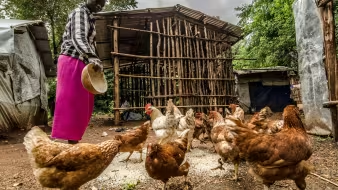
Ethiopia made sweeping promises to integrate 900,000 refugees into schools and workplaces; what changed on the ground?
In recent years, the Ethiopian government has pledged to increase access to education and employment for the more than 900,000 refugees living in Ethiopia, most in camps. There have been ups and downs along the way, but a few key trends have emerged. In this episode of our podcast, Migration Policy Institute Europe Associate Director Camille Le Coz speaks with researcher Abis Getachew about the major policy shifts to open classrooms and jobs to refugees and whether they have been successful.
About the Global Program
The Global Program bridges policy advice, research, and candid dialogue to design effective migration policies, drawing on global evidence and anticipating the forces reshaping how people move.
- Region
- Africa (Sub-Saharan)
- Country
- Ethiopia
- Speakers
-
Camille Le Coz
Director, MPI Europe

Abis Getachew
German Institute of Development and Sustainability, Refugee-Led Research Hub, and Meraki Labs

Related Content