A Passport to Opportunity: The Importance of Refugee Access to Travel Documents
Part of The World of Migration
This transcript was generated using AI and may contain inaccuracies. If you notice an error, feel free to email [email protected].
CHAPTERS
[00:02:37]: What getting a refugee travel document looks like
[00:09:46]: What challenges other refugees face accessing and using travel documents
[00:14:12]: Why refugee travel documents are often not recognized at borders or by visa officers
[00:18:43]: What refugee travel documents should look like in an ideal system
[00:20:45]: What states should commit to at the Global Refugee Forum—and what needs to change
TRANSCRIPT
[00:00:04.04]
Welcome to the World of Migration, a podcast from the Migration Policy Institute that seeks to spotlight interesting trends, policy developments and voices on myriad aspects of immigration around the globe in ways that go beyond the headlines. My name is Susan Fratzke and I'm a Senior Policy Analyst with MPI. For today's episode, we are talking about an essential aspect of international travel that any of us listening who are citizens of the United States or Europe can see as an travel documents. We all bump up against the need for a passport or another kind of travel document when we have to cross international borders. But anyone who has ever lived abroad for any length of time knows that travel documents like passports are also very necessary to get a visa or register with local authorities in the country where you might be studying or working. And eventually, of course, you need a travel document to return to your country of origin. When many of us encounter these situations, we simply hand over our passports without a thought. But for someone who is a refugee, the situation is often much more complicated. For a refugee who is living in a host country and wants to travel internationally for school, school or to work, or even to see family and friends abroad, it can be extraordinarily difficult to get any kind of travel document, let alone a passport.
[00:01:30.03]
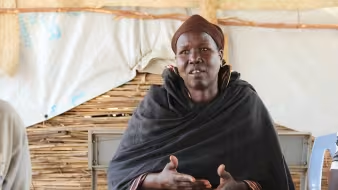
There are many reasons for this that range from policies in the host or destination countries to how travel documents themselves are issued and read at border crossings. To help us dig into these barriers and understand what can be done to address them, I'm delighted to be joined by two guests today. Today first we have Adhieu Achuil, who runs MonyQadow, a woman and refugee-led organization in Kenya. Adhieu has first hand knowledge of the importance of refugee travel documents. She traveled on one herself in 2019 and she works with fellow refugees now to access higher education opportunities and access travel documents if they need them. Welcome Adhieu.
[00:02:10.10]
Thank you so very much, Susan. It's my pleasure to be able to speak about the challenges and the thing that refugees face to be able to move from one country to another another one.
[00:02:19.19]
Second, we have Jackie Keegan. Jackie is Deputy Director of the Division of International Protection at the UN Refugee Agency, commonly known as UNHCR. She is responsible for resettlement and complementary pathways.
[00:02:32.02]
Welcome Jackie.
[00:02:33.23]
Thank you. It's a pleasure to be here.
[00:02:37.07]
So I want to start off by asking you Adhieu about your experience getting a travel document as a refugee. We know that there are many reasons why someone might need to travel internationally for study or for work. Could you begin by telling us why you needed to travel?
[00:02:52.08]
First of all, being in a refugee camp we have restriction of movement. So personally I needed a refugee-that is, conventional traveling document for refugees to be able to go outside the country, maybe to attend some of the international conference, that is youth conference or refugee organization conferences, and some they also need it for education. But personally, at the first place, in 2019, I wanted to have conventional traveling document so that I can attend the Global Refugee Forum that happened in 2019. So that was my first time that I had applied for, I applied for the conventional traveling documents.
[00:03:33.12]
And what was the process of getting a travel document like?
[00:03:37.12]
So the process of getting a conventional traveling document for the refugees was not that easy. Personally, it was a bit frustrating because if I wasn't invited by the UNHCR, it could have taken me almost two years to be able to have an access to the traveling document. So personally, because it was the UNHCR that invited me to the Global Refugee Forum, it wasn't that easier. It wasn't that much hard. It was a bit easier, but it took three months for me to be able to get it. So I had to apply. I also have to look for one of the host community or a Kenyan person be able to send, write a recommendation about me and also wait for three good months so that I can be able to get to to to so that the government can be able
[00:04:20.01]
to issue it to me.
[00:04:21.19]
So it was a tiresome process. It was frustrating at the first place.
[00:04:27.09]
And just to clarify, you needed to go, you said you needed to go to UNHCR and the host country government to get the document you weren't able to travel on on the passport of your origin country, right?
[00:04:40.22]
Yes. As much as I was invited by UNHCR, there's no way that I could have traveled with my passport from my country. But again, I never had any passports. So the only thing that I had was the refugee alien card. And then now I had to support my alien card with the conventional traveling document to be able to access other borders within Africa and outside Africa.
[00:05:06.11]
Jackie, I want to turn to you now. From your perspective at UNHCR, is the experience that Adhieu is describing common? So she mentioned having to go to both UNHCR and to the host country government and then wait for several months. Is that usually how this process works?
[00:05:26.13]
Certainly how it's worked in the past when travel documents were were issued on the basis of pre printed documents that UNHCR brought and then the government would validate on the strength of refugee registration. The process would have been very cumbersome and certainly would have included those two steps. More and more travel documents are issued directly by government authorities, by state authorities, through the same mechanism that issues passports to nationals. This new mechanism is, is not in place everywhere. It's only in place in, in a small number of countries at the moment. But it is certainly the way that we'll have to go as we move towards more machine readable documents and so on. The challenge I think that refugees have faced up until now and, and including now in many places is that they had to justify the need for travel, that they had to come up with a reason that was somehow acceptable to whether it was UNHCR or States or anywhere else, rather than working, all of us working on the presumption that refugees have the same rights and, and opportunities potentially as others, and that they should be able to for the payment of a fee and the, the normal waiting time for a document in that country, they should be able to access a document that will allow them to take up those opportunities.
[00:06:42.16]
So that's a, it's a shift in mindset as well as a shift in the sort of technology and systems that are now in place in the modern world.
[00:06:50.15]
So Adhieu mentioned that it wasn't actually possible for her to use a passport from the, the country she was from to travel. Could you explain a bit about why? Why that would be, why it's not possible for a refugee to travel on their home country passport.
[00:07:09.06]
So refugee by definition has had to leave their country and seek the protection of the international community of a country of asylum against being forced to return home to where their life or free and may be threatened. And while in the country of asylum, generally speaking, they would have documents that would allow them to remain there. But in order to take up work or study or family or leisure opportunities elsewhere, they like everybody else needs a travel document. That travel document needs to prevent them from being inadvertently returned to their country of origin, to the place where they may be in danger. So as of 1922 different forms of travel documents have been issued throughout the last hundred years which have been essentially valid for every country subject to visa except the country from which the person came. In 1951, the Refugee Convention provided a model document. But of course with technology and time and more interest in security and more capacity to manage security through digital identity, it has become important that states issue a machine readable travel document and that refugees are able to be moved through the system in the same way as non refugees.
[00:08:32.12]
And so therefore states need to issue refugees travel documents in the same way that they issue travel documents to their own citizens and to diplomats, etc.
[00:08:43.01]
And you mentioned needing to go to both UNHCR and the host country where she was living. Who is actually responsible for issuing the travel documents? Is that something UNHCR does or is that the host country government's responsibility?
[00:08:59.21]
No, states are responsible for travel document issuance and have been since the 1940s actually. But UNHCR, prior to the days of the machine readable the biometric travel documents, UNHCR used to print the documents themselves, which states would then use by validating them by putting in the refugees data and so on. So the document would still have been issued by the state. But UNHCR had a role in that. And therefore because the documents were limited, they were quite expensive and they came for free, people would need to go through UNHCR to apply for the first step in the process. That really shouldn't be necessary. Refugees should be able to go through a procedure that is at least similar to the procedure that is used by the nationals of the country of of asylum.
[00:09:46.24]
So Adhieu, coming back to you, you also work with other refugees helping them access travel documents. What experiences have you seen with
[00:09:59.20]
the
[00:10:00.02]
others who you work with? What challenges have they faced in actually accessing travel documents?
[00:10:05.14]
So mostly I help students to have a traveling document that is a conventional traveling document for the refugee.
[00:10:12.06]
This.
[00:10:12.22]
So it's a bit quiet heavy and also challenging for it for me to be able to, to help these women and the students to, to have such. So for instance, if it was facilitated by UNHCR, it will be a bit easier. But now coming out because I'm not the, I don't work for UNHCR, it's a bit hard because sometimes you have to justify the reason why you need. They need this traveling document number one. And then number two, they had the government have to verify the justification or the reason to traveling
[00:10:43.18]
outside of the country.
[00:10:44.14]
Let's say it's about education. So once you have an admission, admission is not enough to be able to give once a traveling document what they do also they have to contact the school which may take time because whoever is in charge of admission is not the person who is in charge of finance or whoever is in charge of finance is not able to to be in charge with the scholarship. So it's become a chaotic scenario whereby somebody has to postpone their semester because basically then they're waiting for their traveling document to be issued. Another problem is validity of that passport or validity of that traveling document. Let me put it into that... So this, this traveling document may be valid for two years to which the studies is four years. So one has to go to for country or where they're going to study. Let's talk an example. We have so many students who have gone to Costa Rica, that is South America, for Earth University sponsored by the MasterCard foundation and others in Rwanda at Africa Leadership University. So they have to go and spend two years and come back to Kenya so that they can be able to renew.
[00:11:47.20]
And the process from day one to the renewing is still the same. You have to justify yourself. You also need to know why. So it's become a challenging for them also to come back and renew this traveling document. So the process is from the beginning to the end. You have to like there's a bit of obstacle before getting that traveling document.
[00:12:14.03]
So you and, and the students that you work with and you've actually used the travel documents to, to travel from one country to another. Have you run into or seen any difficulties in terms of actually getting the document recognized at the border?
[00:12:29.20]
Yes. One problem that refugees face is the recognition of the document. Last year we had this scholarship called Ashinaga Scholarship in USA. These students were able to obtain conventional traveling document. Now but applying for the visa at the United States of America embassy was an issue because they said that you are a refugee going to U.S. going into USA. What assurance do we have that you will get back to your country after the education? So this person had to sign a concert form. But still they were not convinced. You know. So again there's some other states that don't recognize the refugees traveling document. Let's talk of the Arab world. During the the World cup we had delegates from refugees community from Kakuma to go and attend the World Cup. They were denied saying that our government does not recognize such passport. Another challenge that I know is for instance, even within the African countries like Ethiopia, they don't recognize such traveling documents. So it's a big challenge whereby borders and communities and societies are not opening their borders and they're not welcoming refugees into their country because they're not actually recognizing their traveling documents. So this traveling document, it acts as a passport for refugees.
[00:13:51.04]
We have no any other passport from apart from that. But still as much as it's a traveling document, it seemed like it's a traveling document with limits. It's not just like the, any other traveling document that anybody can obtain who is not a refugee. So we don't understand is it the status of a refugee or is it the passport itself or the traveling itself that is bringing issues.
[00:14:12.05]
Jackie, I want to turn to turn to you to maybe put some of the challenges that Adhieu has mentioned into context. She mentioned a couple of different things. One was that travel documents often are issued for a very short time period, time period, maybe only two years, which may not be long enough. And she also mentions of course, that travel documents might not be recognized by the embassy that's issuing the visa or, or even recognized when you actually try to cross the border by the border officers. Why is it that in practice it can be so difficult for refugees like Adhieu or the students she's working with to actually use these travel documents and travel on them in practice?
[00:15:00.00]
There are many, many reasons. These are three really solid ones. But unfortunately there are many more than this. So the duration of the lifespan of a travel document issued to a refugee is indeed one of the things that we're working on with governments around the world to broaden and essentially to seek the same conditions as travel documents issued to nationals. I think one of the reasons of course, that states issue short term travel documents is that they are ever optimistic about the possibility that refugees may wish to go home, which, which refugees often share, right? We're all hopeful that people are able to go home sooner rather than later. But the reality is unfortunately that too many situations become protracted situations and the human beings involved, the refugees involved need to be able to make, make their plans on a longer term basis. So that's one of the areas of advocacy that we and others are really taking up with with states that are issuing travel documents. And I think that's, it's something to be honest, that is, that is going to be possible as more and more refugees access travel documents through the same mechanisms.
[00:16:03.01]
That there should be much less of this back and forth that Adhieu was talking about to seek to give reasons and to seek eligibility. Refugees will need to pay for travel documents on the same basis as everybody else. But once they're entering into that system, they should have the same access to it without discrimination. Why would the not being recognized by the issuance of visas, right? For the issuance of visas by countries that are deciding who can come. I think there are lots of different reasons, but the reality is that visas are issued to potential travelers on the basis of a set of criteria. And where a refugee, for example, cannot demonstrate through a travel document that provides for return to the country of asylum, then that's going to raise a flag for lots of countries issuing visas whereby the person will not be able to be given a visa because there's a fear that they will in fact then seek asylum and try to remain through the asylum seeking system through the refugee international protection system. What we're trying to do is to work with states on establishing travel documents that are going to hold that, that confidence that the refugee will be treated the same way as nationals of the country of asylum.
[00:17:18.13]
Which means that if a refugee travels anywhere else in the world, if a refugee travels from Tanzania to Kenya for study, then at the end of their period of study that they would then be able to, to go back and they would, they would commit to going back to Tanzania in order to then follow on with the rest of their lives. That requires a bit of trust between states. And the travel documents issued to refugees need to demonstrate that, that trust. So it'll take a little bit of time for that to happen, I think. But, we're certainly working on it. With regard to recognition at borders, it can be really as simple as the International Civil Aviation Authority worked together with states around the world to establish a set of standards for what travel documents look like today. And what I talk when I say machine readability, there's a whole host of requirements for a travel document to meet those standards. So if a person is attempting to travel on a document that doesn't meet them, then very likely they just won't fit in through the machines at the airport. So you know, they will then be blocked from travel because they don't come up with the security mechanism.
[00:18:15.20]
Even if a visa was potentially available, if they're not recognized by the border control officials, then the person won't get in. And again, this is really what we're trying to do with states around the world to issue travel documents that are in conformity with global standards and that in fact are recognized as a document issued by that state. Even though they're not offered to a national of the state, they're offered to a refugee who comes within that, that state's international protection.
[00:18:43.13]
So how would this all work in an ideal world if everything was working in the way that, that it should be? From your perspective at UNHCR, how would a refugee actually access, access a travel document and use it to travel?
[00:18:58.05]
There are countries of course, that issue machine readable travel documents to refugees. Ghana, Zambia, Uganda, Kenya, lots of countries in Africa, countries certainly throughout, throughout Europe and the Americas. You know, Rwanda has a fantastic example where if you go onto the Rwandan government's application for passport page, it's under Foreign Affairs. It's not under any sort of refugee authority. You seek a travel document and there's a button to click, are you a national or are you a refugee? And you click on refugee, and then you go through the process. So refugees would have a transparent way of entering the application system that they would be treated by the government on the same basis as everybody else. Criteria would be applied, and then they're able to pay a fee and move on. And obviously, if UNHCR is asking somebody like Adhieu to attend a conference, then UNHCR may opt to pay for that. An employer may opt to pay for the travel document and the visa in the same way that many employers often pay for documents as people are traveling around the world. But the rules would be the same and they would be clearly articulated, and refugees would be able to seek redress if they were treated differently from their neighbors.
[00:20:05.01]
So travel documents are one of the items on the agenda for the upcoming Global Refugee Forum in December. And the forum will be convening states, refugees, civil society, UN agencies, all to make commitments in support of refugees that are in line with the Global Compact on Refugees. I wanted to close by asking both Jackie and Adhieu what you think states and other actors should be committing to at the forum, specifically with regard to refugee travel documents. Adhieu, maybe I'll come to you first. What should be on the agenda at the forum to address some of the challenges that you've outlined?
[00:20:45.23]
So my recommendation for the society, civil societies and private donors and all this, the host communities that are hosting refugees will be like, if they can actually try to have a longer period on the conventional traveling document, like validity of that, instead of having two years, then they could make it five years. Number two is about the challenge of accessing this conventional traveling document. They shouldn't make it hard for refugees to be able to access it. That is that instead of us carrying so many documents, then this conventional traveling document should act as a passport. That is, a refugee can be able to use it to open a bank account. A refugee should use this for traveling document. A refugee should use it as an ID instead of having it as just a traveling document, which is just a document that can allow you to move only, but you cannot access banking bank as bank services with it. You cannot use it as an id. So it's like you have a traveling document, but still need a supporting document to be able to validate whatever you have or to validate the traveling document you have.
[00:21:58.00]
So the state should be able to commit to make sure that refugees will have an easy access to the document and refugees should able to use it not only for traveling, but to have a banking, to access banking services with it, like one in all, just like the way other nationalities have their passport. So it should act as passport and all the functional passport should come with it.
[00:22:22.05]
I like a juice list, so I'll build around that. I think, I mean, I think the first thing is the Refugee Forum is an attempt to bring, well, it's, it's so that we can bring states and civil society and academia and donors and host communities and so on all together and certainly with a whole lot of refugees in order to really ask the question, how can the international community support hosting communities around the world? We have four pillars of work, one of which looks at third country opportunities, but the second pillar is actually is looking at livelihoods. And in 2023, if you're looking for an independent livelihood, then movement for some reason, be it for long term employment or just in order to be able to seek goods to sell, may require you to cross a border. So inclusion of refugees in the national system that is established for the issuance of machine readable, fully compliant travel documents is just one of the different forms of inclusion in national systems that we're trying to achieve. We're trying to make sure that refugees are able to access healthcare and education and all sorts of other different mechanisms and then that those systems and services are supported by the international community.
[00:23:35.21]
This is just another one of those systems and services. In 2023, refugees need to have equivalent access to travel documents as any other human being on earth. And those travel documents need to conform to current standards of security and machine readability. They need to ensure protection against reforma or forced return to a place where their life of freedom may be threatened. They need to be of a duration that will allow for work and study visa application. They need to be renewable outside the country of asylum and they need to allow for refugees to return to the country of origin or, excuse me, the country of asylum, which will then allow them to maintain relationships with family who do not travel and which will reassure visa issuing authorities that short term visa issued under work study and other entry mechanisms are not in fact back doors into permanent stay. So those are, that's, that's quite a combination of things. But ultimately it comes down to non discrimination and to what, what is required for an ordinary life in 2023.
[00:24:34.24]
It's quite a long list of things that, that need to happen. Jackie, one final question for you. I mean what you let's say that we get to the forum in December and we get all of pledges for all of these things on the table from different actors. What would actually then need to happen in practice to see those pledges through on the part of either host governments, donors, UNHCR? What are the next steps?
[00:25:06.04]
So it's really about going country by country and having a look at where they are with their systems now and what they're doing to either improve or to, to continue to maintain their systems and then country by country to make sure that refugees are included. So if a country hasn't yet put in place a system for its nationals to have access to a machine readable travel document, then one hope would be that refugees would be included in that process. And so just as states need to issue documents to their nationals traveling on an ordinary basis to diplomatic groups, et cetera, et cetera, refugees would just be another type of document that would be issued and it would have some specificities, but basically it would be the same passport as anybody else. In countries where machine readable travel documents are already being issued, but there are not available yet refugee travel documents, it comes down to making a new template, organizing for a first print run and putting in place a system whereby refugees can apply for a travel document through the same mechanism or related mechanism to that that's used by national. Some of this, the barriers are going to be legislative, some of the barriers are going to be sort of a willingness more political and some of them is going to be financial.
[00:26:15.13]
So one of the things we can do at the forum is to, and we're really working on this in the run up. But certainly as we're working through this all the way up to December at the forum and, and of course beyond is to think about where there might be donors, where there might be actors who can, who can pair up, who can match up. You know, is there a company that is in fact issuing printing on behalf of a government the travel documents issued to nationals? Can they produce a template that a state might be able to use for refugees without charging the state? You know, is that a way of supporting the state with the work that it's doing to include refugees? And that's really the work we're doing country by country.
[00:26:56.17]
Thank you so much. Both I'll be watching eagerly in December to see if we make any progress on addressing some of these challenges. I think our conversation today has really touched on a number of different things that make the system difficult to work for refugees, among them being anything from the reluctance of states to issue travel documents to refugees without a reason to the difficulties and challenges actually developing resources to get documents printed and ensure that they're actually able to be read to, you know, ensuring that visa officers or border guards are actually able to recognize these travel documents and that the travel documents then have sufficient duration and validity to actually allow refugees to do the travel that they needed. Hopefully we'll see some some progress on on these pieces come December. But thank you so much for joining us today and allowing us to to get a better understanding of the challenges that the refugees actually face in making this work. So I want to thank both of our guests today once again, Adhieu Achuil, who runs MonyQadow, and Jackie Keegan, who is deputy director at UNHCR's Division of International Protection. The questions of innovative solutions to the challenges facing our global protection system is something that occupies a lot of our time, both for me and our colleagues at MPI and MPI Europe.
[00:28:37.07]
And I want to mention before I close that we're delighted to be partnering with the Robert Bosch foundation in Germany on an initiative called Beyond Territorial Making Protection Work in a Bordered World, which is thinking through some of these questions and trying to offer solutions. If you'd like to learn more about that initiative, please visit migrationpolicy.org/protection and I want to mention that in the next few months we will be releasing a piece looking specifically at this issue of Refugee Travel Documents, so be sure to check back. Thanks for tuning in to this episode of World of Migration. You can find all the episodes for World of Migration and other MPI podcasts on online at migrationpolicy.org/podcasts or find us wherever you get your podcast. Just search for World Migration and please do leave us a review while you're there. This episode was produced by Yoseph Hamid and Samuel Davidoff-Gore, and editorial input was provided by Michelle Mittelstadt. Our theme music is Bright Idea by Geographer. My name is Susan Fratzke. Thanks so much again for listening.
Refugees are among the most mobile people on earth by necessity, yet the international system makes it nearly impossible for them to travel legally.
Travel documents play an important role in international mobility, and for refugees serve as an essential gateway to a world of opportunities, from pursuing education and employment to reuniting with family. In this episode, MPI’s Susan Fratzke unpacks the complexities around travel documents and their pivotal role in refugees' livelihoods with Adhieu Achuil Kueth, founder of MonyQadow, and Jackie Keegan, deputy director of the Division of International Protection for Resettlement and Complementary Pathways at the UN High Commissioner for Refugees (UNHCR). Kueth shares her first-hand experience traveling on a refugee travel document and her commitment to aiding fellow refugees in accessing higher education opportunities. Keegan sheds light on the challenges refugees face in obtaining these essential documents. Tune in to learn more.
About the Global Program
The Global Program bridges policy advice, research, and candid dialogue to design effective migration policies, drawing on global evidence and anticipating the forces reshaping how people move.
- Topics
- Refugees & Asylum Education
- Region
- Africa (Sub-Saharan)
- Speakers
-
Susan Fratzke
Senior Policy Analyst

Adhieu Achuil Kueth
Founder, MonyQadow

Jackie Keegan
Deputy Director of the Division of International Protection for Resettlement and Complementary Pathways, UN High Commissioner for Refugees (UNHCR)