A Mixed Welcome: Haitian Migration within the Caribbean
Part of The World of Migration
This transcript was generated using AI and may contain inaccuracies. If you notice an error, feel free to email [email protected].
CHAPTERS
[00:04:39]: What Haitians find in the Dominican Republic
[00:07:15]: What Haitians find in the Bahamas
[00:10:05]: How civil society fills the gap governments leave
[00:15:50]: How a 2013 court ruling created a statelessness crisis
[00:21:46]: How Haitians reach the Bahamas—and what has changed
[00:29:40]: Xenophobia in the Bahamas
[00:36:20]: Is integration in the Dominican Republic improving?
TRANSCRIPT
[00:00:03.17]
Migration from Haiti has been a phenomenon for many years, but one that took new urgency after the devastating earthquake in 2010 that claimed the lives of more than 250,000 people, injured hundreds of thousands of others, and left more than 1.5 million homeless. The earthquake decimated an already struggling economy and infrastructure. Since, the attention has mainly been focused on the migration of Haitians to South America, primarily Chile and Brazil. And then around 2018, 2019, as these countries experienced their own economic downturn and governments became less welcoming to Haitian immigrants, a second movement of Haitians occurred through the Americas, passing through the Darien Gap and Mexico ultimately to reach the United States. What has been overlooked is that Haitians have also been migrating to neighboring countries in the Caribbean, where they have encountered several challenges. And another aspect that may have been overlooked is that the migration of Haitians we are seeing today is likely different from prior waves of migrants and may require special attention in terms of humanitarian protection. My name is Valerie Lacarte. I am a Senior Policy Analyst with the Migration Policy Institute, a nonpartisan research organization in Washington, D.C. that studies international migration trends and policies.
[00:01:50.15]
Welcome to the World of Migration, an MPI podcast that's dedicated to discussing many different facets of international migration. Each episode we sit down with an interesting thinker or two on migration and go beyond the headlines on a particular immigration trend, policy development, or other change that we think is interesting. I am delighted today to be speaking with Bridget Wooding, who is a researcher and Coordinator of the Caribbean Migration and Development Observatory based in Santo Domingo, and Louby Georges, who is an immigration consultant who heads the firm Consulting Beyond Boundaries, based in Nassau. We will be speaking about how the Dominican Republic and the Bahamas have dealt with the migration of Haitians. The Dominican Republic, of course, shares the island of Hispaniola with Haiti, the second top destination of Haitian migrants after the United States. According to the latest UN the United Nations data, they host about half a million Haitians in the Bahamas. The number is smaller, about 30,000, but this represents about 10% of the country's total population. By better understanding the policy response by government and actions taken by civil society and others towards Haitians in these two countries, we can get a better sense of the conditions of Haitian migrants in the Caribbean, especially as the conditions are further deteriorating at home.
[00:03:34.13]
Since the assassination of President Jocelerme Moïse almost two years ago, and even a little bit before that, gang violence, kidnappings, rapes have terrorized the local population, and this has prompted over hundreds of thousands of people to be displaced both internally and externally, and mainly from the capital of Port au Prince. So one question here is whether further unraveling of Haiti will lead to more exodus from the country and if so, how are neighboring countries managing these migrants who are fleeing violence in their own country? Bridget and Louby, thanks for coming on the podcast.
[00:04:22.05]
Thank you very much indeed, Valerie, for the introduction. Thank you for inviting us. Looking forward very much to this conversation around Haitian migration in the Caribbean.
[00:04:33.08]
Likewise, Valerie, thank you for the invitation. I am looking forward to a very fruitful conversation and dialog. Thank you.
[00:04:39.20]
Thank you both. I would like to start with you, Bridget, and ask, as I mentioned, the current situation in Haiti has likely prompted more migrants to go to the Dominican Republic, I suppose, are you seeing more people with humanitarian needs who are arriving in the Dominican Republic? And if so, what is the process for those who are seeking protection when they arrive there?
[00:05:10.08]
Yeah, I think it's an excellent question because as you mentioned, we've had several years of considerable instability from the pay lock when the country was practically shut down because of the Petrocaribe scandal, the pandemic, the assassination of the president, various disasters, natural disasters, cholera, and not to mention the violence recently from gangs, which has been also followed up by community kind of reprisals. So all this is creating a very difficult situation in Haiti. However, in the Dominican Republic there has not necessarily been, you know, a welcome with a lot of humanitarian protection. Even if we remember under the 2010 earthquake there was, yes, a six month kind of welcome, welcoming, but after that it was business as usual. Now in the Dominican Republic, we're with a situation where these humanitarian needs are not necessarily being recognized. So people are coming across and feeling a little bit between a rock and a hard place. On the one hand, difficult, insecure, too violent for them to stay in Haiti. On the other hand, coming to the Dominican Republic but with no clear channels for getting status as refugees there's not a tradition of that within the Dominican public for Haitians nor anybody.
[00:06:43.20]
And also with difficulties for accessing legal ways of migrating, legal ways of being able to work in the country, creating a very difficult situation for them. So in short, not a very welcoming situation from the Dominican authorities right now.
[00:07:07.23]
Thank you, Bridget Louby, how does this situation look in the Bahamas right now?
[00:07:15.03]
I will piggyback off of what Bridget would have just presented in describing the situation in Haiti over the past few years and even now here in the Bahamas. Listening, listening to Bridget, it almost sounds as if we're living in the same country because there's not much protection mechanisms in place in the Bahamas it's not very welcoming here in the Bahamas. For Haitians to gain legal status here in the Bahamas is very difficult. We see emigration raids. The topic of immigration is always one that is a hot button topic in the country for media personalities, whether it be social media, media, television or radio. It is a daily topic. And once somebody would present the word immigration or immigrant automatically in the Bahamas, we think Haitians. And as a result we've seen where the political leaders are pushed more so in a corner, whereas they may have the good intentions to assist Haitians. But however, we don't see it happening. The raids, as I would have mentioned earlier, continue to happen here in the Bahamas, all across the chains of the islands, especially in the capital and one of our other main islands called Abaco, which was recently hit in 2019 by a Category 5 hurricane, which was Hurricane Dorian, leaving countless persons homeless, leaving countless persons lost of life.
[00:09:01.08]
The loss of life, however, has not-we've not gotten a true accounting of that being a part of the Haitian community here in the Bahamas. We would have heard, you know, people speaking, saying 7, 800 may have died during that hurricane. However, the official count, and I stand to be corrected, I think it stands somewhere below 100. And it is because those persons were undocumented, they were living in informal settlements, and they continue to live in those informal settlements. However, they're still being exploited by employers for hard labor and cheap pay and forced to live, not being able to afford proper housing, rental facilities. So they're living in these informal settlements. But then the informal settlements being an issue within itself is another argument that is being used against the Haitians here. So again, to what Bridget would have said, it kind of mirrors what I'm hearing here in the Bahamas with the doctor.
[00:10:05.00]
Thank you, Louby. In fact, it sounds like both you and Bridget are, you've both emphasized the lack of recognition basically of the humanitarian needs of this population. Now this we're talking, I suppose from the governments, are there. What about local organizations or faith-based organizations? Civil society, how are they assisting Haitian migrants? We can start with Louby.
[00:10:36.18]
Thank you, Valerie. Well, it is kind of rough for civil society to do its job, to carry out their mandates, what they're passionate about. I was a part of an organization which still exists, which is called Rights Bahamas, one time the Bahamas Human Rights Association. Funding in the Bahamas remains a huge issue. I was once a part of the United Nations as a project coordinator for IOM, the International Organization for Migration. And even for a UN agency, it was kind of difficult to gain to gather funding for projects and also government support during the time that I was a part of the organization. Government support, government buy in. Because the work that we were attempting to do or seeking to do was seen as supporting, benefiting, facilitating, empowering and even unfortunately encouraging Haitian migrants to come to the Bahamas to remain in the Bahamas. We had one project when I was with IOM, which was a documentation/re-documentation program where we were seeking to assist Haitians that would have lost all of their important documents during the hurricane in 2019. That project kind of got us into some hot water with the government, with the Department of Immigration during that time in 2020, thereabout.
[00:12:16.13]
I think if said project were to be done now, maybe it would have been more, a bit, a little bit more accepting based on the current government that is in place. However, if a United Nations agency with its recognition and its stature had issues with implementing projects that were aiming to assist Haitian migrants, let alone think about civil society grassroots organizations, the passion is there. However, the government buy in, the government support is not necessarily there. And because with the lack of that, the political climate, the xenophobia, it makes it very difficult for civil society and even faith-based organizations. We had a very difficult time, or we continue to have a difficult time with faith-based organizations whom we would think would be here to do God's work or Jesus work, as they would say. And it's all about love and loving thy neighbor, doing for the least amongst us that is almost non existent, or if it is existent, we do not necessarily see it in any substantive way. And so their silence, I think, is a major issue too.
[00:13:35.05]
Yes, thank you for sharing this. And you were talking about a project at the time with IOM, the International Organization of Migration, which has been very present from what I understand, at least in the Caribbean, in the Dominican Republic, I believe they are also very present. Bridget, how would you describe the environment there outside of government, in terms of local organizations, international organizations, faith-based organizations, how are they assisting Haitian migrants?
[00:14:11.10]
Yes, in the Dominican Republic, the environment is one of a vibrant civil society made up of the sons and daughters of the original sugar cane cutters who came to the Dominican Republic from Haiti. And they have formed their own organizations, their own groups, and are trying insofar as possible to advocate for the respect of the human rights of the migrants and their descendants, which is increasingly difficult because as in the Bahamas context, there continue to be migration raids, there continue to be deportations on a large scale, despite the UN system asking all of the states in Latin America and the Caribbean to desist from deportations at this moment in time when the situation is so difficult in Haiti. So it's not just civil society organizations that are trying to accompany people, give them legal assistance and so on, but also the UN system, because what we've had in the Dominican Republic is a hardening of migration policy such that those groups that were previously not deportable, such as Haitian pregnant women, nursing women, Haitian children, adolescents, elderly people, are now being deported. And so that requires considerable work from the different organizations, civil society organizations, the UN system, trying to mitigate the difficulties that these people are facing in a situation where Dominican legislation on this question is not being respected.
[00:15:50.18]
I did want to ask you about the conditions in which the migrants are coming, particularly, as we said, in the later, in the more recent years.
[00:16:01.01]
Yes, indeed, the conditions under which people are coming are very difficult because there are virtually no legal channels by which people can come and work. Because the regularization, the first and only regularization program that was started in 2014/15, has been put on hold while supposedly an audit takes place. What we're seeing is far more unaccompanied children and adolescents coming across knowing that in Haiti, the alternatives are to sign up for the gangs, not to be able to go to school and other difficulties for that population. So that's something on which we've recently been doing some research and finding that the Dominican authorities are really up against it in trying to accommodate, in trying to integrate these children and young people who are coming across in situations of considerable difficulty.
[00:17:07.17]
Yes, thank you. And just to clarify, because you did mention the regularization process, could you give a little bit of background as to why there was this regularization process, starting with the 2013 court ruling in the-
[00:17:25.20]
Yes, the regularization program. We're talking about decades of unregulated migration from Haiti to the Dominican Republic when the interstate agreements lapsed in 1986 with the fall of the Duvalier dictatorship. Since then, there was unregulated migration. However, the new 2004 Migration Law stipulated that there should have been transitory dispositions whereby a regularization program should have taken place. It didn't. And it was only in the 2013 Constitutional Court ruling that it was mandated that the regularization plan should play, should take place. However, the architects of that ruling understood that those people who were being denationalized by this ruling, that's to say over 130,000 Dominicans, mainly of Haitian ancestry, who were told that the papers under which they had been granted Dominican citizenship were no longer valid. The original idea had been to move those people across rather quickly as into denationalizing them and making them foreigners and making them into migrants. However, there was such an international outcry that two things happened. The regularization program went ahead, but now mainly for those people born in Haiti with an irregular situation in the Dominican Republic. And on the other hand, there was a new law that was passed, Law 169 in 2014, attempting to remedy the situation of the denationalization.
[00:19:15.06]
And so we have a very confusing situation where these two legislations have been occurring in parallel with a lot of room for confusion, with a lot of room for them being applied very unevenly, such that today the regularization plan, despite having preliminary regularized over 200,000 migrants, is paralyzed. And the Law 169 only managed to restore papers to half those people who had had their papers taken away. And those people who had never been registered as Dominicans, although with the right to do so under the constitution where they were born, have yet to be naturalized, as that law had promised. So, in short, we have a lot of people with a very precarious or no legal situation, no domestic legal status in the Dominican Republic. And all these people may be subject to deportation and in the case of persons born in the Dominican Republic, possible expulsion from the country of their birth. So we're talking about a situation where in civil registry terms and in legal documentation terms, is enormously precarious.
[00:20:42.02]
Yes, this is an important crisis of statelessness in the Dominican Republic. I'm wondering Louby in because one important difference, of course, between the Dominican Republic and the Bahamas when it comes to Haitian migration is that Haitians can essentially, they have a land border with the Dominican Republic, but with the Bahamas, if there are few legal channels, from what I understand, for them to go to the Bahamas, we know that there have been that the. The route, it tends to be through the sea. So could you talk about the conditions in which migrants have been arriving to the Bahamas? And this has been, the migration to the Bahamas is not a recent phenomenon. But has there been a difference in the way that Haitians are arriving to the Bahamas?
[00:21:46.12]
There hasn't been a huge difference over the years and the ways Haitians have been arriving, they're still using the boats. However, with the administration that we have in place now, we've seen where some of the rules or the laws may have been relaxed a bit. For example, in 2018, there was a stoppage of tourist visas for Haitian nationals. And what we saw when the visas were allowed was that Haitians would use the tourist visas to visit the Bahamas. Many of them would stay. And so that would have led to some corruption, including the Haitian embassy at the time. That would have led to the stoppage of the issuance of visas for Haitian nationals. However, in 2021, that would have 2022, that would have been removed. And since then, we've seen where the majority of Haitians, in my estimation and many others, local organizations, civil society, we've seen where, and especially in the line of business that I am in, we've seen where more Haitians, the sloops have kind of slowed down and more Haitians are flying into the Bahamas. Actually, also there is an avenue for persons to be employed in the Bahamas. And so family members would apply for work permits or permits to reside for their loved ones coming from Haiti or friends coming from Haiti.
[00:23:31.22]
But however, In February of 2023, there was a stoppage of the issuance of work permits for Haitian nationals and permits to reside as a result of or that came at the back end of the Haitian national police after they would have had some protest at the national airport, which led to some of the diplomatic community personnel flying out. The Bahamian diplomats that are resident in Port au Prince would have been flown out with assistance from the Dominican Republic's government to the D.R. And then to the Bahamas. Immediately following that, there was an announcement by the Minister of Immigration here in the Bahamas stating that they would stop the issuance of work permits for Haitians at this time, citing that the PNH, PNH, the national police of Haiti, because they, if they are in shambles, how can they be certain that the documents, the police certificates, police records that are coming from the police department of Haiti, how could they be assured that they are legit? And so since then to now, we've seen a stoppage in that. And so that has caused an issue. We've also, as a result of that, we've also seen now that there's a major delay in work permit renewals in the Bahamas.
[00:25:04.05]
I know of persons who have had 10, 12, 13, 15 work permits which would have amounted to-the amount of permits would amount to, be equal to the amount of years that they would have been residing legally in the Bahamas. And even those individuals are having major issues in receiving the renewals on their work permits. And while waiting on the renewals for the work permits, they are essentially now undocumented, which means they are subject to being arrested, detained and deported. Some good news in the area of statelessness, we just recently in the, we are now in the month of April, I mean June. In the month of April, there was a court ruling at the Privy Council level, which is the highest court for the Bahamas or the final court for the Bahamas, based in London, England. There was a recent court ruling that basically stated that kids, children born to foreign mothers, but a Bahamian father, are Bahamian at birth prior to the court ruling and since the independence of the Bahamas, 1973. I'll give a prime example. If a child, a Haitian woman has a child with a Bahamian man, that child took on the nationality of the mother, and if that mother was undocumented and was arrested, that child, even whilst being recognized by the Constitution, would be sent to Haiti along with the mother.
[00:26:53.10]
And we've had countless cases of persons who would have been sent to Haiti with their parents and after becoming adults, having difficulties in obtaining their proper documents and applying to be naturalized in the Bahamas, which the Constitution of the Bahamas, Article 7 actually recognizes them and essentially states that persons born to foreign parents in the Bahamas at the age of 18 has a right to register to be, has a right to apply to be registered as Bahamian citizens. And so with the recent court ruling, we think that is going to alleviate a lot of issues as it relates to regularization and documentation. However, it's not been... The court ruling has happened, but there are no policies or laws in place as yet, nearly three months later to accommodate the application process for these individuals.
[00:27:54.15]
So, Louby, it sounds like you've given a few examples of a change, a recent change in policies towards Haitian migrants that like there's been a softening. I don't know if the word softening is too generous, but, you know, a relaxing of some of the restrictions towards Haitians. Is this, is this linked to the more recent government? Is the Progressive Liberal Party that's in power right now in the Bahamas, is that right?
[00:28:25.09]
Yes, Progressive Liberal Party, which came in, in 2021. After coming in, we saw immediate changes in some of the migration policies and especially towards Haitians. We've seen where more persons born in the Bahamas have been regularized and receiving citizenship certificates and going over to the passport office and receiving their Bahamian passports. It is a good sign things are looking a little bit brighter than times past. However, again, with the continued situations in Haiti, we see where the situation in Haiti is causing there to be political pressure here in the Bahamas and the general Bahamian populace, be it that there is a very high level of xenophobia here in the Bahamas. The pressure that they're placing on the present government is causing them to have to pivot and to do some things that are kind of unfortunate and not in line with the policies that we saw when they were first came in.
[00:29:40.15]
Well, I'd like to pick your brain a little bit more on this question of xenophobia in the Bahamas, Louby, because I think the case of the Dominican Republic is fairly well-documented because, as Bridget mentioned, the, for instance, the denationalization decision had been highly criticized at the highest levels internationally and there have been plenty of reports on human rights violations, et cetera, on discrimination towards Haitians and racial discrimination and ethnic-based, etc. And it's a little bit easier perhaps to understand that when you have, or at least to see this phenomenon when you have a host population and a migrant population that are ethnically visibly different. I mean these are both Afro-descendant populations between the Dominicans and the Haitians, but the Dominicans less so than the Haitians. However, in the Bahamas. I'd like to hear a little bit your thoughts on this question, Loubya, xenophobia. Because you know, for instance, I've been into the Bahamas and I'm a Haitian descendant and frankly, there was no difference. The Bahamians thought I was Bahamian. And it seemed to me that it would be a lot easier in terms of race relations or in terms of the, of the welcoming of fellow Caribbean, fellow Caribbean neighbors, you know, to come to the Bahamas especially for the children of those migrants.
[00:31:21.10]
But how is, how would you say that the xenophobic element shows up and what is it based on?
[00:31:29.06]
I think the xenophobia has always existed. However, you know, with social media and instant messaging it is more pronounced in this day and time. We now have a political party that ran for the first time a slate of candidates in the general elections in 2021. It's very new party, they're still in existence. They call themselves the Official Opposition, which they're not... received no votes, but however, they are the loudest bunch that we now have in the country and they are the epitome of xenophobia. They have a very large following and their following is growing by the day. You can check them out on social media, on all platforms, YouTube, Twitter, TikTok. They go by the name of COI, the Coalition of Independence and they are wreaking havoc. These guys as a political party in leadership positions with thousands of followers are going into the informal settlements, they're stopping Haitians on the streets, they are questioning them on live social media feeds, asking them for documents, asking them all sorts of crazy questions, making them uncomfortable they are going and having their own interviews, their own live shows, and just everything it seems about this political party is anti immigrant and anti Haitian.
[00:33:13.11]
They are wreaking havoc. They are raining down terror on Haitians in this day and time. And to go back to your question earlier about, you know, the faith-based organizations and the church, where is the church? And that is a question that we are continuously asking. And speaking of the church, the guy, the leader of this political party is actually, so he says, an ordained pastor and everything. They've had rallies, they've had protests at the House of Assembly in front of the parliament. The CARICOM meeting that was held here in the Bahamas-one day before the CARICOM meeting and as the delegates were supposed to be coming in and, you know, going to the hotel and to the conference, they had a major protest on the streets of Nassau in front of one of the. In front of the hotel, in fact. And this entire protest was strictly about Haitians, the existence and presence of Haitians here in the Bahamas, the fact that they want the Bahamas to be rid of Haitians. And so xenophobia in the Bahamas right now is at an all time high. And we do not see the efforts, whether it be from civil society, whether it be from the government, or whether it be from the church to try to squash and try to combat the xenophobia.
[00:34:42.04]
When I was with IOM, we had a program or a project called Bahamas Kind. It was sort of a social cohesion, anti xenophobia project that we were bringing in prominent Bahamians alongside Haitians. We had social media influencers and we would have them, you know, we would have different topics on kindness, on empathy, love, passion, compassion, those sort of stuff. And we would have them speak about it and try to send positive messages out there. We would try to highlight persons of Haitian descent who are thriving, who are successful, who are contributing positively to the environment and to the community or to the country at large. We tried. However, in this day and time, with what we're seeing now, we've seen where this political party has gone over to Miami, in front of the Bahamian consulate to host protests. And in every protest that they've ever held on, every live feed, live interview, talk shows that they've been on, it's all about Haitians, Haitians, Haitians, Haitians. For them, they're presenting Haitians as if every issue that Bahamians face, crime, murder, rape, the economy, health care, education, you name it, Haitians are the cause. So xenophobia, it's at an all time high.
[00:36:14.19]
But sadly we're not seeing enough being done, if anything at all, to combat it.
[00:36:20.11]
That is a very vivid account and I think perhaps surprising for some people who are not aware of the context in the Caribbean. Bridget, I would like to turn to you for our last question. I was encouraged by the statements you made around civil society in the Dominican Republic. Their role in assisting migrants mainly led by Haitian descendants. For sure, the integration of Haitians in the Dominican Republic is a complex question. There are Haitians of all statuses who live in the Dominican Republic and who have different conditions there. And the two countries have such a long history and it would take, we would probably need a whole podcast to talk about this. But in brief, I'd like to know if you see the situation getting any better or worse with regards to the integration of Haitians in the Dominican Republic.
[00:37:31.00]
Yes, I think there has been a history of troubled relations and anti Haitianism for a whole series of socio cultural reasons. Dominicans simply don't want to be Haitians. However, there have been some efforts at integration, unfortunately not at the level that there needs to be. For example, in education, have syllabuses which are intercultural, use Creole as a medium, and so on and so forth. And even more recently there have been some draconian education directives from the Ministry of Education which effectively make it difficult for newcomers to access public education or for people indeed in the system to continue. That said, there are a number of exceptions, extremely interesting art and cultural projects which attempt to link people on both sides of the island which attempt a culture of resistance to some of the more extreme xenophobic anti Haitian actions which are going on. And I think that's very important to see. Just over the weekend there was a blatantly racist discriminatory action that was carried out by the migration arm of the Ministry of Interior in the transport that they were using for deportees when a woman was left hanging on to her almost two-year-old between the bars of the transport.
[00:39:15.20]
And this was widely shared and actually received a very empathetic, very sympathetic response. And the migration arm of the Ministry of Interior was forced to immediately put an end to the migration officer's kind of work with the, with the Ministry. So that there are certain things which are, which are positive I think in terms of seeing how resistance can happen. And certainly on the Dominico Haitian border where we've been working a lot, people get on fine when there's no interference from the respective central governments and people engage in small scale commerce, they engage in everyday relations. There are mixed couples and so on. And so there are positive examples of integration. That said, there need to be far wider government initiatives which look at ways in in which Haitian culture can be more properly regarded. So for example, at least in when the the Dominico Haitian Gaga happens, which is a variation on the Rara, which is something which is carried out in, in Haiti in the lead up to to Easter, to Holy Week, finally this is becoming more acknowledged as something which is to be respected and not to be obliterated in the Dominican Republic and that that's positive to the extent to which it's not just assimilation but that also regard for the positive aspects of, of art and culture, gastronomy and so on.
[00:41:10.09]
So I think mixed situation, some positive signs, but still a long way to go.
[00:41:16.21]
Thank you so much for this optimistic, I would say view on what can happen in the Dominican Republic with Haitian migrants. Bridget and Louby, thank you so much for coming on the podcast. I wish we could continue this conversation. I'm sure we could go on for hours, but this is all the time we have for today.
[00:41:40.21]
Well, thank you so much Valerie for the invitation. Bridget it was nice to meet you, to hear from you and to get some perspectives. I learned a lot today myself, so it was a total... Thank you very much indeed.
[00:41:54.03]
Valerie, Louby, it was a great space in which to talk, have this conversation and hopefully move the debate a bit further further in terms of getting a more nuanced approach to Haitian migration in the Caribbean and elsewhere. So thank you very much.
[00:42:13.16]
Thank you. Bridget Wooding is a researcher and coordinator of the Caribbean Migration and Development Observatory based in Santo Domingo. And Louby Georges, who is an immigration consultant, heads the firm Consulting Beyond Boundaries based in Nassau. It's been a pleasure to have these two experts on today. If you're interested in more of MPI's work on Haiti, it's all collected in one easy-to-access place, migrationpolicy.org/Haiti. Thanks for tuning in to this episode of World of Migration. You can find all the episodes for World of Migration and other MPI podcasts at migrationpolicy.org/podcasts. Or find us wherever you get your podcasts. Just search for World of Migration and please leave us a review while you're there. This episode was produced by Yoseph Hamid and Michelle Mittelstadt and made possible with the help of Lisa Dixon. Our music is a song called Geographer by Bright Idea. My name is Valerie Lacarte. Thanks again for listening.
Nearly 1.8 million Haitians live outside their country, but the story of where they go within the Caribbean and what awaits them there is rarely told.
Following the 2010 earthquake in Haiti that decimated the country, Haitians have fanned out across the Americas, but less focus has been given to their migration experiences within the Caribbean. In this episode, MPI Senior Policy Analyst Valerie Lacarte speaks with experts Bridget Wooding and Louby George about migration of Haitians to the Dominican Republic and the Bahamas. What have been the policy responses? And the warmth of the welcome? Tune in.
Latin America and Caribbean Initiative
The Initiative combines rigorous research with direct engagement of governments, institutions, and stakeholders to help build orderly, rights-respecting migration systems across one of the world's most dynamic migration regions.
About the Global Program
The Global Program bridges policy advice, research, and candid dialogue to design effective migration policies, drawing on global evidence and anticipating the forces reshaping how people move.
- Countries
- Haiti Dominican Republic
- Speakers
-
Valerie Lacarte
Senior Policy Analyst
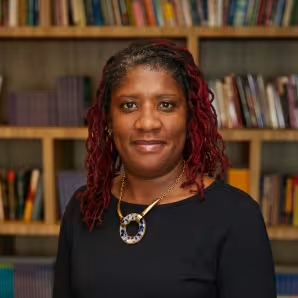
Bridget Wooding
Researcher and Coordinator, Caribbean Migration and Development Observatory

Louby George
Immigration Consultant, Consulting Beyond Boundaries


