On the Move: Rapidly Evolving Migration Trends and Policies in Latin America and the Caribbean
This transcript was generated using AI and may contain inaccuracies. If you notice an error, feel free to email [email protected].
[00:00:00.07] - Andrew Selee
Welcome everybody. Thank you for joining us today. It's a pleasure to be with you. I'm Andrew Selee, the president of Migration Policy Institute, and it's my pleasure to welcome you to On the Move: Rapidly Evolving Migration Trends and Policies in Latin America and the Caribbean. We're going to spend the next hour talking about the migration policies and how they're being shaped in Latin America and the Caribbean. And to start us off, we're very pleased to have with us Ambassador Roberta Jacobson. Ambassador Jacobson is a founding partner of Dinámica Americas. She is also a former ambassador, U.S. Ambassador to Mexico, and former Assistant Secretary for Western Hemisphere Affairs— Assistant Secretary of State for Western Hemisphere Affairs. We're trying to get your title right here. And I should also say that we're really fortunate that she's also the chair of the MPI Board of Trustees. So someone who both knows Latin America and the Caribbean incredibly well from work she's done throughout her career, but also someone who knows MPI well and has been an inspiration for many of us. So Roberta, over to you.
[00:01:04.13] - Roberta S. Jacobson
Thank you so much, Andrew. You know, I was really excited to be asked to open this event, and I won't take much of your time because these are people who I know from MPI, where I am very proud to be the chair of the board of trustees. On the Move really underscores that regardless of the political environment in any particular country, MPI remains committed to nonpartisan evidence-based research and filling the gap, as the authors say in the book, with their analysis. Like most of us in the Americas, I am the proud grandchild of migrants. In my case, Jews from Eastern Europe. And frankly, because I wrote my master's thesis on a Jewish community in the region and have visited nearly every Jewish community in the hemisphere in my travels, the book spoke to me in talking about restrictions against Jews in migration policies. The nice Jewish girl from New Jersey who's made a career of the Americas. But a few things strike me as most important as we kick off this conversation. One is that despite the current debate, most migrants actually remain in the region, and I think that's really crucial. Second of all, of course, the fact that people and countries in this region have overwhelmingly welcomed migrants.
The countries that produce higher numbers of migrants often act in ways that they hope their own citizens will be treated in the receiving countries. And perhaps most importantly, that the capacity of countries to act for migrants or refugees is lagging far behind their goals. And Then I think the most important thing that, that they point out at the— in the book at the beginning is that the book tries to answer how governments make migration policy, but then the other part of it is how well these migrants or refugees are doing in the societies into which they move and how well are their societies doing in really welcoming them at the beginning, but adapting to them. And this is large-scale migration in the Americas, the likes of which we haven't seen. And I think that's really important. The data are clearly and well articulated with all the notes you could ever want to check their work. I confess I didn't check everything, but that's because I know the authors and know the and the quality of MPI's work. So to me, this provides an enormous resource and evidence-based information filling the gap and our hope, my personal hope, and I hope many of yours, for the best informed debate we can have.
So thank you so much, Andrew. I appreciate the opportunity to be here with Ariel, Diego, and Valerie. And all of you that are on this webinar or will see it later. Thanks.
[00:04:34.08] - Andrew Selee
Thank you very much, Ambassador Jacobson. That was a fabulous way to get us started. We really appreciate it. As Ambassador Jacobson said, I mean, this is, you know, much of the debate when we think about the Western Hemisphere, we tend to think in migration, we tend to think about people moving to the United States or maybe to Canada. Right. But the reality is much of the movement is really within the rest of the hemisphere, in Latin America and the Caribbean. We'll talk more about this in a second. It doesn't mean there isn't still or hasn't been recently a lot of movement to the US as well, because certainly there has been. But a lot of the movement has actually been in the hemisphere. Much of what we know about migration policy is what we— much of the academic research is taken from what we know about the US and Canada, Australia, Western Europe. But the reality is many of the migration movements in the world are taking place in other in other parts, in Latin America and the Caribbean, in Africa, in the Middle East, in Asia. And, you know, it seemed to us particularly important since the four of us had been working on Latin America for a number of years and had had the privilege of both doing research but also being engaged with some of the governments, international organizations, and nonprofits that were also trying to fill the gap in trying to seek a response.
A lot of the migrant-led organizations and refugee-led organizations as well to try and put down what we thought was was the direction that migration policies were going, in part because it turns out there's some differences. We'll get into this in a minute. There's some interesting differences. There are things that are unique about the hemisphere. There are lots of differences from country to country, of course, but there are some throughlines that turn out to be quite significant and quite particular to the region. And I think it expands our understanding of the kinds of policies that are possible in terms of dealing with migration, as well as really highlights important decisions that were made by countries in Latin America and the Caribbean at a time when migration flows changed and actually were much more directed towards other countries, neighboring countries, rather than just to the US or Canada or Europe. And we're appreciative of Stanford University Press for publishing it. Thank you, by the way, to all the footnotes. Please, unless you're an academic, please don't read all the footnotes. But I have to say, we're deeply indebted to other researchers and scholars who have been following these trends in the hemisphere.
We are deeply indebted to the policymakers and international organization leaders. Who gave their time to be interviewed for this as well. We've had the privilege to work with, you know, so this is really— we're hoping that to reflect a broader body of work that many others are doing, either through practice day to day, implementing policy, designing policy, or people who have been doing research on this as well. And let me start off. I'm going to actually speak very little today. I'm really going to— 3 co-authors are really the ones who deserve the bulk of the credit for this book. So let me go to my colleagues and say and ask you the key question, which is why did we do this book now? You know, why not 20 years ago or 20 years hence? Why was it important to write about Latin American Caribbean migration policies at this moment? And maybe Valerie, we can start with you.
[00:07:32.13] - Valerie Lacarte
Thank you. Thank you, Andrew. And thank you everybody for being on this call and joining us. I think, you know, we have a lot of evidence that shows that in the last 20 years we've seen so much movement, so much human mobility throughout the region. And so from a very broad standpoint, you know, the general answer to this is that accounting for the migrant populations, understanding who they are, where the flows are, the concentration as well, really is fundamental in order to establish admission policies, tailoring, updating systems, migration systems towards these populations, managing borders better, working on integration services. Now, this is the theoretical answer, but I think for all of us, as we dug into the, the, the data, it was very, it was very obvious where there were gaps and where there were areas of improvement perhaps for the region. So, for instance, in the case of the Caribbean and across the book, actually, what we did is we looked at the top 3 nationalities of foreign-born populations in each nation. And that was very, that was enlightening to understand specifically who are those migrant populations. In the case of the Caribbean, for instance, you know, we, there are a few nationalities that stood out like Haitians, Venezuelans, Dominicans from the Dominican Republic, Guyanese, and also U.S.-born citizens and French nationals as well who are very present in most of the Caribbean nations.
Now, once we understand who those populations are, we have different ways of analyzing this data, like understanding the concentration. You know, in some cases, yes, the numbers are very large as a region, but then they're very, they're very concentrated in certain countries. There are facts, I think, that are important as well that perhaps even us who work on certain regions, it's— we may not have known as well. For instance, the U.S.-born that I mentioned, the U.S.-born citizens and the French nationals are fairly present in several of these countries of the Caribbean nations. And there are some populations, it's important to understand as well how they how long, whether they were established or not. So the Guyanese, for instance, are present in many Caribbean countries, and the Venezuelans are more recent, and they arrived in large numbers, right? And it's in some very specific countries. So all of these, the composition of those flows in themselves really helps to then frame the book and really the conversation around migration policy systems and what is more desirable for some countries to develop. But I'll pass it on to Diego.
[00:10:51.01] - Diego Chaves-González
I think that when we talk about migration policies in Latin America, what has changed is that we now need to address multiple sub-agendas all at once in an era of human mobility. 18 million people are immigrants in Latin America. At the core are still the integration challenges of Venezuelans, but we also face at least for the case of South America, new dynamics, especially deportations. In the book, we talk about the D for demolition mark where President Maduro marked the doors of many Colombians, which ultimately meant D for deportation back in 2015. And over 900,000 Colombians, for instance, returned during the period of 2015 and 2021. And I say returned, quote unquote returned, because many, like for instance, Juan Viloria, one of the people that we interviewed for this book had never actually set foot in Colombia, even though he held citizenship of Colombia. With the Trump administration approving $170 billion for immigration enforcement over the next 4 years, parenthesis, $180 billion had been approved for this in the last 35, 40 years since the 1980s, I believe, the region really must prepare. We cannot afford to have purely reactive policies once deportations ramp up. We need real reintegration plans in place.
Guatemala, Central America, is an important example of how countries could prepare better. Remittances are another central piece to why this matters now and why this book matters. The most obvious cases are, again, in Central America, where remittances make up 20-25% of the GDP in some of the countries. But they're also critical in countries in South America like Ecuador, like Colombia, where remittances, for instance, in Colombia represent 3% of the GDP, which is more than coffee itself. So we are, we immigrants from Colombia are a more important export than coffee itself. Beyond this, we need stronger protection systems. Most of the debates of the future of international protection system take place in the Global North, yet the majority of refugees live in the Global South. And we cannot forget issues like, for instance, labor mobility. In recent years, 2021 to 2024, more than 500,000 Colombians and over 400,000 Ecuadorians have left the country, but the policy frameworks for mobility remain precarious. Some progress has been made, but much more is needed. And finally, to perhaps the most important point, I think most governments still treat migration as a problem to be solved, along with other many problems we face historically as middle-income countries.
So therefore, policies remain mostly humanitarian, and our donors and our partners also mostly respond in a humanitarian way with only limited steps forward towards integration. I think the challenge is to change that mindset in policymakers, donors, the private sector, to start asking development questions and make migration part of the national strategies for education, labor, and pension reforms, demographics, and productivity and competitiveness. That's how migration can stop being, I guess, a zero-sum game in the eyes of many and instead become a driver of development in the region. Over to you, Ariel.
[00:14:15.21] - Andrew Selee
Great point. By the way, that is Diego Chavez-González, who's Senior Manager for Latin America and the Caribbean Initiative at MPI. So, and now we're on to Ariel Ruiz Soto, who is a Senior Analyst. MPI works both on the US but also Latin America and the Caribbean. So, Ariel. Over to you.
[00:14:30.07] - Ariel Ruiz Soto
Yeah, I wouldn't add much. I think Valerie and Diego covered it all really well, but I do want to mention one really important takeaway, especially for those of you joining us from the United States. I think a lot of the attention over the last several years has been at the U.S.-Mexico border and what other countries are or not doing to help the United States stop people coming from South America and Central America, the Caribbean, to the United States. And so much of the question, so much of the attention is always driven to see what they're doing at the border. But very few, or at least a fraction of attention, is actually focused about what countries are doing for migration for themselves. And what we're trying to do with this book is try to position the government's strategies, try to understand them, analyze some of their shortcomings, but also look at the opportunities that they're doing and what's changed. So a lot of, for example, a lot of times when Mexico, Central America come into the focus, we think of deportations, removals, and that's an important piece of it, that I'm sure we'll talk about today.
But also, it's, it's an important part for us to talk more about how Mexico, for example, received the third largest number of asylum requests in the world in 2022 and 2023, only after Germany and the United States. A lot of times people don't think about those pieces of information, and I think that's a very important piece for us to understand, not just what's happening at this Mexico border, but what's happened well beyond that border and how countries are focusing and making policy for migration for their own benefit and their own strategies, oftentimes in complicated ways, many times not successful. But I think we need to be focusing well beyond what's happening at the United States border, U.S.-Mexico border, and trying to understand how these countries actually are trying to make migration work for themselves.
[00:16:08.19] - Andrew Selee
Thank you, Ariel. That was great opening, everyone. And actually, I'm going to come back to Ariel next. So, you know, you can stay unmuted, Ariel. One of the things we argue in the book is that Latin American Caribbean countries countries have pursued a different set of policies than the United States. It's not that there isn't influence, there certainly is, and there's mutual influence back and forth, but that there's slightly different foundations for policymaking in the region than there is elsewhere in the world. And this is probably true of every region, right, that there are different fundamentals at play which then shape the way that the policies emerge and what they look like and what they emphasize. Tell us a little bit, Ariel, what, you know, what are these foundations and how do they look different today than they did even 5 or 10 years ago?
[00:16:55.05] - Ariel Ruiz Soto
Sure, and I want to start by saying that even within Latin America there's clear differences even within sub-regions. So what I'm going to say is a general statement of the foundations of the region, but clearly there's even differences between South American countries among themselves or Caribbean countries among themselves. For the foundations that we focus on the book, we try to go back to the early foundations of migration in the region, and what they were is generally As Diego mentioned, humanitarian stances toward protecting and integrating people. At the same time, one of the key examples is the number of countries that signed the Cartagena Declaration to try to expand protections for migrants or refugees in these countries. But at the same time, they also wanted to try to incorporate mobility because for decades migration has happened in the region. They tended to take a more favorable approach to that. More recently, say in the last 7 or so years, especially alongside the Biden administration in the United States leading the regional cooperation with many countries, the foundations became broader and they included a desire to control entry to which countries they're going to back and forth.
Each region is taking that differently. We also saw an increase in expanding labor pathways, and that doesn't mean just labor pathways to the United States. In fact, many countries' most important aspect of it, especially in South America and Central America, has been the labor pathways between countries in these regions that actually make and facilitate mobility significantly. Third has been seeking to incorporate displaced populations. Venezuelans are the most important case, but not the only case in Central America. Nicaraguans have become a key part of the conversation for many years. Haitians from coming into Central America as well, and even in Mexico, that's been a key point of it. And then the fourth foundation that we've seen is now Also, looking and understanding— I think Roberta really pointed at this in her initial comment— is trying to figure out how to conduct outreach to the diasporas that are in other countries, especially for the biggest of those migrants across the region. How do we make our migration policy in ways that we can try to help our migrants where they are in other places? The 4 variables that we analyzed that really defend or define— excuse me— these foundations are the following: institutional capacity, how countries actually put into place the policies that they have and how much leverage do they have to implement these policies.
At the same time, we also look at public opinion, which has been changing in all the different parts of Latin America, how public opinion informs how countries respond or not to migration. Geopolitics clearly are a significant role, especially for Mexico and Central America with the proximity to the United States, but even across other parts of South America and the Caribbean that I'm sure Valerie and Diego can discuss. And then finally, symbolic politics has been a clear point of conversation as well, especially among countries that have— that most of them share Spanish as a common language. And in other cases, the proximity geographically to each other has tried to make a bond for decades, try to work together at least in practice. So that symbolism of trying to be unified I think has made Latin America very differently in its response to other countries. We'll see, and we have seen tests and begin to see some fissures in how that agenda is being unified. But at least those are the foundations that we've seen change over the last 5 to 10 years.
[00:20:12.14] - Andrew Selee
Thank you, Ariel. Diego, one of the things, I mean, picking up what Ariel said, I mean, one of the things that, you know, we say is that on average, countries in Latin America and the Caribbean have been a little bit more open towards migration than in some of the traditional destination countries. At least what we think of as the traditional destination countries, Western Europe, United States. Canada is actually a case, a separate case in this. But, you know, there's huge differences. This is not true of every country, and it's not true in every country towards every population that comes. So there— but on average, they've been somewhat more open to the arrival of migrants, and it's become less politicized. How do you explain that, Diego?
[00:20:54.17] - Diego Chaves-González
Well, I think that there are several factors. First, The cultural proximity. In the case of Venezuelans, for instance, we share the same language, similar values, and even historical ties. Ecuador, Colombia, Venezuela, Panama were once part of the same country. So, so as Ariel mentioned, there is this sort of like cultural proximity which allowed, I think, an easier process of integration. Second, our economies are also similar with high levels of informality. We were working all in sort of like similar sectors, which allowed many migrants, particularly those who arrived during the first waves, to adapt more seamlessly. Another important factor was the profile of the first arrivals. In the book, for instance, we illustrate that this through the story of Jacqueline Perdomo, a Venezuelan leader who settled in Chile during the first waves of migration. In Venezuela, she and her family lived comfortable lives and held professional titles. When she arrived in Chile, she opened the business and created jobs, a clear example of how the first arrivals contributed very positively to host economies. Later, when more vulnerable groups started to arrive, and societies appealed a lot to the solidarity principle, which I think has remained to some shape or form, remembering that Venezuela had once hosted hundreds of thousands of, for instance, Colombians and others nationalities fleeing, for instance, dictatorships, conflict, or poverty.
So that sense of paying it forward was actually very powerful. Finally, I think that there is an element of politics that played and continued to play a role in the process of integration, in the failure, in the success of the integration of migrants, particularly Venezuelans. At the height of migration, many right-leaning governments were denouncing the Maduro regime. Through the Proceso de Quito, through the Grupo de Lima, sorry, where 12 countries actually signed this declaration. Regularization then became both a humanitarian measure and a political statement against some of the human rights abuses, hyperinflation, and authoritarianism that existed at the time. I, of course, do not want to oversimplify. There are more details behind each of these dynamics. But in short, I think openness in Latin America has been driven by proximity, solidarity, and political timing, which is somewhat different from what we see in other parts like the United States or Europe.
[00:23:20.05] - Andrew Selee
Great, thank you. We're going to open it up to questions and answers in about 5 minutes, everybody, so get your questions ready. You can do questions through the Q&A icon that you have there. But let me do one final round with the three of you. I'm going to come back to you first, Diego. I mean, tell us a little bit about the kind of collaboration that developed between countries in Latin America and the Caribbean during the Biden administration? And then maybe I could turn to Ariel and Valerie to talk a little bit about what's changed today with the Trump administration and changes within Latin America and the Caribbean as well. So, but Diego, what kind of collaboration developed during this period?
[00:23:56.18] - Diego Chaves-González
I think one of the first and most important was, I think, the Los Angeles Declaration, which was a very important innovation instrument because until then cooperation was mostly sub-regional. So we had the South American Conference on Migration, the Regional Conference on Migration, the Quito Process, the MIRPS, but none of them actually included the US or even Canada for that matter as being part, like embedded in the conversation. What was new about the Los Angeles Declaration is that it tried to align these efforts in a hemispheric framework. Another innovation was the Safe Mobility Initiative offering legal alternatives to irregular crossing. But here is where things didn't quite work, I think, for both of these models. Many governments saw these tools as US initiatives with little staying power beyond the Biden administration. So buy-in from some of the Latin American governments was actually very limited. In the case, for instance, of Safe Mobility, while useful, was introduced primarily in Latin America as a response to irregular migration. So at the very moment where more than 1.2 million Venezuelans were crossing the Darién between the years of 2021 and 2024, that meant it was seen as competing with rather complementing national integration efforts that had been carried out by countries like Chile, Peru, Ecuador, Colombia, Brazil.
So on the ground, it often felt like two separate strategies instead of one coherent approach. So I think that the lesson and the most important lessons that we have is that hemispheric cooperation can be innovative and it should continue to be innovative, but it needs durability. Ownership from Latin American governments and a balance between managing flows and supporting and strengthening integration.
[00:25:42.15] - Andrew Selee
Thank you. So there were some real advances here, but there were also some disconnects there, and there was some skepticism, which turns out to probably have been warranted, in that the US changes policies over time, changes administrations, changes policies. So what did it change to? Ariel, I'm going to go to you next, and then we'll finish with Valerie, who's going to run the Q&A. So what did you What has changed now? I mean, this is an administration with a completely different set of assumptions on immigration than the Biden administration, though they were both trying to limit arrivals at the border, but two very different approaches and different approaches to the hemisphere.
[00:26:16.17] - Ariel Ruiz Soto
Yeah, so clearly one of the key things that have changed has been the focus on trying to make enforcement part of any agenda with any collaboration with any country that the United States is working with. And in this case, perhaps among the most pressure has been on Central America and Mexico trying to increase and improve is control enforcement. The book clearly shows how Mexican enforcement in Mexico has actually increased significantly, and Mexico actually detained more people than the United States for between May of last year and through early, the early months of this year. And that's an important aspect of it. But for other countries that are smaller and maybe farther away from the US-Mexico border, the key pressure has been on trying to reduce the way that, or trying to work with the countries to reduce their visa policies of who comes through these countries to then make them or decrease or allow the people that make it to Central America and then the United States. We saw the clearest example has been Ecuador recently where they actually have implemented more visa restrictions for people who before would come through Ecuador to then maybe from Asia or Africa, for example, be able to come to those settings.
But I think that the biggest part of the conversation that's often missing is how the countries themselves are seeking at the same time to take part of these negotiations as an opportunity to open up their agendas and what they can do domestically. Their countries are trying to, I think successfully, trying to begin to think about how to expand their labor mobility and understand that many of this, even though many of these societies have been sending countries for a while, now are becoming either transit or destination countries. And what that potential could be for immigrants to settle in those countries, to develop their economies, to find different ways to increase their social mobility as well. And that's an important aspect that we don't often see. I think there's countries that take a different approach. Of course, there's some that continue to place more restrictions or make it more difficult for migrants to be given access to these services. But overall, we've seen a more open consideration to seeing how they can actually utilize migrant labor, migrant talent to be able to fortify their economies. And I think that will continue going forward. Obviously now it's deportations and how to manage deportations from the United States is a big clear point, but it's not the only one.
I think countries, including in the Caribbean, are going to play a more significant role going forward.
[00:28:36.01] - Andrew Selee
Thank you, Ariel. Valerie, let me come to you. We also, by the way, during Q&A, we will dig down into some of the subregions because we've deliberately written the book with a chapter on Mexico and Central America. Ariel, we all actually wrote all parts of this. This was actually quite a joint effort, but Ariel took the lead on that and his area of expertise, Diego on South America. Which is a different subsystem where obviously the Venezuelan crisis in Mexico and Central America, the US is a much more prominent actor, not the only one because some people are actually moving to other countries in Central America and Mexico, but it's also where people cross through. Diego took the lead on South America, which has really been marked by the Venezuela displacement crisis, but also to some extent by the Haitian displacement crisis and other forms of mobility that have nothing to do with displacement as well. And Valerie took the lead on the Caribbean. Which has been marked by both a displacement from Haiti, but also a lot of historical mobility which continues today and strengthened by attempts by the governments to actually create a more integrated society.
And so you can each, we'll go to each of you during Q&A when there's specific questions, but Valerie, you have the last word on this. What is changing and what changed and what is changing now?
[00:29:48.13] - Valerie Lacarte
Sure, thank you, Andrew. And I will, since I'll be moderating the Q&A, I've been looking at some of the questions and I think I'll be able to kill two birds with one stone right now with my answer. One distinction from what was mentioned, especially from Diego, is that in the Caribbean, there were about 5 countries that signed the LA Declaration. And so in that sense, the Caribbean region did not— and there wasn't as many endorsements to the LA declaration as one might have hoped during the Biden administration. However, I do think that a lot of the initiatives that were supported by the Biden administration, including through the funding and the support to IOM and to UNHCR, that trickled down to the Caribbean region because there were a lot more regional regional forums to discuss and to build on the Caribbean initiatives that already existed, especially the CARICOM, the Caribbean Community, and how to advance the full free mobility regime that already has been in construction since the '70s in the Caribbean. And so notably in 2023, the Caribbean heads, the CARICOM heads decided that they wanted to move forward and really implement full free mobility for all CARICOM nationals.
[00:31:25.24] - Valerie Lacarte
So CARICOM does have 15 member states. There was an exception for Haiti because of the political situation, but that in itself was an important advancement. And that was, you know, at their 50th celebration, the 50th celebration of CARICOM. The other thing, and this is where I was going to kill two birds with one stone, is that one example of a country that did have innovative policies during the Biden administration, it was Belize. So Belize did have, and we talk about this, you know, in the book, Belize had a regularization program that was expansive and that— there was a lot of legwork behind that program to try to reach as many people as possible in the country. A lot of them were Central Americans, but there were— there's as many other countries. Belize had experienced a diversification of migrants coming into the country. And so that program had some flaws as everything does have, but it is considered, I think during that period, one of the policy initiative migration policies that we highlighted in the book as being successful. So with that, I guess I can thank our authors, our co-authors, and then turn over to the Q&A.
[[FOR THE Q&A PORTION OF THE TRANSCRIPT, SPEAKERS ARE NOT IDENTIFIED BY NAME. PLEASE SEE THE RECORDING TO IDENTIFY SPEAKERS.]]
[00:32:55.08] - Speaker 3
And I already have something that I'd like to start off with, Ariel. We received a very specific question to your unaccompanied children, and maybe you can answer later directly to the person who wrote, because it's about, it's more about US policy really towards the way they release unaccompanied children. But I wanted to take advantage of that question to ask you if you could, You know, give us, uh, talk a little bit more about, um, knowing that, that nationals from Mexico, Guatemala, Honduras, and El Salvador are amongst the largest populations of unauthorized immigrants in the United States. And we have a lot going on in terms of the number of deportations as well. How are these governments responding to rising immigration enforcement in the US? And potential increases in deportations? And importantly, what are the reintegration services that these governments are offering their citizens upon return?
[00:33:59.23] - Speaker 5
Sure. And I also saw a question there about TPS that I can try to swing into my answer to that. So let me, let's start by saying that about two-thirds of the undocumented or not-documented population in the United States is from Mexico, Guatemala, Honduras, and El Salvador. If you combine those four countries, they make up about 67% of the 13.7 million people here without a legal status or another temporary status of some sort, including TPS in our case. That means that they are the largest population subject to deportation potentially, and that means that these countries have and are seeing significant numbers of removals to these places. Now, I want to be clear that saying that even though there's been an increase in arrests across the Trump administration's first or second time in office, the numbers actually haven't really increased as significantly as one would think, especially for Mexico, Guatemala, the two largest countries receiving migrants from deportations in the region. The numbers have actually remained relatively lower than what they were last year because many of those people that were being deported by the Biden administration were coming from the border, and now there's less people coming to the border.
[00:35:10.17] - Speaker 3
Those deportations are now coming from the interior. What the countries do in some ways are similar once the migrants get back to their country of origin, but they depend in several aspects. They generally have the same pathway. People, once they return either by air or by land, receive some hygiene kits, information, documentation to help them have a local ID or some sort of state ID to be able to move and to go about making regular transactions. Sometimes they are given screen, health pre-screenings and bank information to try to figure out bank accounts locally. And then later on, they receive a second set of services for some, especially those in urban areas, especially larger urban areas that may actually have more services for reintegration, which we mean by people going able to, people going to offices to receive their stipends, reimbursements, and/or information about enrolling, for example, kids in education, subscribe themselves to the local or to the national health programs, as well as what, in many cases, just trying to understand what is available for them to work. There's local job sites in place where they can try to find different opportunities for them. The difference though is that, or I guess another similarity, is that they're very limited across the board because they don't have the scope nor the institutional capacity to implement or reach to everyone.
[00:36:33.03] - Speaker 3
And that makes it difficult that every person who's returned actually receives the service. Again, it varies by, by country, El Salvador had one of the most expanded reintegration services a couple years ago. Guatemala now is trying to build back up theirs. Honduras is probably the one that's lagging the most, and Mexico has had a very relatively large program, but it sort of depends and varies across the board. The final thing I'll say about these reintegration programs, however, is that Even when there are services, many people who are being returned to these countries may not actually seek to have the services, either one, because they want to return to the United States and don't see a reason why they should seek benefits for a country they don't want to stay in, especially people who have been in the country, in the United States, for very long. All they were thinking is trying— most of them are thinking, how do they come back to the United States? And then the second piece is that many of those migrants may actually not trust their government to receive services or have the confidence in them to deliver those services.
[00:37:28.24] - Speaker 3
And may actually choose not to seek them. And I think that's an important part about it. But I think we are seeing countries like Guatemala, Mexico, and El Salvador, Honduras as well, and others across the region trying to figure out how to do that better. And TPS, I think, will prove one of the first biggest challenges if there are deportations from the United States in large numbers of TPS holders, Temporary Protection Status, meaning that that would then be a significant population that has been longer time in the United States and will require specific services, not just bus passes or health screenings, they will have come with psychosocial trauma that will need to be addressed as well.
[00:38:06.19] - Speaker 3
Thank, thank you very much, Ariel. My next question is for Diego. Diego, there are several questions having to do with the policies towards Venezuelan migrants back then under the Trump administration, but as well as the recent, the rise, or I don't know if we would say recent or continued rise of anti-migrant sentiments in South America. So I wonder more broadly if you could tell us, you know, 10 years after Venezuelan migration has reshaped really South America's migration flows, what has worked, what hasn't worked, and what lessons could we carry forward?
[00:38:54.00] - Speaker 4
So I guess that at the onset of the migration crisis back in 2015, governments quickly understood that existing tools they had, for instance, their national policies, national laws, and cooperation agreements among different countries, were not enough, and they moved more to a pragmatic approach to provide, for instance, regular legal status to millions of Venezuelans. That was, I guess, the right call. But there were also a lot of shortcomings. First, I guess, discontinuity. Every government, almost since 2015, wants to reinvent the wheel. In Colombia, the 10-year protection permit was discontinued and replaced with a new regularization program that was launched just a year before the elections last week. That undermined the trust, not only among the migrant population, but also among the private sector actors who had invested in integration under the old framework. So instead of strengthening what was already working, policy kept shifting. And we've seen similar issues in places like Ecuador, like Peru, When permits expire every 2 years with no path to permanence, and when the rules of the game are changing with every government, migrants fall back to irregularity, which undermines the whole process of integration as a whole. The second part is that integration itself needs sort of like a quote-unquote second generation of policies.
[00:40:38.09] - Speaker 4
Even with registration processes which exist, We do not know enough and we do not have enough information about who the migrants are after 10 years. And they are not fully connected to the social safety net, to the social security systems, to the national statistics of governments. So until they are included in those systems, integration will remain fragile. And then third, I guess migration is still treated as a crisis, not as a development tool. So when governments debate about education reform, pension reforms, how to boost productivity, how to modernize agriculture, how to provide more services, renewable energy, migration is absolutely absent from these conversations, from these debates. So unless migration becomes part of those national debates, part of the national development plans, an integral part of the national development agenda of countries, it will never reach its full potential as a driver for development, and migrants themselves will never be able to fully realize full integration as we hope it happens.
[00:41:52.09] - Speaker 3
Thank you, Diego. Can I ask Andrew to jump in as well? Because Andrew, we had received this question earlier on, you know, the wave of anti-migrant sentiment in South America, the example of Argentina recently tightening restrictions and all the candidates in Chile's presidential elections this year. You know, what do you see? How do you see this sentiment shaping other upcoming votes in the region, like in Colombia and Peru? Do you have any, anything you'd like to add to Diego's point?
[00:42:26.19] - Speaker 1
You know, I would say it's been surprising how little this issue has been politicized till now. And it's been Migration has been quite a significant issue since at least 2018, probably when the largest numbers are 2018, 2019, and up through about 2023, the largest number of arrivals, and how much it has stayed out of partisan politics. But I don't think that's going to last. We have seen moments. The Dominican Republic is a separate conversation because there's a historical identity question vis-à-vis Haiti, right? And so there's always been tension around who is allowed to stay and who isn't, who can become Dominican. But identity politics, and actually Felipe Muñoz, if he's on this call, Felipe made this point in the book, actually an interview we did for the book, that identity politics have been less important in Latin America and the Caribbean overall than they have been in other countries, particularly in Europe and the United States, where these are major phenomena. Look at, you know, what's going on today in the Norwegian election or in Sweden, Germany, France, other places, Denmark, in Western Europe, and certainly in the United States, where people sort of wonder who has the right to become part of our country.
[00:43:44.16] - Speaker 1
That's been less present. That's actually been surprisingly less present, which means, yes, there are fears about people losing jobs. And there's some evidence emerging that there may have been, you know, some real shocks in the informal markets early on, which over time abated. And so now, actually, if there's anything, there's probably a net positive for the growth of the economy coming from the arrival of migrants. But that doesn't exclude the fact that early on, the first couple of years, there really was an impact, and people remember that. And people in informal markets working in the informal economy are among the most vulnerable people in society. There certainly have been concerns over services, over, you know, overcrowded classrooms, which are already a concern, or overcrowded emergency rooms. And you add more people and it becomes a bigger concern, you know, and people wonder why, you know, why do we have to take in these folks that are actually expanding our already stretched services? That's all been there, right? I mean, all of this has been there, and yet it hasn't become politicized most places. There have been moments where you've seen some real you know, some really awful incidents actually against migrants, and you've seen tensions between migrants and host communities.
[00:44:52.18] - Speaker 1
But generally speaking, it's been fairly muted over time. I think we are seeing the rise of this now. Chile is probably, other than Dominican Republic, Chile is probably the next place where we're going to see a lot of this. Ironically, Chile is a place where immigrants have a higher education level than they do many other places, and at least we don't know the latest numbers yet, But at least until recently, migrants actually had a slightly higher, were slightly more likely to have finished college than non-migrants in Chile. Now, that may be getting closer right now. But in Chile, one thing that did happen is that Tren de Aragua and other Venezuelan gangs followed the migrants, originally as smugglers. Later, they started extorting micro-businesses. And later, they moved into, you know, some of the— to extorting Chileans, moving into the drug business and other things. And so it has created a reaction in part because they've seen violent crime go up. And it is the one place— we actually looked at this a couple of years ago. On average, migrants were not more likely to commit crimes, actually slightly less likely to commit crimes than the native-born in Chile.
[00:45:57.13] - Speaker 1
But it is true that some of the most violent groups are in fact Venezuelan or Venezuelan gangs that followed the migrants in there. And so it's created a perception around this. In Peru, you've seen some of this as well, also because Tren de Aragua and some of the other gangs have been present there. And you are seeing bits of identity politics, right? I mean, you know, Latin— we should not assume that Latin America and the Caribbean are immune to identity politics. It's been somewhat easier that you're talking about people who speak, for the most part, the same language or a similar language that come from the same region where there is this sort of symbolic sense that, you know, we're all part of the same heritage and the same— all that's helped. But I don't think we should assume that that that will last forever. And so I do think we're at a critical tipping point. It may turn out to be a story only of a couple countries, but it could be the beginning of a greater politicization, at least in some countries. But for example, in Colombia, I mean, Colombia, Diego can comment on Colombia more than me, but there is certainly a lot of grumbling about migration.
[00:46:56.17] - Speaker 1
It's certainly not a non-issue for your average person in Colombia, right? I mean, there is a sense that it's stretched services, particularly stretched services that were already underfunded. But it has yet to develop into an issue that campaigns are won and lost on. And that, I think, is different than we've seen in some other countries where it really does become a lightning rod issue for a substantial sector of society.
[00:47:25.00] - Speaker 3
Thank you, Andrew. I'm going to take a few of the questions on the Caribbean. So I would say, and you've heard this throughout, I think, all as we were speaking, we always take care to say, you know, there are caveats, there are exceptions throughout the region. So even when we talk about successful policies, we have seen that there are notable exceptions. And in the case of the Haitian displacement in particular, we do I do note throughout the book and in conversations that there have been serious challenges and there continues to be serious challenges, particularly with the Dominican Republic, but not only the Dominican Republic. So with the DR specifically, there's been about, I think we're close to 300,000 removals of Haitians now, you know, and it's clearly, a very, it's a, it's a very clear mass deportation effort that's ongoing that has monthly targets. Uh, there are questions around those numbers as to know if there are multiple people, like multiple removals of the same people. So the numbers themselves may not be exactly that, but still on the ground, there's plenty of evidence of that going on. And a lot of the discussions, unfortunately, even though there has been, there have been advances advancements in terms of talking about integration and migration policies in the Caribbean, that very important dynamic has essentially stayed outside of all of those discussions.
[00:49:00.17] - Speaker 3
And in fact, when I was speaking earlier about the LA Declaration endorsements, one of the important— some of the most important countries that face problems with migrant arrivals in the Caribbean were not signatories of the LA Declaration. Namely the Dominican Republic, Trinidad and Tobago, with the question of Venezuelans, and the Bahamas, for instance, that also has several challenges when it comes to Haitian migrants. Now, at the same time, on Trinidad and Tobago, because somebody asked about this in the Q&A, yes, Trinidad and Tobago do not, they don't have, there are certainly gaps in terms of their policies of recognizing refugees. We note that in the book as well. But Trinidad and Tobago has also been working relatively closely with the international organizations like IOM and UNHCR to provide and to address some of these challenges when it comes to Venezuelan migrants. So yes, it's been a very large number of arrivals in Trinidad and Tobago of Venezuelan migrants, you know, a population that is outside of, again, of CARICOM and of the Caribbean community, the usual Caribbean member states that they have policies with. So there's been, you know, a lot of work and at least some intentionality, I would say, from that government, even though they're in deep challenges.
[00:50:32.04] - Speaker 3
Still. And just before I hand it over to Andrew, on Cuba, somebody mentioned that we didn't mention Cuba. We definitely— Cuba is interesting, I think, and we do note a lot of what's going on in Cuba is that if you look at Cuba, it's one of the few countries in the Caribbean actually where there aren't that many Caribbean migrants or people even from the region. Who are in Cuba, but the government itself has long had a policy of engaging on many other fronts with the neighboring Caribbean and with the overall region. And of course, Cuban migrant flows have increased significantly and had different inflection points over the period that we analyzed. But Andrew, would you like to jump in?
[00:51:24.03] - Speaker 1
Yeah, I would say Cubans are everywhere also, right? There are Cuban communities Uruguay and Brazil and Mexico and many other places, but often professionals, right, tend to be a lot of professionals were able to get visas to those countries to stay. I was just going to say, I mean, I think we've said this in multiple ways, but we haven't perhaps called it out. One of the things that was really important in this story too is the role of UNHCR and IOM, the NGOs, domestic NGOs in all of these countries, And then Venezuelan, Haitian, Nicaraguan-led organizations, right, and others, right? I mean, the migrant-led organizations where the older waves of migration who are much more settled, who are often more professionals, who knew the country well, were able, created associations, then helped others who were coming behind them, right? And this sort of dense tapestry of civil society and international organizations has played an enormous role in helping people get settled, in helping make sure it's not a zero-sum game with local communities, trying to get resources both to the receiving communities as well as the migrants themselves, and making the adjustment in influencing policy, making the adjustment as, as for, for all sides as, as easy as possible.
[00:52:36.20] - Speaker 1
I think it remains to be seen. Now we're in a time where a lot of funding is being cut largely because of the US changes in US policy, but to some extent some belt tightening in Europe as well. And whether that's going to have an adverse effect, because that did cushion— there isn't a strong social safety net in most of these countries, but this dense tapestry of civil society and international organizations that worked quite well together really did play a key role in helping manage a very rapid transformation.
[00:53:08.08] - Speaker 3
Thank you. Thank you, Andrew. So we have just a few minutes left. I'm going to see what other question I can take here. I've seen a few questions around, of course, the cost of deportations, of US deportations to Latin America. We've touched on this a little bit, but I could broaden this question to how should in the future, in the, in, well, right now and in the next few years, how should Latin America and Caribbean governments position themselves as they are facing dwindling funds in terms of development pressure, financial pressure, budgetary pressures, and still trying to strive with keeping up these ideals of integrating migrants. How do you see— how are there any hopes, I guess, that there are countries that will continue to prioritize the integration piece despite all of this pressure? This is a tough one, but I will— so I will first send it to Diego.
[00:54:19.13] - Speaker 4
I guess that the most important thing that I think countries need to be focusing on right now is trying to consolidate integration and connect integration services also with development opportunities for countries. I also think that the migration agenda in Latin America has suffered some transformations since 2015. We're not anymore talking about specific bubbles, you know, the Venezuelans only in South America, the people from Haiti only within the Caribbean, or a number of countries, for instance, in South America, or Central Americans going to the United States. We have a bit of a more mixed migration right now happening all over. And this question about deportations from the United States also will present new challenges for, for the region as a whole. And I think that some of the things that have been happening despite this sort of like evolution in terms of the migration patterns or the migration flows, is that we continue to treat our migration policies in silos. So for instance, we have a specific law on specific routes and coordination mechanisms to deal with diasporas or to deal with remittances or to deal with return migration or labor mobility or transit migration or integration.
[00:55:42.07] - Speaker 4
And they are all part of separate conversations. And we need to even interact as the Migration Policy Institute on the ground. We need to interact even with different actors and different ecosystems within this whole of like sort of like migration approach. So I do think that there needs to be more ties directly about the human mobility agendas in our countries, tie them more together and bring them more closer to the idea of development. So I guess that in short, we also need to continue to do the work on humanitarian response. I think that is still important and will continue to be important. But it also must become other strategies to strengthen productivity, deal with demographic change, and with other challenges that we have as middle-income countries in Latin America. That is, I think, the only way to make mobility a driver of growth instead of just a crisis to be managed. And with everything that is happening right now here in the United States, with perhaps maybe in the future more deportations start to happen, I think preparation, I think coordination within the governments, I think coordination among different governments, among different countries is going to be very important right now in order to address the challenges of today and the challenges of the future as well.
[00:57:11.06] - Speaker 3
Thank you. Thank you, Diego. Ariel and Andrew, and then we're going to close. We'll go over like 5 minutes. Ariel?
[00:57:20.16] - Speaker 5
I think going forward, it's important for us to think about how these countries are actually going to reconsider the benefits of migration. Oftentimes, as I think we've mentioned across the board, these countries are now thinking of migration a little bit differently, and the publics are pushing them to think about migration a little differently. Sometimes it's controversial for migrants who are staying in public places longer. Sometimes it's actually welcoming in some places but not in others, even within the same country. I think we'll begin to see that even though in many countries, or at least in Central American countries and Mexico, for example, migration is not a top agenda item in their domestic policies, migration needs to be more specifically thought about as a strategic point moving forward. And that includes development, as Diego mentioned, but also in many particular ways for people who have been returned or returning with US citizens, which oftentimes is an ignored part of the conversation. How to then strategically integrate them as well. I think that's going to be particularly important for Mexico and Mexicans returning with U.S. citizens to Mexico, and it would be in the benefit of the U.S. government as well to participate and help those people returning.
[00:58:26.17] - Speaker 5
Andrew?
[00:58:27.11] - Speaker 3
Thank you. Actually, I'm going to answer and then pass it on to Andrew so that he can take us to the conclusion. Yes, I think one of the highlights as well of thinking about all of these topics is that migration is always interconnected with other themes. And so it is very possible that in these years that in this political environment, that migration in itself may not be spelled out as a top priority, but that there are opportunities to tackle other issues that are directly related. So thinking, for instance, in the Caribbean, the Haitian displacement crisis is clearly very tightly connected with the security crisis in the country. So while the US has its own self-interest, for instance, in deporting Haitians and a lot of them TPS holders, in order to do that, they're also at the same time investing in resolving the security crisis. And so we don't know yet how that's going to play out, but there are plans in place, there are conversations in place around what actually having a, a comprehensive, you know, approach to the security crisis in Haiti, which could, you know, address important issues and that are relevant to the rest of the Caribbean community.
[00:59:54.14] - Speaker 3
So And of course, like the climate change issue is always an important theme within Caribbean nations, very increasingly so. And so there might be other opportunities to get to climate displacement through these parallel conversations. So I'll stop there. Andrew, can you bring us to the conclusion?
[01:00:17.01] - Speaker 1
I have one comment to add because I think my colleagues have said everything else that needed to be said is that right now the debate has been on displacement. It's been on mobility. It's on the US deporting people and reintegration. All of these are the top lines, right? And they are the most important things right now. But we shouldn't forget that Latin American and Caribbean countries are growing old, some of them quite fast, actually. Uruguay, Costa Rica, Barbados are countries that have low birth rates. And low birth rates are a result of a certain degree of development success. Not perfect. I know people in those countries would say, you know, we still have a long way to go, but they really have had some success, and birth rates are going down below replacement rate, and populations will start to decline absent immigration. And the same is going to be true in Mexico, Brazil, Chile, Argentina. I mean, sort of run through the list. I mean, eventually, most countries that are not, you know, Haiti, Guatemala, Honduras, a couple others, most others are very soon going to see actual some demographic pressures and some need for immigration policy.
[01:01:15.22] - Speaker 1
So I think the next debate is going to be a different debate. It's not going to happen immediately. It'll probably take a decade, maybe like two decades before it starts. You're going to start to see it in some countries like Uruguay now and Barbados that have actually been having conversations on this. But I think you will start to see it in other countries. You're starting to see it in selected regions within some countries and selected sectors of the labor market. And I think we shouldn't forget this. Right now, people are complaining about immigration. But they may be asking for more of it in the future also, because Latin America and the Caribbean are going some of the same directions that some of the developed countries of the world have, and we'll have some of the same pressures. And just to say thank you to everyone who joined us and spent an hour with us following what we think is one of the key topics for the future of the Western Hemisphere. Thanks so much.
How has Latin America and the Caribbean responded to the surge in migration in the region? This webinar looked at surprising patterns and related policy questions.
No single world region has experienced a greater relative increase in international migration between 2010-2025 than Latin America and the Caribbean. Buffeted by displacement crises, economic dislocation, and changing migrant demographics, Latin America and the Caribbean have seen migration become one of the most pressing issues of our time. And while movement from the region toward the United States has dominated much of the public discourse, in fact, most migrants from the region remain within Latin America and the Caribbean.
How are these countries responding to this new reality?
In a Stanford University Press book, On the Move: Migration Policies in Latin America and the Caribbean, MPI President Andrew Selee and coauthors Valerie Lacarte, Ariel G. Ruiz Soto, and Diego Chaves-González offer a comprehensive look at policy responses by governments in the region and shed light on the lesser-known dynamics of migration in, to, and through the region.
Through compelling storytelling and rigorous analysis, the authors uncover how governments and societies in Latin America and the Caribbean are adapting—unevenly, yet innovatively—to an era of unprecedented human mobility.
This webinar featured discussion of the authors’ key findings, surprising patterns, and the urgent policy questions facing Latin America and the Caribbean.
There is also a Spanish-language webinar recording.
Speakers:
Andrew Selee, President, MPI
Valerie Lacarte, Senior Policy Analyst, MPI
Ariel G. Ruiz Soto, Senior Policy Analyst, MPI
Diego Chaves-González, Senior Manager, Latin America and Caribbean Initiative, MPI
Opening Comments by:
Roberta S. Jacobson, Founding Partner, Dinámica Americas; former U.S. Assistant Secretary of State for Western Hemisphere Affairs; former U.S. Ambassador to Mexico
Latin America and Caribbean Initiative
The Initiative combines rigorous research with direct engagement of governments, institutions, and stakeholders to help build orderly, rights-respecting migration systems across one of the world's most dynamic migration regions.
About the Global Program
The Global Program bridges policy advice, research, and candid dialogue to design effective migration policies, drawing on global evidence and anticipating the forces reshaping how people move.
- Speakers
-
Andrew Selee
President, MPI

Valerie Lacarte
Senior Policy Analyst

Ariel G. Ruiz Soto
Senior Policy Analyst

Diego Chaves-González
Senior Manager, Latin America and Caribbean Initiative
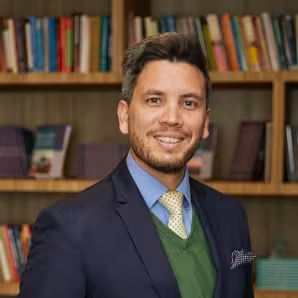
Roberta S. Jacobson
Founding Partner, Dinámica Americas

Related Content