Displacement in the Sahel: Exploring Rising Migration and Responses in West Africa

Part of The World of Migration

This transcript was generated using AI and may contain inaccuracies. If you notice an error, feel free to email [email protected].


CHAPTERS 

[00:00:00]: Why Sahel displacement is invisible in global migration debates 

[00:04:23]: How economic migration routes became refugee routes 

[00:06:08]: Why host communities are welcoming—and for how long 

[00:08:36]: How governments are responding to IDPs—and what they lack 

[00:10:47]: Why Burkina Faso has the largest IDP population in West Africa 

[00:13:33]: The gap between refugee policy on paper and reality on the ground 

[00:17:24]: Why tensions between host communities and displaced people are growing 


TRANSCRIPT 

[00:00:03.05] 

Welcome back to Word of Migration, a podcast from the Migration Policy Institute that delves into interesting topics on immigration, immigrant integration and humanitarian protection with some of the world's big thinkers and policymakers. My name is Camille Le Coz and I'm your host today and a Senior Policy Analyst at the MPI International Program. In this episode we'll take a dive into displacement and migration trend in the West Africa Sahel region. Looking into what forces are causing this displacement. What has changed in recent years, but also what could be done to better address the needs of displaced person and the communities that host them. The Sahel is witnessing a multifaceted crisis with outbreak of violence, weak economies and various governance issues. The effect of climate change are adding to all of these challenges. With an increase in temperature that's 1.5 times faster than the global average, this factor all intersect and drive more people to be displaced internally or to seek refuge in another country. As of last year, 3 million people were internally displaced in Burkina Faso, Mali, Niger and Chad. But there was also over 1 million refugees and asylum seeker in the same four countries.


[00:01:19.01] 

All of this population are hosted by local communities, but services and international aid fall short to meeting their needs. And insecurity has made the delivery of humanitarian assistance even more complicated. And yet government in the Sahel have open policies toward refugees. Chad has been praised for his progressive refugee policy. Niger is one of the champion country for the upcoming Global Compact for Refugees. Today this is particularly important because in the past years humanitarian organization and others have warned that we shouldn't forget the crisis in the Sahel. And that's why we thought it would be important to hear from a guest, Alexandra Tapsoba, about what's the latest in the region. Alex is a development economist and a lecturer and researcher at the Ayer Institute for Population Science at the University Joseph Ki Zerbo in Ouagadougou. She's also part of the research project MIDEQ, Migration for Development and Equality. Alex has done a lot of work on migration remittances and climate change and previously consulted for the International Organization for Migration and the Economic Community of West African States. She's joining us today from Burkina Faso, so let's dive right in. Alex, welcome.


[00:02:28.16] 

Hi Camille. Thank you for having me.


[00:02:31.19] 

Alex, the past few years have been hectic with a global pandemic, political turmoil and more climate events, all of which are shaping and reshaping displacement in the Sahel. And I'd first like to discuss what has changed and what new trend explains that we're seeing more displacement than in the past.


[00:02:49.17] 

First of all, I would like to say one thing or two about the context of migration in the Sahel region. Basically, one thing that we know now is that what's going on in the Sahel can be referred to as a south-south migration, meaning people moving from a developing country to another developing country. Unfortunately, this kind of migration is not really studied or talked about by the media. And it's very easy when you just type migration in Google, you just have results for people trying to reach Europe. However, in our region, in the sub Saharan region, the World bank assessed that in 2019, 70% of the migration was occurring in intra regional sub Saharan countries. So people are mainly moving from neighboring countries to another neighboring country. So that's the first thing I wanted to say. Either or if they are moving for economic reasons or now they are moving for, I would say it's more of a forced migration given what you were saying, given the insecurity in the region, given climate change and also the pandemic. So first of all, it's a very recurrent type of migration, understudied, underdeveloped and people, people don't really know about it and it is exacerbated by what's going on regarding the insecurity in the region.


[00:04:23.11] 

That's a very good point. And I think here I want to talk a little bit about the routes because we know there's all these migration routes in the region that have been used by migrants for many years, for decades and often longer. And can you tell us how these routes are different or the same when we look at displacements that's happening in the Sahel today?


[00:04:45.05] 

Yes. So to talk more about this, I can take the example of Burkina Faso and Cote d'Ivoire. These two countries have a long history of migration and historically Burkinabé mainly migrating to Cote d'Ivoire since the colonial times, since the beginning, since like the creation of our countries, Burkinabé really are migrating. The first destination of migrant migrants are towards Cote d'ivoire. In 2006, the share of Burkinabé migrants going to Cote d'Ivoire was more than 70%. And in 2019 this share was 71%. Meaning that the share is declining, but it's still very high with the context today. One very interesting thing is that people now migrating because of insecurity are also going to cultivate mainly the UNHCR actually estimated that as of yesterday, actually there was 17,929 Burkinabé asylum seekers in Cote d'ivoire. So meaning that the old routes for economic migrants, if I can say it like that, is now the same routes people seeking refuge are actually going.


[00:06:08.19] 

That's fascinating. And I think this also has to do with relation with local communities, because what is striking in the region is local communities host all this displaced population. And there does not seem to be serious tension between this group. And of course, looking at other contexts in the Middle East, in Europe, that's very different. Is that just a representation? Is that really the case? And how do you explain it?


[00:06:36.04] 

Yes, that's true. Because I think that one particular thing in Africa or in sub Saharan Africa, is that we have, we share very similar cultural aspects. Like the same ethnic group that you will find in Cote d'Ivoire, in the upper North Cote d'Ivoire, you'll find them in the southern part of Burkina Faso. So people sometimes don't really feel like they are changing countries. They are more like we are just... They don't really think that they are crossing borders, they're just moving around. So the modern concept of borders are not really the same for them. So first of all, they don't feel like they are traveling to another country. That's the first thing. And the second thing maybe also because in Africa, I would say like in Burkina Faso, some ethnic groups are, they consider someone coming from another country or somewhere, either another country or another region, they will consider him more respectfully and give him more attention because they feel like they are more vulnerable because they are not with their family. So in general, in the case of Burkina Faso, people are very welcoming. However, it's a situation that we never experienced before.


[00:07:55.22] 

The insecurity very, very much started in 2016 in Burkina Faso. So for now, I would say that local communities are very welcoming. In 2016, Burkina Faso experienced its first terrorist attacks. And since then, the number of IDPs and now the number of refugees is very much rising. So this is a relatively new phenomenon for the country. And as you were saying, host communities are very welcoming to IDPs. And when we are looking at the neighboring countries, they are also welcoming of the asylum seekers.


[00:08:36.20] 

Thanks. And that's actually something else I want to ask you about because we often talk about refugees, but we know internally displaced persons actually make up the wide majority of the displaced population in the Sahel. And I was wondering if you could tell us a bit about how government seizes groups in the region in Burkina, but also in Niger or in Mali.


[00:08:57.23] 

It's a relatively new phenomenon. The insecurity, the terrorist attacks started in 2016 in Burkina Faso. But we experienced the first numbers of IDPs. The government started recording IDPs in 2018 upwards, meaning that it's a relatively new phenomenon and governments are just trying to manage the situation. They don't really have clear plan for now. I think they are more responding to the emergency situation, which is providing protection, providing assistance to IDPs. So if I have to answer to that question, I will say that they are managing the situation. And each government now is seeking new ways of taking care of these IDPs. If they have to stay in the host communities for a long period of time, this may require some type of policies. And if they have to go back to the origin communities, how are these things managed? And so each government in the region have their own way of dealing with the IDPs phenomenon. So currently we have more than 2 million IDPs in Burkina Faso and they are spread in all the 13 administrative regions. So meaning that we have the largest parts of IDPs in Sub Saharan Africa. When you are looking at the YMU community, like the West African Monetary and Economic Union or the ECOWAS, we have the largest number.


[00:10:47.03] 

And Alex, why is that?


[00:10:50.02] 

So we have the largest number of IDPs for several reasons. First of all, when you look at the map of Burkina Faso, you will see that first of all, it's a very small country compared to Mali, to Niger, our neighboring countries that are struggling with terrorism as well. So for someone to move from one region to another region in Mali, it's not the same thing of like a Burkinabé moving from his region to another region to seek refuge. Distances are smaller, so they are more prompt to move than in Niger and Mali, where the distances are very far away. That's the one point. The second point is that of course, and unfortunately we are the epicenter of terrorist attacks for the last two or three years. We have a lot of terrorist groups in the country and they are intensificating there. The attacks are very much recurrent. And also you add to that the political instability. So as you were saying at the beginning, we are struggling with. It's a multifaceted phenomenon and a lot of things are intertwined and it's just like a toxic situation where people are just fleeing to save their lives.


[00:12:25.19] 

You mentioned that some may be able to return in the future. And looking at the situation in Burkina Faso, is the government trying to prepare for this? Are international organizations trying to prepare for this return? Or how does that work at the moment?


[00:12:43.15] 

Yes, there are Some efforts done by the government to ensure that people are able to go back in their local, in their origin communities. But it's very much linked to this insecurity, to the terrorist attacks. You cannot make someone return to a situation that is threatening his life. So this is all related to the capacity of the government to secure the origin communities. And no one can say at the moment when this will end. But the policy, like the idea of the government is for people to go back in their local government communities.


[00:13:33.16] 

That's really interesting. And I think it's also connected to the conversation about the refugee presence in the region, the refugee response. And you talked a little bit earlier about government trying to develop policies to address the needs of internally displaced person. And I'd like to turn to the refugee response in country like Burkina Faso or Niger. Can you tell us a little bit about what's the policy framework regarding refugees? Is it the same across Niger, Mali, Burkina Faso? What may be more formalized in some countries compared to others?


[00:14:08.20] 

Usually countries in the region ratify a lot of texts regarding the refugees. So I'm pretty sure that we have the same level of and the same understanding of policies. And I don't think there's very much difference from one country to another regarding refugees. Actually, we are hosting more than 30,000 Malian refugees and now within security, they are also hosting Burkinabé refugees. So I'm pretty much sure that we have the same policies regarding refugees because we ratify the same text, the same convention.


[00:14:53.05] 

Yeah. And that's actually a key question is whether refugees can actually access the rights they're entitled to and enjoy basic services. Because as you said, you can ratify some international agreements, some international convention. But then there is a question of what's actually happening on the ground. Can you tell us a bit more about what you've seen in terms of this access to rights?


[00:15:16.14] 

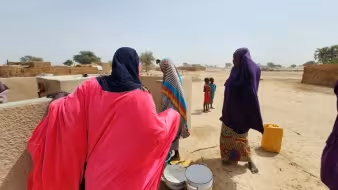
Yes, this is a very important question because you can ratify convention. And what's going on on the ground is something different. So governments are working with international organizations to ensure that they provide support, they provide protection, and they ensure that IDPs have their basic needs. So there are a lot of organizations, international organizations that operates in the Sahel. I'm thinking of UNHCR, IOM or the World Food Programme to make sure that this particular and very, very vulnerable communities are really taken care of. If I have to add a point regarding the host communities and how they are welcoming towards IDPs, for example, I would like to highlight the fact that people that are moving are mainly people working within the agricultural sector, which is very common in African countries in the Sahelian regions. And we have some examples of host communities that consciously, like they lend some parts of the agricultural lands to IDPs so that they can work on it during the raining seasons. So we have this type of help that communities like the host communities will just organize themselves and integrate the IDPs within their community because they know that they are vulnerable.


[00:17:03.11] 

So even without the help of the governments and NGOs, local communities are really welcoming and they are trying to help IDPs to face this situation and not be always dependent on what's coming from the governments or what's coming from the NGOs.


[00:17:24.11] 

That's really interesting. And a question for you is, do you feel there might be a distinction in how refugees are received against IDPs, both in terms of the support from local communities, but also the government response?


[00:17:39.14] 

Yes, there are some differences and this actually sometimes lead to conflicts between host communities and IDPs, because sometimes host communities feel like IDPs are treated better than them. This happens when we talk about migration because, for example, there are some international organizations that help migrants that want to go back in their country to come back. They help them set up something to make a living. And these kind of things can be perceived as not just not equal to local communities. Sometimes they feel like this person was able to migrate, his migration was not successful, now he's coming back and he's receiving more help than us that did not migrate. These type of things happens also when we talk about IDPs and host communities or refugees and host communities, because sometimes they feel like they are treated better, they are offered more opportunities than local communities. So these kind of things should be taken care of by policymakers to ensure that host communities also are not receiving the same thing, but in a way that they are also looked at just not to create other type of conflicts that are not needed at all.


[00:19:24.02] 

Thanks, that's a very good point. And we know that agencies and development actors like the UNHCR or the World Bank are thought to have this comprehensive approach to both host communities, internally displaced person refugees. But as you described, there's still a lot to do in this area, and especially as we know this, issues are likely to persist. And that's one of my last question for you. What's likely to happen in the region in the next few years? What are the key trends that we should be watching?


[00:19:57.17] 

I would like to say that we hope that insecurities and terrorist attacks will not occur that often. Everything is linked to the capacity of governments to face terrorism if they are able to fight back and if they are able to treat the underlying reasons why people are turning against their state or everything is linked to the capacity of governments to face terrorism. The answer to that question is linked to that. If they are able to ensure the security of populations, we may witness a decrease of the number of IDPs and an increase of people going back to their origin communities, to their origin countries. But if the fundamental issues that are linked to government failure, that are linked to people not being able to provide for their living, if these kind of issues continue, continues, we unfortunately will witness more and more IDPs, more refugees, and this is not what we hope for our countries. And hopefully governments will be able to tackle these issues and be able to face the terrorism. And everything is basically linked to that.


[00:21:27.03] 

And I think on this I just want to ask your last question because we've, you know, we sometimes read about the connection between local violence, local tension, terrorism, and also just climate change and the effect of climate change on displacement on migration. Is that something that you see also as gaining importance in the next years and how, you know, what could be done, how government anticipating for this?


[00:21:51.22] 

Yes, this is a very important question because most of Africans are working in the agricultural sector and with the climate change and with the number of IDPs that are increasing in host communities, this will exacerbate the consequences of climate change because creates tension on the resources like water, land and so on. And if governments are not able to manage that, this will lead to what we call in economics a tragedy of comments though this means basically that it's a key point that the government have to very much put an eye on and work a lot on it because with the climate change, with the increased number of people in host communities that are basically not prepared to receive this amount of people in a short time, it creates tension on the resource. And this is an important point, this is a key point where the governments have to work on.


[00:23:02.09] 

Thank you very much Alex for all of this insights and thank you for joining the podcast and for all your precious insight today. To our listeners, thank you for tuning in to another episode of the Word of Migration. If you enjoyed this question conversation, please check out our other episodes which you can find on Word of Migration wherever you get your podcast. And while you're there, please leave us a review. You can also find all of this episode for this and other MPI podcasts at MPI website migrationpolicy.org/podcast. Finally, this episode was produced by Yoseph Hamid and made by possible with help from Lisa Dixon and editorial input from Michelle Mittelstadt. Our theme music is called Bright Idea by Geographer and I'm Camille Le Coz. Thank you again for listening and see you next time.

What is driving the displacement crisis across the Sahel, and what does it look like from inside one of the most affected countries?

West Africa’s Sahel region is experiencing crisis, with outbreaks of violence, weak economies, governance issues, and climate change. These challenges are leading to an increasing number of people being internally displaced or seeking refuge in other countries. In this episode, MPI Europe Associate Director Camille Le Coz discusses rising displacement in the Sahel with development economist Alexandra Tapsoba.

About the Global Program

The Global Program bridges policy advice, research, and candid dialogue to design effective migration policies, drawing on global evidence and anticipating the forces reshaping how people move.