Essey Workie
Essey Workie is former Director of MPI's Human Services Initiative. Her work focused on unaccompanied children, immigrant families, and access to local, state, and federal health and human service programs.
Ms. Workie previously worked as the Director of Refugee Health and the Director of Planning and Development at the U.S. Committee for Refugees and Immigrants, where she established the national refugee medical assistance and medical screening programs in multiple states. Previously, she served as the senior federal official and regional spokesperson for the U.S. Department of Health and Human Services' Administration for Children and Families in the mid-Atlantic region. She also founded the division of refugee health at the federal Office of Refugee Resettlement.
Ms. Workie began her career in nonprofit organizations and local government as a social worker, specializing in child and adolescent mental health.
She has a bachelor’s degree in psychology from James Madison University and a master’s degree in social work from Temple University. She is also a leadership coach with an executive certificate in leadership coaching from Georgetown University, and provides pro-bono coaching services to immigrants, minorities, and other marginalized groups.
Explore Content by Essey Workie
Showing 1-10 of 14 total results
Four Strategies to Improve Community Services for Unaccompanied Children in the United States
Coordination, school-based hubs, interdisciplinary care, and a skilled workforce are four key strategies to improve post-release services for unaccompanied children.

The Public-Charge Final Rule Is Far from the Last Word
The Biden administration public-charge final rule undoes deep restrictions imposed during the Trump era, codifying much of the policy in place from 1999 to 2019. Yet confusion and fear over triggering negative immigration consequences will continue to keep many immigrants and their U.S.-born relatives from accessing benefits and services for which they are eligible absent a robust educational campaign, this commentary explains.

The Missing Link: Connecting Eligible Asylees and Asylum Seekers with Benefits and Services
Asylees are eligible for many U.S. refugee-equivalent benefits but lack systems to connect them. Weak outreach and fragmented data leave many underserved.

En Busqueda de Seguridad: Opciones de protección regional para personas de Centroamérica
Con motivo de la publicación de un informe del Instituto de Política Migratoria sobre posibles vías de protección para las personas centroamericanas, este webcast ofrece un análisis sobre las vías humanitarias y de reasentamiento que ya se utilizan en la región así como las oportunidades y los obstáculos para expandir estos programas.
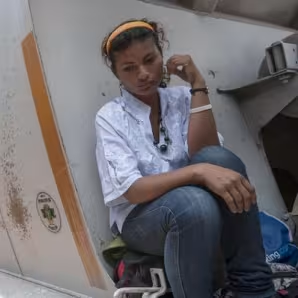
Seeking Safety: Regional Protection Options for Central Americans
Speakers offered analysis on regional resettlement and humanitarian channels for Central Americans, along with specific actions the United States and Canada could take.
Bridging the Digital Divide for U.S. Children in Immigrant Families
Taking stock of lessons learned about remote learning during the pandemic, this webinar examined how governments, schools, and service providers can advance digital equity for children in immigrant families.
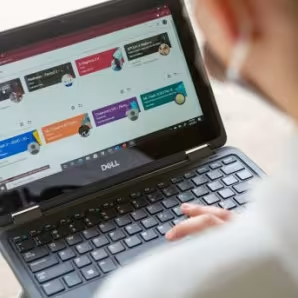
Advancing Digital Equity among Immigrant-Origin Youth
This report examines digital equity barriers facing immigrant-origin youth in the United States and offers recommendations to help schools and policymakers close technology gaps.
El relanzamiento del Programa de Menores Centroamericanos: Oportunidades para realzar la protección infantil y la reunificación familiar
El relanzamiento del Programa para Menores Centroamericanos en 2021 expandió el acceso a la reunificación familiar, pero aún requiere más financiamiento localizado, procesamientos más sencillos y mayor apoyo a la integración.

Relaunching the Central American Minors Program: Opportunities to Enhance Child Safety and Family Reunification
The Central American Minors Program relaunch in 2021 expanded family reunification access. But it needs dedicated funding, simpler processing, and stronger integration support to succeed.

MPI 20th Anniversary Conference: Migration & Humanitarian Protection in a Rapidly Evolving World
MPI’s 20th Anniversary featured the Director-General of the International Organization for Migration, António Vitorino, in an armchair conversation with MPI co-founder and President Emeritus Demetrios G. Papademetriou, and a panel discussion with UN High Commissioner for Refugees Filippo Grandi and MPI co-founder Kathleen Newland.
