Getting the Balance Right: Strengthening asylum reception capacity at national and EU levels
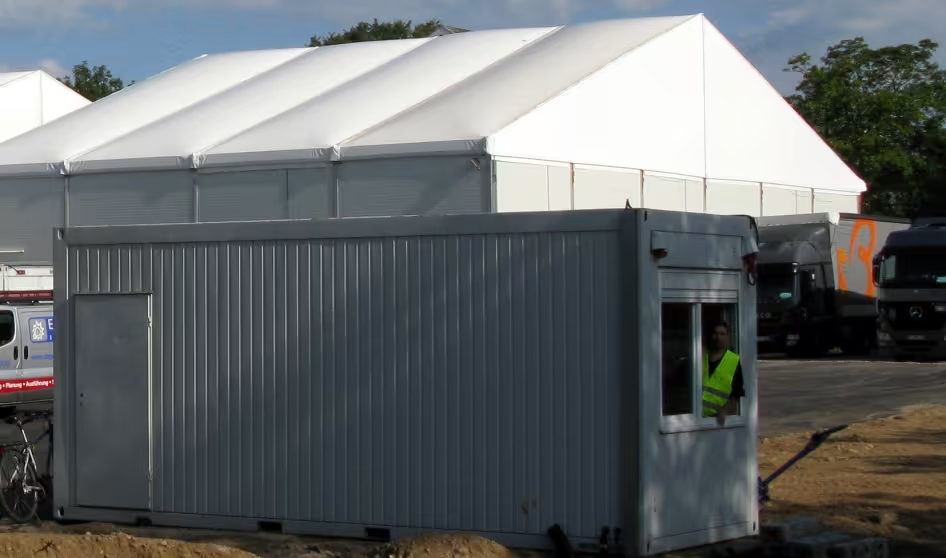
EU asylum reception demands simultaneous flexibility, efficiency, and quality, and when any Member State fails to maintain all three, the effects cascade across the bloc.
With arrivals of asylum seekers to the European Union (EU) occurring on a major scale, Member States face daunting technical and political challenges. The resources and institutional reception capacity of some Member States have been overwhelmed in recent months, leaving people homeless or in overcrowded and otherwise precarious shelter and livelihood situations. These outcomes highlight the central importance of well-functioning reception systems for asylum seekers in the European Union, as this MPI Europe report details.
When the reception capacity of one country comes under pressure, efforts to promote solidarity at the wider EU level can be undermined. A country whose overburdened system cannot accommodate more applicants may see new arrivals avoiding or passing through it in search of better conditions elsewhere. Faced with high numbers of arrivals, countries with less-developed reception systems or more limited experience integrating refugees effectively may attempt to deflect migrant flows by, for instance, facilitating their onward travel or closing borders. The result is even greater pressure on neighboring Member States. In a separate point, Member States struggling to process spontaneous arrivals may prove reluctant to accept asylum seekers and refugees by other means, such as relocation or resettlement.
This report, written by the Operational Director for the Belgian reception agency, seeks to understand the reception capacity challenges faced by EU Member States and to stimulate reflection on possible answers. It first presents the three tenets of a successful reception system—flexibility, efficiency, and quality—and the difficulty balancing their often-conflicting demands. It then reflects on divergent national approaches to reception management, and seeks to understand why certain strategies are adopted, and with what consequences for Member States and the Common European Asylum System (CEAS) at large. The report concludes with reflections on the central importance of reception as a building block of the CEAS, and potential ways forward to strengthen its quality, flexibility, and cost efficiency through improved coordination and delivery of support.
Table of Contents
I. Introduction
II. Managing Reception: Key Challenges
A. Background: Managing Resources in a Volatile Environment
B. Balancing the "Reception Triangle"
C. An Integrated Approach: Internal and External Measures
D. Challenges Across National Reception Systems
III. The European Perspective
A. The Case for European Cooperation
B. Toward Greater Solidarity: Recommendations to Strengthen Reception Capacity EU-wide
IV. Conclusion
About the Moving Europe Beyond Crisis Project
As the systems designed to process migration flows to Europe buckled in 2015-16, this project offered new ideas to manage mixed flows and create sustainable long-term solutions for refugees.
About the Global Program
The Global Program bridges policy advice, research, and candid dialogue to design effective migration policies, drawing on global evidence and anticipating the forces reshaping how people move.


Related Content