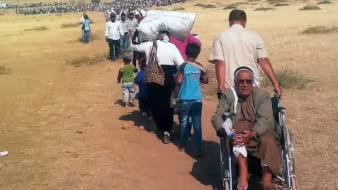
Asylum Reception in the European Union: A flexible model for the future?
The pressure brought by the influx of migrants and refugees to Europe has drawn attention to the need for systems to receive and house new arrivals that can adapt to unpredictable numbers, remain cost-efficient, and meet national and EU standards. Experts discuss how to devise a more responsive asylum reception system that upholds common standards at the national and EU level.
The pressure brought by the recent mass influx of migrants and refugees to Europe has drawn attention to the need for systems to receive and house new arrivals that can adapt to unpredictable numbers, remain cost-efficient, and meet national and EU standards. But what does it take to set up and manage a reception system that can simultaneously meet the demands of flexibility, quality, and efficiency?
While countries such as Greece, Germany, and Sweden continue to strive to find enough basic accommodation for newcomers, others, such as Finland, have announced a major scaling back of (underused) facilities. Still others have opted to cap the number of asylum seekers registered daily to maintain minimum standards. Yet, there may be strength in such different approaches. EU Member States may benefit from cooperating with each other—and actors such as the European Asylum Support Office (EASO)—to pool expertise and experiences, and create economies of scale. Such cooperation may have added benefits: creating habits of working together can help build the trust and confidence needed for a political breakthrough in other areas of asylum policy.
Michael Kegels, Fedasil Belgium’s Director of Operational Services and author of the recent MPI Europe report, Getting the Balance Right: Strengthening Asylum Reception Capacity at National and EU Levels, examines how to devise a more responsive asylum reception system at national and EU levels that upholds common standards. Speakers also discuss the practical challenges of meeting asylum-seeker reception demand, the prospects of greater cooperation, and the place of asylum reception policy at the heart of the Common European Asylum System.
Speakers:
Michael Kegels, Director of Operational Services, Fedasil Belgium
Jamil Addou, Coordinator of the Quality Division, Centre for Training, Quality, and Expertise, European Asylum and Support Office
Karoline Preisser, Legal Expert, Department for Basic and Federal Care, Federal Ministry of the Interior, Austria
Moderators:
Hanne Beirens, Associate Director, Migration Policy Institute Europe
About the Moving Europe Beyond Crisis Project
As the systems designed to process migration flows to Europe buckled in 2015-16, this project offered new ideas to manage mixed flows and create sustainable long-term solutions for refugees.
About the Global Program
The Global Program bridges policy advice, research, and candid dialogue to design effective migration policies, drawing on global evidence and anticipating the forces reshaping how people move.