Hanne Beirens

Hanne Beirens is former Director of Migration Policy Institute Europe, where she specialised in European Union policies related to asylum and migration, human trafficking, labour migration, and youth. She is an MPI Europe Fellow.
Prior to joining MPI as Associate Director in 2015, Dr. Beirens worked as a Lead Managing Consultant for ICF Consulting, where she focused on impact assessments, feasibility studies, and evaluations for the European Commission, with a particular focus on EU asylum and migration policy.
Earlier, Dr. Beirens worked as a Research Fellow at the Institute for Applied Social Studies of the University of Birmingham, evaluating services, organisations, and community-based initiatives pursuing the integration of asylum seekers, refugees, and third-country nationals. She also has worked for the United Nations High Commissioner for Refugees (UNHCR) and as an independent consultant for the International Labour Organization (ILO) and the Quaker United Nations Office (QUNO).
She holds a master's degree in race and ethnic relations (with distinction) and a PhD in sociology and ethnic relations on the participation of minors in armed conflict, both from the University of Warwick (UK).
Explore Content by Hanne Beirens
Showing 1-10 of 36 total results
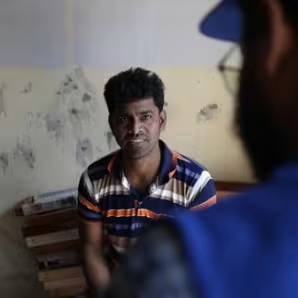
To Leave or Stay? Examining the role of counseling and reintegration assistance in the return decision-making of migrants ordered to leave the Netherlands
More counselling and better reintegration support increase uptake of assisted return in the Netherlands, but neither factor alone determines the return decisions of migrants ordered to leave.

Germany, and Maybe the European Union, Are at a Migration Crossroads
Germany's reinstatement of border controls with its nine neighbors runs the risk of creating a chain reaction, with other EU Member States following suit. In the process, this go-it-alone approach could pose a serious threat to the Schengen free movement zone as well as put the common European asylum system at risk, as this MPI Europe commentary explains.
Ukrainians in the EU: What is next after the Temporary Protection Directive?
On the second anniversary of the first-ever activation of the Temporary Protection Directive, this event considered EU support for millions of displaced Ukrainians, the directive's possible 2025 expiration, and other innovative approaches to temporary status.
One Phase Closes for the New Pact on Migration and Asylum. Now Another Begins
The New Pact on Migration and Asylum agreed in December 2023 by EU Member States and the European Parliament after lengthy negotiation will, without a doubt, go down in history as a signal political accomplishment. But will it result in better management of migration and asylum systems in a complex era? The outcome will turn on implementation and communication, this MPI Europe commentary explains.
What Role Could Digital Technologies Play in the New EU Pact on Migration and Asylum?
EU asylum reforms hinge on the effective use of digital tools, but without strong safeguards these same technologies could harm migrants’ rights.

Toward a Road Map for Digitalisation in the EU Humanitarian Protection Space
Digital solutions were crucial for governments and stakeholders involved in the reception and integration of displaced Ukrainians. This conversation examined lessons learned and how digital tools might strengthen migration and integration systems.

Ukrainian Displacement in Europe, One Year Later
In 2023, one year into Ukraine's displacement crisis, this discussion examined integration into housing, education, and labor markets in Europe, return preparation, and lessons from the Temporary Protection Directive.
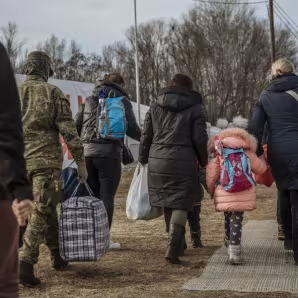
Prolonged Ukrainian Displacement: An uneasy marriage of reception, integration, and return policies
One year into the vast Ukrainian displacement crisis sparked by Russia's invasion, European policymakers are having to confront the likelihood of prolonged stay for millions of Ukrainians and the prospect of new displacement. How can they juggle longer-term integration, first-reception services for new arrivals, and prepare Ukrainians for eventual return to rebuild their country? They will have to focus on multipronged policies and services, this commentary suggests.

Rebooting the Asylum System? The Role of Digital Tools in International Protection
COVID-19 accelerated digital innovation across asylum systems. Six key lenses reveal both the promise and significant risks of using technology in humanitarian protection systems.

Delivering on the Promise of Predeparture Counselling for Sustainable Reintegration
Experts examined how to leverage predeparture counselling for sustainable reintegration of returnees and how to strengthen the links between the predeparture and post-arrival phases in reintegration programs.