Lucía Salgado
Lucía Salgado was an Associate Policy Analyst at MPI Europe, where she focused on European policies related to migrant integration and return.
Prior to joining MPI Europe, Ms. Salgado worked for the United Nations High Commissioner for Refugees (UNHCR), first at the UNHCR Representation to EU Affairs in Brussels and later at its Liaison Office to the European Asylum Support Office (EASO) in Malta. Previously, she worked as a Blue Book Trainee at the Directorate General for Migration and Home Affairs within the European Commission, where she focused on return and irregular migration policies. She has also worked at the Consulate General of Spain in Melbourne and interned with the Spanish Ministry of Foreign Affairs, where she assisted with asylum-related matters.
Ms. Salgado holds a master’s degree in international relations, with distinction, from King’s College London, where she specialised in EU migration policy. She also holds bachelor’s degrees in sociology and political science from University Carlos III of Madrid.
Explore Content by Lucía Salgado
Showing 1-10 of 10 total results
Exploring Refugees’ Intentions to Return to Ukraine: Data insights and policy responses
Drawing on surveys of nearly 61,000 Ukrainians, this report finds that security, host-country support, and jobs shape Ukrainian refugees’ return plans.

Managing International Protection Needs at Borders
Amid rising mixed migration flows, managing international protection needs at borders requires differentiated screening, flexible surge capacity, interagency coordination, and proactive investment.

Ukrainians in the EU: What is next after the Temporary Protection Directive?
On the second anniversary of the first-ever activation of the Temporary Protection Directive, this event considered EU support for millions of displaced Ukrainians, the directive's possible 2025 expiration, and other innovative approaches to temporary status.
Confronting Compassion Fatigue: Understanding the arc of public support for displaced populations in Turkey, Colombia, and Europe
Compassion for displaced Syrians in Turkey, Venezuelans in Colombia, and Ukrainians in Europe is fading as displacement persists and public anxiety over housing, jobs, and identity deepens.

What Role Could Digital Technologies Play in the New EU Pact on Migration and Asylum?
EU asylum reforms hinge on the effective use of digital tools, but without strong safeguards these same technologies could harm migrants’ rights.

Prolonged Ukrainian Displacement: An uneasy marriage of reception, integration, and return policies
One year into the vast Ukrainian displacement crisis sparked by Russia's invasion, European policymakers are having to confront the likelihood of prolonged stay for millions of Ukrainians and the prospect of new displacement. How can they juggle longer-term integration, first-reception services for new arrivals, and prepare Ukrainians for eventual return to rebuild their country? They will have to focus on multipronged policies and services, this commentary suggests.

Delivering on the Promise of Predeparture Counselling for Sustainable Reintegration
Experts examined how to leverage predeparture counselling for sustainable reintegration of returnees and how to strengthen the links between the predeparture and post-arrival phases in reintegration programs.
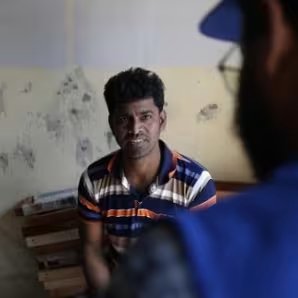
Leveraging Predeparture Counselling to Support Returning Migrants’ Sustainable Reintegration
Poor information-sharing limits predeparture counseling in European return programmes; data standards, virtual provider links, and digital tools can improve reintegration.

Promoting the Inclusion of Europe’s Migrants and Minorities in Arts and Culture
Europe's cultural institutions trail societal diversity. Anti-racism movements and the COVID-19 pandemic have heightened the push to include migrants and minorities in the arts.

Putting Migrant Reintegration Programmes to the Test: A road map to a monitoring system
EU-funded assisted voluntary return and reintegration (AVRR) programmes lack robust monitoring. This road map proposes frameworks for economic, social, and psychosocial outcomes.