Human Services Initiative
The Human Services Initiative produced research, policy analysis, and technical assistance to inform U.S. federal, state, and local policies on immigration issues affecting children, families, and health and human services. Its work spanned three core areas: strengthening refugee resettlement services with attention to underserved groups such as women, children, and individuals with disabilities; analyzing policies and programs for unaccompanied minors in custody, in communities, and upon return to their countries of origin; and examining legal and policy frameworks governing immigrants' eligibility for public benefits such as Medicaid and SNAP, while addressing barriers to access for asylees, children of immigrants, and other eligible groups.
Keep Up with the Latest
Showing 21–30 of 40 results
Strengthening Services for Unaccompanied Children in U.S. Communities
Tens of thousands of unaccompanied children arrive in U.S. communities each year with critical legal and service needs that local systems are ill-equipped to meet.

U.S. Government Makes Significant Strides in Receiving Unaccompanied Children but Major Challenges Remain
The federal government has made notable progress since March 2021 in getting unaccompanied children arriving at the U.S.-Mexico border out of Border Patrol facilities and into Office of Refugee Resettlement (ORR) custody, and then releasing them to parents or other sponsors. Yet there are serious concerns about standards of care and conditions in a new type of ORR facility: emergency intake sites, as this commentary explores.
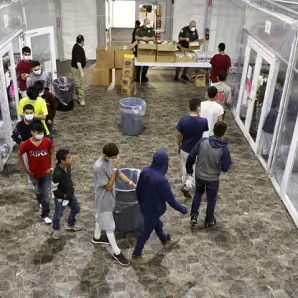
Hampered by the Pandemic: Unaccompanied Child Arrivals Increase as Earlier Preparedness Shortfalls Limit the Response
The increase in unaccompanied child arrivals at the U.S.-Mexico border in February and March has led to backups and overcrowding at U.S. Customs and Border Protection facilities ill-suited to house children, in part due to earlier significant reductions in Office of Refugee Resettlement shelter capacity during 2020. This commentary explores preparedness shortfalls and the options the Biden administration has moving forward.
Nearly 3 Million U.S. Citizens and Legal Immigrants Initially Excluded under the CARES Act Are Covered under the December 2020 COVID-19 Stimulus
The pandemic-recovery stimulus package that passed Congress in December rectified what many had viewed as a significant oversight in the earlier CARES Act: Its exclusion of U.S. citizens and legal immigrants in mixed-status families. MPI researchers estimate nearly 3 million U.S. citizens and legal immigrants excluded from the earlier legislation can receive the later relief, as well as qualify retroactively for the CARES Act payment, as this commentary explores.

Anticipated “Chilling Effects” of the Public-Charge Rule Are Real: Census Data Reflect Steep Decline in Benefits Use by Immigrant Families
Researchers, service providers, and others have long predicted that sweeping revisions by the Trump administration to the definition of who constitutes a public charge would deter large numbers of immigrant-led households from using federal means-tested public benefits for which they are eligible. Recently released Census Bureau data show they were right: During the administration's first three years, program participation declined twice as fast among noncitizens as citizens.
Barriers to COVID-19 Testing and Treatment: Immigrants without Health Coverage in the United States
Some 7.7 million uninsured noncitizens faced barriers to COVID-19 testing and treatment in 2020, with millions excluded from Medicaid due to immigration status restrictions.

Green Cards and Public Charge: Who Could Be Denied Based on Benefits Use?
On this webinar MPI experts discuss their estimates of the populations that could be deemed ineligible for a green card based on existing benefits use. They also discuss the broader consequences of the public-charge rule implemented in February 2020, through its "chilling effects" and imposition of a wealth test aimed at assessing whether green-card applicants ever would be likely to use a public benefit in the future.
The Public-Charge Rule: Broad Impacts, But Few Will Be Denied Green Cards Based on Actual Benefits Use
While the Trump administration public-charge rule is likely to vastly reshape legal immigration based on its test to assess if a person might ever use public benefits in the future, the universe of noncitizens who could be denied a green card based on current benefits use is quite small. That's because very few benefit programs are open to noncitizens who do not hold a green card. This commentary offers estimates of who might be affected.

Employment Services for Refugees: Leveraging Mainstream U.S. Systems and Funding
On this webinar, experts and state refugee resettlement program leaders discuss two activities that can be key parts of a broader strategy for sustaining and improving employment services for refugees: Partnerships with experts in workforce development strategies, and access to federal workforce development funding.

Health Insurance Test for Green-Card Applicants Could Sharply Cut Future U.S. Legal Immigration
A new Trump administration action requiring intending immigrants to prove they can purchase eligible health insurance within 30 days of arrival has the potential to block fully 65 percent of those who apply for a green card from abroad, MPI estimates.