Immigration Systems

All Content
Showing 1021–1030 of 1266 results
Lessons from the 2007 Legal Arizona Workers Act
Discussion on new Public Policy Institute of California (PPIC) report with PPIC Research Fellows; Bruce A. Morrison, Former U.S. Congressman from Connecticut (1983-1991) and Chair of the Immigration Subcommittee; and Marc Rosenblum, MPI Senior Policy Analyst.
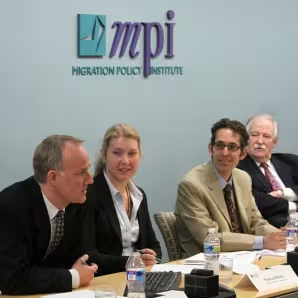
Steps to Fix the U.S. Immigration System: What Can the Administration Do?
MPI report release with authors MPI's Donald Kerwin, Margie McHugh, and Doris Meissner who engage in a discussion with Eva Millona, Executive Director, Massachusetts Immigrant and Refugee Advocacy Coalition; and Juan P. Osuna, Acting Director, Executive Office for Immigration Review, U.S. Department of Justice, on what the U.S. administration can do to fix immigration policy absent congressional action.

Executive Action on Immigration: Six Ways to Make the System Work Better
Six executive actions could improve U.S. border control, integration, legal admissions, and fairness in enforcement without new laws.

A New Architecture for Border Management
Information-driven, risk-based “smart border” systems push controls away from the physical frontier toward advance data screening, while raising ethical concerns.
E-Verify: Strengths, Weaknesses, and Proposals for Reform
E-Verify’s gains in speed and coverage are undercut by data errors, identity fraud, and gaps in worker protections.
Delegation and Divergence: 287(g) State and Local Immigration Enforcement
MPI Report release with authors MPI's Randy Capps and Muzaffar Chishti examining step localities are taking in enforcing immigration law and the possible impacts on communities. Jerry Gonzalez, Executive Director, Georgia Association of Latino Elected Officials, and Captain LeRoy Kirkegard, Las Vegas Metropolitan Police Department, provided comments.
The Evolution of Border Controls as a Mechanism to Prevent Illegal Immigration
Modern border controls combine technology and risk profiling. But without legal channels, they often displace rather than deter irregular migration.
Does Low-Skilled Immigration Hurt the U.S. Economy? Assessing the Evidence
Report release and discussion on the impacts of low-skilled immigration on the U.S. economy, with author Harry Holzer, Professor, Georgetown Public Policy Institute; Darrell M. West, Vice President and Director of Governance Studies, and Founding Director, Center for Technology Innovation, Brookings Institution; and MPI's Demetrios G. Papademetriou, Doris Meissner, and Michael Fix.
Earned Legalization: Effects of Proposed Requirements on Unauthorized Men, Women, and Children
The brief models how common requirements in U.S. earned legalization plans, English skills, steady work, long-term U.S. residence, and monetary fines, would affect who qualifies.
Immigration Policy and Less-Skilled Workers in the United States: Reflections on Future Directions for Reform
The mixed impacts of less-skilled immigration suggest the need for legal channels, flexible visa numbers, and job portability reforms to build a more adaptive system.