The Evolution of Border Controls as a Mechanism to Prevent Illegal Immigration
Modern border controls combine technology and risk profiling. But without legal channels, they often displace rather than deter irregular migration.
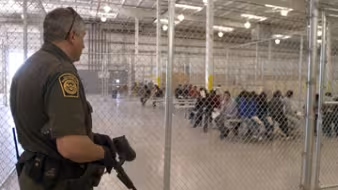
Effective border control in the United States has become an increasing challenge over the past few decades. Faced with enormous political pressure to stop illegal immigration and to prevent the entry of potential terrorists, the U.S. government has devoted ever more resources to enforcing border policies. It remains unclear, the author argues, whether the efficacy of these programs warrants their enormous costs.
Efforts to prevent entries at unauthorized locations have mainly targeted the U.S.-Mexico land border, and have included the construction of physical fencing; a controversial and ultimately unsuccessful “virtual fence” program with an array of radars, ground sensors, and unmanned aerial vehicles; and a fivefold increase in the number of agents deployed at the Southwest border. U.S. policymakers have also designed various systems to collect more extensive data on incoming travelers before they reach the United States. Certain programs have been executed with relative ease, while implementation has proved more difficult for other programs—as has the challenge of managing ports of entry, spurring the creation and development of systems intended to both provide more intensive screening and to facilitate international trade and the movement of people. At the same time, Congress has a history of setting immigration enforcement goals that are not always realistic or feasible.
Though political support remains strong for border management efforts, the programs’ varying levels of success calls into question whether they are worth their extraordinary cost or whether resources could be more productively employed elsewhere.
Table of Contents
I. Introduction
II. The Challenges of Border Security
A. Legal and Illegal Entries to the United States
B. Increasing Resources for Border Security
C. Chasing a Moving Target?
D. Facilitating and Securing International Trade and Mobility
III. U.S. Border Security Systems: Development, Implementation, and Effectiveness
A. Surveillance Between Ports of Entry and the Secure Border Initiative
B. Border-Control Processes at Ports of Entry
C. Registered-Traveler Programs
D. Entry-Exit Systems
E. Visa Waiver Program Reform, ESTA, and US-VISIT Air Exit
F. Challenges Implementing US Border Policies
IV. Conclusion
About the MPI-EUI Project
This concluded, EU-funded project identified ways in which European and U.S. immigration systems can be improved to address major challenges, in the context of economic turmoil and in the longer term.
About the U.S. Immigration Policy Program
The U.S. Immigration Policy Program provides analysis of U.S. immigration pathways, the impacts of enforcement and other policies, and the characteristics of immigrant populations.