The State of Global Mobility in the Aftermath of the COVID-19 Pandemic

Related Content
Highlights
COVID-19 shut down global mobility during the first year of the pandemic. But 2022 saw a rapid rebound. This IOM-MPI report reveals shifting patterns post-pandemic, from Gulf labor flows to climate-driven displacement.
- By 2022, nearly all COVID-19 travel measures had been lifted and mobility rebounded almost instantly, with labor migration from South and Southeast Asia to Gulf Cooperation Council (GCC) countries exceeding pre-pandemic levels.
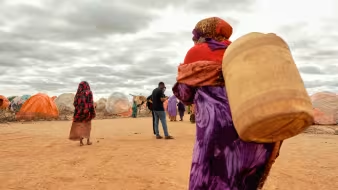
- Climate shocks drove mass displacement: East Africa's fourth consecutive failed rainy season triggered 3.1 million internal displacements in 2022, while catastrophic flooding in Pakistan displaced 8 million people.
- Irregular migration to Europe reached its highest levels since 2015–2016, with migrants shifting to more dangerous routes—Mediterranean crossings and the Balkans—as legal pathways failed to keep pace with demand.
- Migration in the Americas became truly hemispheric: Venezuelan and Haitian displacement stretched across the region, with record crossings of the Darién jungle as migrants moved northward toward the United States.
The robust recovery of migration and travel following the COVID-19 pandemic-induced slowdown has vividly highlighted the resilience of human mobility. Yet even as cross-border movement has rebounded to pre-pandemic levels, it has also changed in notable ways.
This report—a collaboration between the International Organization for Migration (IOM) and MPI—seeks to understand how the volume, composition, and distance of movements, as well as the terms under which people move, are changing in the aftermath of the pandemic. While existing data do not make it possible to sketch a full picture of mobility around the entire globe, this study brings together IOM flow monitoring data from different regions to examine the changing face of migration, both regular and irregular.
The report presents seven case studies that cover a wide range of migrant destinations: the strengthening of migration corridors to Gulf Cooperation Council countries; resurging intraregional mobility in Southern Africa; Latin America's shifting status as not just a source of emigrants but also a destination for migrants; and the rebound in irregular migration to Europe. These case studies also cover a diverse set of drivers, including growing climate shocks in East Africa and Pakistan, the Taliban takeover in Afghanistan, and the Russian invasion of Ukraine.
Table of Contents
1 Introduction
2 COVID-19 and the Global Reopening in 2022
3 Reinvigorated and Diversifying Movement to the Arabian Peninsula
4 Growing Climate Mobility Challenges in East Africa and Pakistan
5 Short-Term Mobility, Crises, and Tensions in Southern Africa
6 Refugees from Ukraine and the Changing Face of Conflict-Related Displacement
7 Revived Irregular Migration to Europe
8 Changing Migration Patterns to, from, and within Afghanistan
9 Accelerating Crises and Mobility Transitions in the Americas
10 Conclusions
About the Global Program
The Global Program bridges policy advice, research, and candid dialogue to design effective migration policies, drawing on global evidence and anticipating the forces reshaping how people move.





Related Content