
Lawrence Huang

Lawrence Huang is a Senior Policy Analyst with MPI’s Global Program, primarily working on climate and migration. His research areas also include development and migration, border management, and refugee protection. He leads a research project on climate and migration and the intersections with development, social cohesion, labor migration, and protection. He has also worked on issues around climate financing, conducted external evaluations of climate migration programming, and advised governments, international organizations, and multilateral development banks working on the issue. He also supports MPI’s work on borders and mobility, including MPI’s Task Force on Borders and Mobility During and After COVID-19.
Previously, Mr. Huang worked as a consultant at the International Organization for Migration, where he led capacity-building and knowledge management in an 11-country global program on migration and sustainable development. Earlier, he was an Editor at the Oxford Monitor of Forced Migration and co-ran the annual conference of the Oxford Migration Studies Society.
He holds a master’s degree in migration studies from the University of Oxford, funded by the Healy Scholarship at St. Cross College, and a BA in government with honors from Georgetown University.
- Media Inquiries
-
Michelle Mittelstadt
202 266 1910 [email protected]
Explore Content by Lawrence Huang
Showing 1-10 of 26 total results
Migration Diplomacy in an Age of Transactionalism
As international cooperation frays, balanced diplomacy—rather than coercive dealmaking—promises the most effective approach to emerging migration challenges.

The Role of Immigration as South Korea Navigates Demographic Decline
A country that was 0.3% foreign-born in 1998 is now racing to redesign its immigration system before a demographic crisis reshapes its economy and workforce.
Migration amid Climate Change: Adaptation, Displacement, and People Trapped in Place
How does climate change reshape human mobility? Webinar offers on-the-ground insights into climate-driven migration, adaptation, and displacement.

Humanitarian Assistance in a Time of Deep Foreign Aid Cuts
The U.S. gutted its foreign aid budget, Germany cut humanitarian assistance by nearly half, and the UK followed—a frontline worker in Uganda explains exactly what that looks like for refugees on the ground.
Can Innovation Help Blunt the Impact of Foreign Aid Cuts on Migration Management Programs?
The termination of what MPI estimates is up to $2.3 billion in yearly U.S. foreign aid earmarked for migration and displacement projects leaves a vast gap that other international donors are unlikely to fill, particularly as European countries are themselves cutting their assistance. This short read posits three scenarios that may emerge, including one in which these funding shocks unleash long-discussed innovations and efficiencies in migration management and displacement programming.

Funding Climate Mobility Projects: Key Players and Strategies for Growth
Climate mobility funding has expanded since 2017 but still falls short of need; bilateral donors lead while multilateral funders hold untapped potential to finance at scale.

Charting a Smart Agenda for Managing Climate Migration
Experts offered concrete examples of how governments across the globe can respond to the nexus of climate change and migration and manage climate mobility.
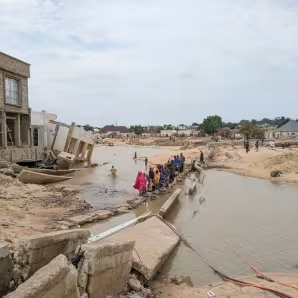
Engaging Local Communities for More Effective Climate Mobility Programming
Local NGOs and municipalities must be treated as genuine partners, not just implementers, if climate mobility programs are to deliver effective, sustainable, and just outcomes.

Displacement and International Protection in a Warming World
Climate-related displacement often falls outside humanitarian protection rules. Governments should consider humanitarian visas, flexible status, and more accessible mobility pathways to address this displacement.

Public Opinion of Climate Migrants: Understanding What Factors Trigger Anxiety or Support
Public support for climate migrants is fragile and can decline when movement seems unmanaged, permanent, or likely to strain climate-affected host communities.
