Muzaffar Chishti

Muzaffar Chishti, a lawyer, is an MPI Senior Fellow and Director of the MPI office at New York University School of Law. His work focuses on U.S. immigration policy at the federal, state, and local levels; the intersection of labor and immigration law; immigration enforcement; civil liberties; and immigrant integration.
Prior to joining MPI, Mr. Chishti was Director of the Immigration Project of the Union of Needletrades, Industrial & Textile Employees (UNITE).
Mr. Chishti serves on the board of the New York Immigration Coalition. He has served as Chairman of the Boards of Directors of the National Immigration Forum and the National Immigration Law Center, as a member of the American Bar Association’s Coordinating Committee on Immigration, and on the board of the Asian American Federation.
Mr. Chishti has testified extensively on immigration policy issues before Congress and is frequently quoted in the media. In 1992, as part of a U.S. team, he assisted the Russian Parliament in drafting its legislation on forced migrants and refugees. He is a 1994 recipient of the New York State Governor's Award for Outstanding Asian Americans and a 1995 recipient of the Ellis Island Medal of Honor.
Mr. Chishti was educated at St. Stephen's College, Delhi; the University of Delhi; Cornell Law School; and the Columbia School of International Affairs.
- Media Inquiries
-
Michelle Mittelstadt
202 266 1910 [email protected]
Explore Content by Muzaffar Chishti
Showing 1-10 of 235 total results
From Counterterrorism to Immigration Enforcement: 25 Years On, Post-9/11 U.S. Changes Have Been Repointed
Post-9/11 national security tools have been repurposed for immigration, expanding the U.S. government’s capacity for surveillance, data sharing, and enforcement.

In Its Second Term, Trump Administration Quietly Expands Family Separation
Immigration enforcement during the second Trump term is driving a quieter, more diffuse wave of family separations inside the United States, often through detention, deportation, and pressures to depart the country voluntarily.

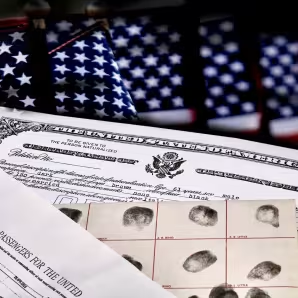
From Last Resort to Intimidating Enforcement Tool: Denaturalization in the Trump Era
The Trump administration is looking to sharply expand denaturalization, which has been historically rare, by using quotas, instituting new priorities, and broadening its targeting.
Attacked as "De Facto Amnesty," U.S. Temporary Protected Status Is Abruptly Eroded
The Trump administration moved to terminate most of the 17 Temporary Protected Status (TPS) designations in place when its second term began, potentially leaving zero protections in place by late November 2026.

Though Rare, Birth Tourism to the United States Sparks Outsized Concern
While rare, birth tourism has become a central but contested justification in the Trump administration's push to end the guarantee of birthright citizenship.

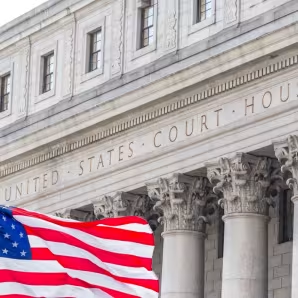
The Trump Administration’s Immigration Policies Encounter Resistance in the Courts
Federal courts have become a key check on the Trump administration’s second-term immigration agenda, frequently halting or narrowing marquee policies.
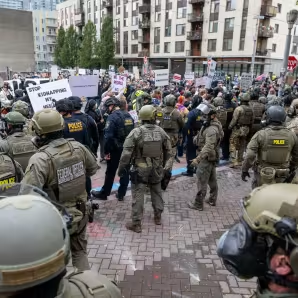
Escalation of ICE Operations Emboldens State and Local Lawmakers to Constrain Its Operations
As ICE enforcement intensified in 2026, a record number of states enacted laws limiting or expanding their cooperation, creating a growing patchwork.
Beyond “Shock and Awe”: Immigration Actions in the First Year under Trump 2.0
Analysts assessed the sweeping immigration enforcement actions, executive orders, and legal challenges marking Trump's second term's first year.

Unleashing Power in New Ways: Immigration in the First Year of Trump 2.0
The Trump second-term immigration overhaul—500-plus policy actions in the first year, record enforcement, and sweeping legal rollbacks—is reshaping who is welcome in America.
U.S. Immigration Courts at a Crisis Point
U.S. immigration courts are facing record backlogs and structural challenges. MPI examined the Biden and Trump administrations' policies and what reforms are needed to improve efficiency and fairness.