U.S. Immigration Policy Program

The U.S. Immigration Policy Program provides thought leadership on ways to improve the U.S. immigration system so that it works most effectively in the national interest. To that end, its work focuses on immigration pathways to the United States and immigration enforcement policies and their impacts. It examines the complex demographic, economic, social, political, foreign policy, and other forces that shape U.S. immigration.
Program staff produce data and analyses of immigration trends and the characteristics of U.S. immigrant populations, including unauthorized immigrants. And they conduct original research on the impacts of policy change and the experiences of immigrant populations in diverse parts of the country. This work is frequently informed by private convenings of policymakers and key stakeholders. For more, click here.
The Latest Research
U.S. Deportations and “Self-Deportations” in the First 18 Months of the Second Trump Term
Filling a gap amid a slowdown in official data reporting from the federal government, this analysis offers a window into deportation and "self…

Featured
Physicians in an Era of Changing Immigration Policy: The Case of Nephrology
The care of kidney disease in the United States relies heavily on international medical graduates (IMGs). Recent policy changes could deepen…

Temporary Visa Holders in the United States
The number of U.S. temporary visas plummeted during the COVID-19 pandemic, rebounded, and then fell again in fiscal year (FY) 2025. Preliminary data…

Following Years of High Border Arrivals, the U.S. Unauthorized Immigrant Population Hits New Peak
MPI estimates the U.S. unauthorized immigrant population reached a new peak of 15.8 million as of mid-2024, after holding steady at around 11 million…

More Featured Work
From Counterterrorism to Immigration Enforcement: 25 Years On, Post-9/11 U.S. Changes Have Been Repointed
Post-9/11 national security tools have been repurposed for immigration, expanding the U.S. government’s capacity for surveillance, data sharing, and…

Attacked as "De Facto Amnesty," U.S. Temporary Protected Status Is Abruptly Eroded
The Trump administration moved to terminate most of the 17 Temporary Protected Status (TPS) designations in place when its second term began,…

Though Rare, Birth Tourism to the United States Sparks Outsized Concern
While rare, birth tourism has become a central but contested justification in the Trump administration's push to end the guarantee of birthright…

Key Statistics
Learn more about immigrants and immigration to the United States
14.8%
The immigrant share of the total U.S. population
Learn how this share has evolved (opens in a new tab)50.2 million
The number of immigrants in the United States
Explore Data Profiles by State (opens in a new tab)18.4%
The share of workers in the U.S. civilian labor force who are immigrants
Get the data at U.S. and state levels (opens in a new tab)
Showing 681–690 of 824 results
Impending Deadlines on a Number of Immigration Decisions Await Obama
A range of difficult immigration decisions await the incoming Obama administration.

Obama's Homeland Security Selection Viewed as Focused on Immigration
Arizona Governor Janet Napolitano's centrist record on immigration left policy experts speculating about the future of U.S. enforcement under the Obama administration.
Mandatory Verification in the States: A Policy Research Agenda
Laws requiring mandatory employment verification in selected states create a critical opportunity to study how employer enforcement reshapes immigration control.
Hispanic Vote Goes for Obama But May Not Lead to Quick Action on Immigration Reform
In 2008, 67 percent of Hispanic voters backed U.S. President-elect Barack Obama, yet Congress was seen as unlikely to act on immigration reform.
Unauthorized Immigration Declining, But Experts Disagree on Why
Unauthorized immigration to the United States fell sharply after 2005, but whether enforcement or the slowing economy deserves credit remained hotly contested.
Foreign-Born Veterans of the U.S. Armed Forces
Foreign-born veterans form a small but highly integrated share of the U.S. veteran population, yet some still struggle with citizenship hurdles.
Party Platforms Discuss Immigration, But Candidates Scarcely Mention It
In 2008, U.S. Republican and Democratic platforms staked out opposing visions on immigration, yet both presidential candidates barely mentioned it at their conventions.
Government Self-Deportation Program Attracts More Criticism Than Immigrants
A 2008 U.S. voluntary departure pilot drew only six participants out of 457,000 eligible immigrants.
Reports Spur Debate Over Immigrant Detention Conditions
As U.S. immigration detention reached 311,213 people in 2007, a federal watchdog report and proposed legislation exposed gaps in detainee medical care.
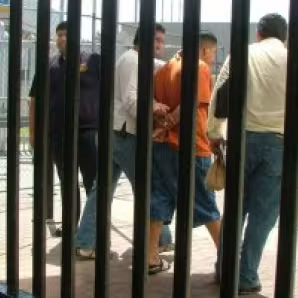
Iowa Raid Raises Questions about Stepped-Up Immigration Enforcement
The May 2008 Agriprocessors raid in Iowa, billed as the largest criminal worksite action in U.S. history, charged many workers criminally rather than administratively.


- General Inquiries
- Media Inquiries
-
Michelle Mittelstadt
202 266 1910 [email protected]