The Challenges of Humanitarian Protection in the 21st Century
Part of The World of Migration
This transcript was generated using AI and may contain inaccuracies. If you notice an error, feel free to email [email protected].
CHAPTERS
[00:02:11]: Dimensions of vulnerability: exposure, sensitivity, and adaptive capacity
[00:04:54]: Why climate impacts do not always lead to migration
[00:07:40]: Constraints on mobility and populations unable to move
[00:14:13]: Evidence from Bangladesh on climate impacts and mobility decisions
[00:19:20]: Climate gentrification and changing patterns of urban development
[00:24:23]: Disaster assistance and variation in recovery across communities
[00:26:56]: Potential destination areas and planning for future population movements
TRANSCRIPT
[00:00:03.05]
Welcome to the World of Migration, a podcast that the Migration Policy Institute has launched as part of its 20th anniversary celebration. This series showcases some of the top thinkers on migration policy who were foundational to MPI's creation, asking them not only to reflect on how policy has changed over the past two decades, but also to share some of their reflections on their careers and offer thoughts for today's emerging migration experts. My name is Susan Fratzke. I'm a Senior Policy Analyst with MPI's International Program, and I'm delighted to speak with MPI Co-Founder and Senior Fellow Kathleen Newland. Kathleen needs almost no introduction. She is extremely well known in humanitarian protection, migration and development, and migration governance circles around the world. She has served on the boards of the International Rescue Committee USA for UNHCR and Kids in Need of Defense, among others, and is Chair Emerita of the Women's Refugee Commission. I am truly hard-pressed to think of anyone better to take on our subject today. The challenges of humanitarian protection in the 21st century. Welcome, Kathleen. The issues facing humanitarian the humanitarian protection community are really more pressing today than they ever have been, I think.
[00:01:28.13]
There's of course the record forced displacement around the world with 82 million people globally who have been displaced from their homes. Nearly 21 million of them are refugees, with largest numbers coming from Syria, Venezuela, Afghanistan, South Sudan, Myanmar, among other countries in Africa and beyond. And of course, the COVID-19 pandemic led to a cascade of border closures that cut off many of the routes that that refugees and other displaced people used to seek protection and completely upended the refugee resettlement system. But we've also seen some real innovation since 2016. A number of countries have started private sponsorship programs that allow individual citizens to welcome refugees. And there are a number of emerging initiatives in Europe and the US to open work and study visas to allow refugees to travel more easily. All that is to say that this is an incredibly timely and interesting moment to be having this conversation. And Kathleen, thank you so much for coming. I think perhaps the best place to start is simply to ask your view. Do you believe that the challenges of humanitarian protection are more complex today than they were 20 years ago? And if so, why?
[00:02:40.07]
I think they are more complex. I can think of a couple of reasons. One of the main reasons is that other event we see when we look back 20 years, namely the terrorist attacks of September 11th and the beginning of the so called war on terror. September 11 had a huge impact on the way the west looked on refugees, especially Muslim refugees, refugees from conflict and Persecution in the Middle east, in North Asia, the so called arc of crisis that generated so many of the world's refugees came to be associated in many people's minds with threat. Even though many refugees were the victims rather than perpetrators of extremist violence, politicians responded by putting in place security vetting that created enormous barriers to refugee movement. Political fallout made humanitarian assistance to areas controlled by extremists more difficult, even impossible. A pattern that we may see repeating itself in Afghanistan after the Taliban took over for the second time in 2021. The people caught in the middle are doubly victimized by armed conflict and persecution, as well as the reduction of humanitarian and development assistance. I look back on September 11th, it was exactly one week after we opened the doors at MPI and think about how dramatically it changed the protection agenda.
[00:04:16.02]
Another complication is that humanitarian action has fallen victim to the polarization of domestic politics in many of the countries that were pillars of the post war World War II humanitarian consensus to the point where many people, including me, fear that the system is on the point of collapse. In 2021, we hear the UK government threatening to push back asylum seekers who attempt to reach Britain by boat across the English Channel and to automatically deny them asylum if they succeed in reaching the uk. That's a straight violation of international refugee law, which Britain was instrumental in drawing up. One of the provisions of that law is that people must not be penalized for moving outside of legal channels when they are seeking asylum. So, yes, I think things are more complicated than they were 20 years ago.
[00:05:11.05]
And I would be curious to hear what you think is actually driving these shifts. Because of course it's not just Britain who has begun to engage in pushbacks, but we've had reports of Greece doing that as well. And of course the US and even Canada closed borders to asylum seekers last year and cut off access to their territory for those who are trying to seek protection. What is it that has made governments less willing to leave themselves open and accessible for refugees and those seeking protection? Is it protection fatigue or something else?
[00:05:47.22]
Well, I think that one of the main factors in that is the politicization of immigration issues, which have been used as an issue in the center right and even more so in far right political structures to create fear of refugees and to obfuscate the reasons that people are actually leaving their homes. You know, mixing up the idea that refugees, refugee flows may harbor terrorists or other people who intend harm to the receiving country. And that has really led to more reluctance on the part of politicians to sort of Feed that beast. By seeming to encourage further inflows of refugees. They saw the price that Angela Merkel paid in 2015 when she was seen as flinging open Germany's doors to refugees fleeing from Syria. And I think that lesson was not lost on politicians, even those who might be generally well-inclined toward refugees.
[00:07:04.23]
And of course, we're also talking about a world where the reasons that people may be fleeing have become more complicated, which also plays, I'm sure, into some of these dynamics. So I'd be curious to hear what you think the impact of more complex situations and drivers of migration will be in the future, particularly climate change and how climate change might affect the situations that people are fleeing and the actual willingness as well of governments to admit them.
[00:07:41.18]
Climate change is creating pressures on livelihoods and human security that, in combination with other factors like poor governance, economic failures and armed conflict, are compelling more and more people to leave their homes. And because climate change isn't usually associated with political persecution, we don't really have the kind of tools in the international system to deal with this and various other kinds of distress. Migration, that's a term coined by Professor Jacqueline Baba, which is useful as a way of thinking about migration caused by climate change, systemic economic failure, failures of governance, the things that were really not made explicit in the international refugee law that was formulated after World War II. Now, the recurring international conferences on global warming are groping toward agreements on mitigation and adaptation to climate change, but they haven't managed to pin down who should take responsibility for people who've had to leave their homes as a result of extreme extreme weather or natural disasters or collapsing ecosystems. We're just beginning to see these consequences unfold, and they could be larger than anything the world has had to cope with before. I think that really it's the potential magnitude of these challenges that's creating a kind of policy paralysis.
[00:09:20.04]
It's just too big. Policymakers have a hard time imagining, much less figuring out ways to cope with challenges of this magnitude.
[00:09:33.00]
Do you see any hope for addressing that paralysis? Is there any movement towards beginning to tackle some of these non traditional drivers of forced migration and of mobility, or are we stuck with the framework?
[00:09:55.18]
Well, I think that there certainly is increasing attention and an increasing sense of urgency about displacement that might result from climate change. And part of that is just the result of the new data that we see coming out month after month about the pace of global warming, the melting of the ice sheets, rising sea levels, and all of that. And it has gotten to a point where it's it's harder and harder for policymakers to ignore those impending threats. So I think that is sort of concentrating the mind. And while we still have these major questions of whose responsibility is this? With people from developing countries arguing that it's the responsibility of the West because they have consumed the overwhelming majority of fossil fuels and generated the carbon dioxide and so on, methane that are causing the atmospheric changes, whereas people, policymakers in the west tend to dismiss those arguments and without any sense of a compulsion to act that results in a kind of stalemate. But I do think that the sense of compulsion to act is growing the more we learn about the impact of global warming.
[00:11:32.24]
The other major disruption we've of course seen in the international protection system in the last couple of years is the COVID-19 pandemic. And I'm wondering what you see as the effects of the pandemic on the protection system both in the immediate term, where has it left us in terms of ability of the system to provide protection and whether or not there are likely to be long-term consequences of the pandemic for protection?
[00:12:02.01]
Yeah, I think it's a really fascinating and of course, very disturbing phenomena, the pandemic. And in contrast with the other things we've been talking about, persecution and climate change, which creates pressures for people to move, the COVID-19 pandemic has created a crisis of immobility, forcing people to stay where they are rather than move to escape the danger. And this is a new kind of challenge for a globe that's become so thoroughly integrated by trade and travel and migration and knowledge networks. COVID is aggravating inequality among countries and creating huge new needs for humanitarian assist, especially for prevention and treatment of the disease caused by the COVID-19 virus. As you know, vaccine distribution to developing countries has been very slow getting started and is completely inadequate. As we move through the second year of the pandemic, only about 3% of people in African countries have been fully vaccinated. By September 2020, as some of the highly developed countries are reaching 75, 80% of their populations being fully vaccinated. And to sort of get back to the essence of your question, refugee protection, humanitarian protection is just one of the values that has fallen victim to the pandemic.
[00:13:42.13]
Refugee resettlement came almost to a halt as you mentioned. Borders have closed, preventing people from fleeing situations that put them in danger. And countries are very reluctant to admit asylum seekers, sometimes because they fear that they'll be carrying the disease, and sometimes I think because it provides a handy excuse to close their borders to people in need of protection.
[00:14:10.23]
As I mentioned at the top, there have also been a number of movements in the last few years to seek to expand resettlements, particularly prior to the pandemic, and open other possibilities and avenues for people to move. Do you think things like resettlement or opening labor visas or study visas to refugees could provide some off ramp or some solution to the immobility that COVID-19 and some of the political polarization has caused?
[00:14:45.13]
I think it could. I think the real challenge there will be scale, you know, be relatively easy to give a few scholarships to open a few occupations, particularly occupations where labor shortages are being felt in highly developed countries. But I think the problem is going to be opening enough opportunities to make a dent in the the burdens that some of the countries of first asylum are bearing.
[00:15:21.20]
Speaking of scale, one of the major challenges that's come up in the last few weeks, of course, is trying to find avenues and enough avenues to actually evacuate and to find places for everyone who has left and is seeking to leave Afghanistan since the the Taliban has now come back into power again. And of course you have an excellent historical view and long view on the protection system. And I'm wondering if you see any comparisons to the situation in Afghanistan and efforts to evacuate and provide channels for those who are fleeing there and what the international community faced after the fall of Saigon and the the end of the Vietnam War and withdrawal of the U.S. There. Are we likely to see a similar outpouring of support and sort of opening of avenues and pathways to protection that we saw after the fall of Saigon? Or will this new environment and politicization around protection and sort of where we are with the post-COVID space lead to a different outcome.
[00:16:33.18]
I've been thinking about this a lot in the last few weeks of or in the beginning weeks of September 2021. As you know, as I look back on the Indochinese refugee crisis which was unfolding just as I began my career in this field, and I think we are seeing an outpouring of goodwill and desire to help. <y perspective is only from the United States, of course, because that's where I've been throughout the weeks when this has started to unfold in September 21st. But I think part of the reason is that like the Vietnam War, the conflict in Afghanistan was a very long running one. Americans were familiar with it and and many Americans had direct or indirect experience of it, either had been there themselves in the military, in NGOs or international organizations, or as contractors. So there were an unusual number of Americans who had experience in Afghanistan compared to the other big refugee generating areas that we see, like Myanmar or Congo or some of those other locations. And I think that sense of connection to refugee populations is one of the reasons that so many Indochinese refugees were welcomed to the United States and France and Australia and other countries that had been involved in the war.
[00:18:32.09]
And I think people feel the same way about Afghanistan in 2021. And I think the other thing that's really striking to me is that the response to the refugee outflows from Afghanistan in 2021 have been bipartisan by and large, as they were with the Indochinese refugees. And it's a very welcome retreat from this polarization that I spoke about earlier, which affected the refugee program and caused between 2016 and 2020 a real decimation of refugee resettlement. So let's hope that lasts and that our leaders are able to explain what we are doing to convey a sense that it's being well managed and that it is a bipartisan effort. I think that's really extremely important, finding
[00:19:38.14]
ways to translate this broader support for one population in particular to broader support for the international refugee regiment. It seems like the major challenge.
[00:19:50.09]
Yes, indeed, I agree with that. But I think that it's true that people in many countries who've experienced direct inflows, and I think of Germany in 2015, in Turkey and Lebanon in the aftermath of the Syrian civil war of Jordan during the Iraq War wars, that these countries that are experiencing direct inflows feel really overwhelmed and with good reason, because the responsibility for coping with refugee inflows and other forms of distress, migration is born so unevenly. You have those countries feel that they're being asked to do too much, even though, you know, in some cases they benefit certainly in the long run, but even in the short to medium term, they may benefit in some ways from the talents and energies that refugees bring with them. But in, you know, we see leaders playing politics with refugees both in those countries that are experiencing direct inflows and others. So I think, you know, the best way to deal with this is really to share the burdens of humanitarian protection more widely. I know it's not politically correct to talk about the burdens of refugee flows, but it does impose a burden on the finances and the public services and the housing markets and the labor markets of countries that are receiving large, unexpected inflows of refugees.
[00:21:35.16]
And the system would certainly work a lot better if there were a wider sharing among countries of those responsibilities.
[00:21:48.05]
There have been some recent efforts to do this. There was, of course, the Global Compact on Refugees that came out of the meetings that were held at the UN in 2016 to try to find ways to share responsibilities a bit more equitably and get assistance to some of the host countries that you mentioned who can really feel overwhelmed and have difficulty dealing with the responsibilities that were placed on them. I'm wondering how you see the outcomes of the Global Compact on Refugees and the mechanisms that have come out of it. Is there anything that, around that process or broader efforts to engage international cooperation in support of host countries that gives you hope for the, for the future and what protection might look like and responsibility sharing?
[00:22:44.04]
Well, I think, you know, it's still early days for the Global Compact on Refugees as well as the sort of twin Global Compact for Migration. But I think that there are a number of innovations, or at least trends that crystallized around the Global Compact on Refugees. One thing that I think is very important is it is giving more attention to the needs of host countries and host communities, not just focusing on the obligations they have toward refugees, but looking at the kind of help they need to fulfill their responsibilities and connecting back to the conversation we were having earlier about sharing those responsibilities and burdens more widely. So I think that is a, you know, it's not just a specific program, but a real change of emphasis in how the international refugee protection system works. And I think that will, I think. I think that will have a very beneficial impact over time. I also think there's more recognition of the ability of refugees to contribute to their host communities and to become agents of their own fate, rather than just being seen as victims. And that, too, is important.
[00:24:23.01]
I'm curious as to whether you see any other broader trends within the humanitarian protection space, particularly the way that protection and protection assistance is being provided beyond the megatrends around politicization that we've been talking about and sort of closures of boards that borders. Has anything changed around how protection and protection assistance specifically is being provided?
[00:24:49.23]
Yeah, I think there's some really interesting developments there. The large humanitarian organizations, whether we're talking about intergovernmental organizations like the UN High Commissioner for Refugees office or private international NGOs like the International Rescue Committee or Save the Children or Doctors Without Borders, I think these organizations are becoming more professional and also much more sophisticated, particularly in their use of data. You know, for the last several years, three or four years now, UNHCR and these other organizations have been using data, big data, that is the sort of electronic breadcrumbs that people leave behind when they make a call on a cell phone, or visit a website, or use social media. Using this anonymized data to predict distress migration and to analyze the needs in the places where these groups of people seem to be heading to pre position supplies, for example, or to identify resettlement locations where refugees are more likely to succeed in integrating. We've also seen much greater use of digital means to distribute benefits, including greater use of cash benefits rather than commodities, which is much more efficient and also more beneficial for the host communities because refugees can then buy things from local merchants and stimulate the local economy.
[00:26:36.14]
This is a transformation that is really making humanitarian assistance more efficient and effective. The professionalization of humanitarian NGOs has really proceeded apace in the last 10 years or so, in the the decade of the 2000 and tens and continuing now that humanitarian organizations are being held to account, are holding themselves to account and have really professionalized their systems, whether it's the way they hire people, the way they involve refugees in assistance programs, and the way they try to identify the most urgent cases for resettlement. That professionalization is something that I have noticed very Sharply in my 30 or 40 years in this field. We've gone from the era of the passionate amateur to, to the humanitarian professional.
[00:27:57.12]
Well, I think we're coming close to the end of our time together, but I want to make sure to take advantage of having you here to ask you one last question that I think everyone will be eager to hear the answer to. I'm curious as to, when you look at the emerging generation of leaders and doers in the humanitarian and protection space, what advice you would give to them as they embark on their careers. And particularly for those who are coming to these issues with a refugee background in themselves and with their own lived
[00:28:32.00]
experiences, well, it's very encouraging that we do see more people coming into this field who do have a refugee background. And many of them have sort of come up through the ranks of humanitarian organizations starting out when they were refugees, working in the field and rising through the ranks through their hard work and their talents. And I think that adds a reality check as well as a whole new layer of talent to the field. But in terms of advice for the future leaders and practitioners, I offer a couple of things with all humility. One is to continue to hold humanitarian organizations to high professional standards of performance and accountability. But I would also say that in professionalizing, don't lose the human connection. Don't lose sight of the inherent dignity and resilience of people who become refugees. If I have an extra minute I'll tell a quick story that really brought this home to me. I was on a fact finding mission with the Women's Refugee Commission in North Macedonia at the time of the refugee crisis from Kosovo, and I met an artist who was a refugee in one of the camps we visited. He had some of his work on display there beside the tent that he'd been assigned to.
[00:30:10.02]
I really liked one of them and I asked him if it was fetched for sale and what was the price. He must have seen the surprise on my face when he told me a rather high price, and he said to me gently that it was the price he had charged in his gallery in Pristina and that his work was not worth less because he was a refugee. Of course I bought the picture. It now hangs at MPI. It's a wonderful painting, but it also reminds me of that lesson to understand that becoming a refugee does not diminish people's talents or their personhood and it shouldn't diminish their dignity.
[00:31:03.10]
Wonderful story, Kathleen. And I can't wait until the next time that we are both in the office because I'm deeply curious now as time to which picture that is. But I think the the message about individual dignity within the protection system is and the importance of that is a fantastic, a fantastic note to end on. And I think that is about all that we have time for. But it's been a fascinating discussion and thank you so much for coming and sharing your insights.
[00:31:31.09]
Oh Susan, it was my pleasure and I was really delighted to have have this conversation with you.
[00:31:37.07]
Thank you very much. It's really been a pleasure for me as well. Kathleen Newland is a Senior Fellow at the Migration Policy Institute, which she co-founded in 2001. Thanks for tuning in to this episode of the World of Migration. You will find all the episodes for this and other MPI podcasts online at migrationpolicy.org/podcasts or you can find us wherever you get your podcasts. Just search for World of Migration and please give us a review while you're there. The episode was produced by Michelle Mittelstadt, Yoseph Hamid and made possible through the assistance of Lisa Dixon. Our music is a song called Geographer by Bright Idea. My name is Susan Fratzke and thanks so much again for listening.
Could private sponsorship programs, refugee labor visas, and the Global Compact on Refugees scale fast enough to offset the political forces working to shut refugees out?
Are the challenges of humanitarian protection more complex today than they were 20 years ago? And is a protection system that emerged after World War II still fit for purpose? In this conversation, Migration Policy Institute Co-Founder Kathleen Newland and Senior Policy Analyst Susan Fratzke discuss the challenges, but also the innovations in the refugee resettlement and asylum spaces, as countries around the globe cope with record displacement, mixed migration, climate pressures, and more.
About the Global Program
The Global Program bridges policy advice, research, and candid dialogue to design effective migration policies, drawing on global evidence and anticipating the forces reshaping how people move.
- Topic
- Refugees & Asylum
- Regions
- Europe North America
- Speakers
-
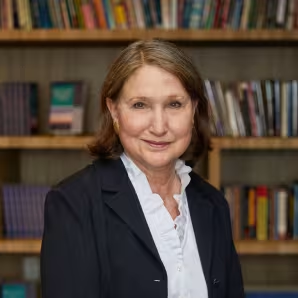
Kathleen Newland
Senior Fellow
Susan Fratzke
Senior Policy Analyst


Related Content


