Kate Hooper

Kate Hooper is a Senior Policy Analyst with MPI’s Global Program, where she leads MPI’s international work on labor migration. Her areas of research include legal migration pathways, fair and ethical recruitment, the implications of remote work and other nontraditional working arrangements for immigrant selection systems, labor market integration, and complementary pathways for displaced populations.
Ms. Hooper has advised governments and intergovernmental organizations on legal migration pathways and opportunities to adapt immigration and immigrant integration policies to respond to emerging labor market trends. She had a part-time secondment to the United Nations Development Program, where she conducted an internal review of UNDP’s programming on return and sustainable reintegration.
Ms. Hooper is the primary point person for the Transatlantic Council on Migration, MPI’s flagship international initiative that brings together senior policymakers, experts, and other stakeholders to discuss responses to pressing migration, protection, and immigrant integration issues.
She holds a master’s degree with honors from the University of Chicago’s Committee on International Relations, and a bachelor of the arts degree in history from the University of Oxford. She also holds a certificate in international political economy from the London School of Economics.
- Media Inquiries
-
Michelle Mittelstadt
202 266 1910 [email protected]
Explore Content by Kate Hooper
Showing 21-30 of 65 total results
Reassessing Recruitment Costs in a Changing World of Labor Migration
COVID-19 raised migrant workers' recruitment costs via new testing, travel, and quarantine rules, exposing regulatory gaps and the need for broader worker protections.

Why the European Labor Market Integration of Displaced Ukrainians Is Defying Expectations
People displaced from Ukraine are finding work more rapidly in European countries than prior refugee cohorts. But uncertainty over how long they will stay, combined with hurdles such as language barriers, has meant many are prioritizing any job over the right job. This commentary examines how policymakers could address this waste of skills as they seek to fill pressing labor needs and facilitate deeper integration of the new arrivals.

The Future of Remote Work: Digital Nomads and the Implications for Immigration Systems
More than 25 countries offered digital nomad visas by mid-2022, but most immigration systems remain ill-equipped for remote work and need reform, including to tax and social security systems.

How Can Europe Address Its Labour Market Needs at a Time of Upheaval?
This conversation explored how Europe could potentially address its labor market needs and how immigration and immigrant integration policy might help propel Europe’s economic recovery.

Coming Together or Coming Apart? A New Phase of International Cooperation on Migration
International migration cooperation is fragmenting, yet post-pandemic openings and regional coalitions could still revive governance if enforcement gaps are addressed.

How Can Europe Deliver on the Potential of Talent Partnerships?
Amid looming labour shortages, Europe’s Talent Partnerships represent a possible solution. But success will depend on buy-in and flexible design, as pilot programmes have yet to demonstrate scalability.

Connections Between Refugee Sponsorship and Complementary Pathways
This expert panel discussed the connections between refugee sponsorship and complementary pathways.
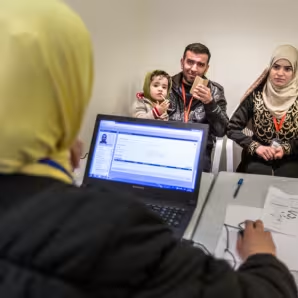
Symposium on the Migration Dynamics of North America Before, During, and After Covid-19
This symposium examined the migration dynamics of Canada, the United States, and Central America, the complications of the Covid-19 pandemic, and what governments should consider as they pursue pragmatic and cooperative policy solutions.
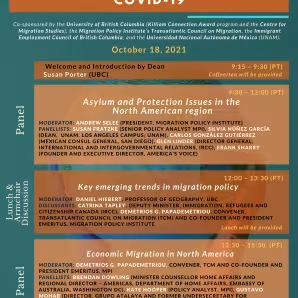
Labour Shortages during the Pandemic and Beyond: What role can immigration policy play?
As European countries seek to revive their economies in the wake of the COVID-19 pandemic, acute labor shortages in a variety of sectors risk stopping the recovery in its tracks. This commentary explores why these shortages are emerging and how immigration policy can form one part of the broader strategy to meet labor market needs.
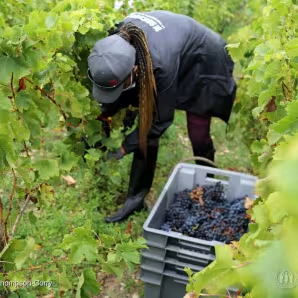
Refugee Resettlement and Complementary Pathways: Opportunities for growth
Resettlement reaches fewer than 1 percent of refugees annually. To scale protection, labor, education, and sponsorship pathways are being used but face persistent barriers.