Demetrios G. Papademetriou

Demetrios G. Papademetriou was a Distinguished Transatlantic Fellow at the Migration Policy Institute, which he co-founded and led as its first President until 2014 and where he remained President Emeritus until his death in January 2022. He served until 2018 as the founding President of MPI Europe, a nonprofit, independent research institute in Brussels that aims to promote a better understanding of migration trends and effects within Europe.
He was the convener of the Transatlantic Council on Migration, which is composed of senior public figures, business leaders, and public intellectuals from Europe, the United States, Canada, and Australia. He also convened the Regional Migration Study Group in 2011–15, an initiative that proposed and promoted multi-stakeholder support for new regional and collaborative approaches to migration, competitiveness, and human-capital development for the United States, Canada, Mexico, and Central America.
Dr. Papademetriou co-founded Metropolis: An International Forum for Research and Policy on Migration and Cities (which he led as International Chair for the initiative’s first five years and where he continued to serve as International Chair Emeritus); and served as Chair of the World Economic Forum's Global Agenda Council on Migration (2009-11); Founding Chair of the Advisory Board of the Open Society Foundations' International Migration Initiative (2010-15); Chair of the Migration Group of the Organization for Economic Cooperation and Development (OECD); Director for Immigration Policy and Research at the U.S. Department of Labor and Chair of the Secretary of Labor's Immigration Policy Task Force; and Executive Editor of the International Migration Review.
He published more than 275 books, articles, monographs, and research reports on a wide array of migration topics, lectured widely on all aspects of immigration and immigrant integration policy, and advised foundations and other grant-making organizations, civil-society groups, and senior government and political party officials, in dozens of countries (including numerous European Union Member States while they hold the rotating EU presidency).
Dr. Papademetriou held a PhD in comparative public policy and international relations (1976) from the University of Maryland and taught at the universities of Maryland, Duke, American, and New School for Social Research.
Honoring the Life of Demetrios G. Papademetriou

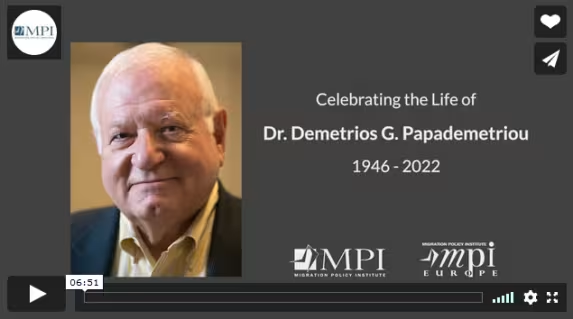
Friends and colleagues from around the world came together in March 2022 to celebrate Dr. Papademetriou's legacy during a tribute event in Washington, DC. To watch the event video, click on the image below.
For more on his remarkable legacy, read the MPI statement and a collection of tributes.
To read the obituary, click here.
During MPI's 20th anniversary celebration in 2021, its internship program was renamed the Demetrios G. Papademetriou Young Scholars Program in honor of the career-long dedication that he exhibited in training, mentoring, and helping the careers of the next generation of migration thinkers around the world.
To support the Young Scholars program, click here.
Explore Content by Demetrios G. Papademetriou
Showing 71-80 of 105 total results
Public Opinion, Media Coverage, and Migration: Developing Strategies for Immigration and Integration Reforms (Council Statement)
A strategic mix of evidence, narratives, and trusted messengers can build durable public backing for immigration and integration reforms.

Immigrants in the United States and the Current Economic Crisis
The U.S. recession slowed unauthorized immigration, but large-scale returns appeared unlikely.
Immigrants and the Current Economic Crisis: Research Evidence, Policy Challenges, and Implications
The Great Recession of 2007–09 slowed immigrant inflows and hit low-skilled immigrants hardest, while policy limits on access to safety nets heightened their vulnerability.
Migration and the Economic Downturn: What to Expect in the European Union
EU migration is likely to slow during recessions, though continue as long as opportunity gaps between origin and destination countries persist.
Talent, Competitiveness, and Migration (Transatlantic Council Statement)
Advanced economies need coherent strategies that align migration policy, education, and the labor market while investing in integration and avoiding zero-sum competition.
Talent in the 21st-Century Economy
Global competition for highly skilled workers is intensifying, and countries must align immigration, education, and talent policies to stay competitive.
Hybrid Immigrant-Selection Systems: The Next Generation of Economic Migration Schemes
Points systems and employer-driven admissions models each have key flaws; hybrid systems that combine both can better serve immediate labor needs and long-term national interests.
Delivering Citizenship (Transatlantic Council Statement)
A transatlantic agenda that links clear citizenship pathways, dual nationality, and practical integration support can lead to stronger, more cohesive democracies.
Gaining from Migration: Towards a New Mobility System
The emerging global mobility system seeks to manage labor flows as a shared labor market while advancing migrant integration and development in Europe and partner countries.
Selecting Economic Stream Immigrants through Points Systems
By 2007, points systems were spreading worldwide as a way to select skilled immigrants for long-term economic goals, often alongside employer input.