Demetrios G. Papademetriou

Demetrios G. Papademetriou was a Distinguished Transatlantic Fellow at the Migration Policy Institute, which he co-founded and led as its first President until 2014 and where he remained President Emeritus until his death in January 2022. He served until 2018 as the founding President of MPI Europe, a nonprofit, independent research institute in Brussels that aims to promote a better understanding of migration trends and effects within Europe.
He was the convener of the Transatlantic Council on Migration, which is composed of senior public figures, business leaders, and public intellectuals from Europe, the United States, Canada, and Australia. He also convened the Regional Migration Study Group in 2011–15, an initiative that proposed and promoted multi-stakeholder support for new regional and collaborative approaches to migration, competitiveness, and human-capital development for the United States, Canada, Mexico, and Central America.
Dr. Papademetriou co-founded Metropolis: An International Forum for Research and Policy on Migration and Cities (which he led as International Chair for the initiative’s first five years and where he continued to serve as International Chair Emeritus); and served as Chair of the World Economic Forum's Global Agenda Council on Migration (2009-11); Founding Chair of the Advisory Board of the Open Society Foundations' International Migration Initiative (2010-15); Chair of the Migration Group of the Organization for Economic Cooperation and Development (OECD); Director for Immigration Policy and Research at the U.S. Department of Labor and Chair of the Secretary of Labor's Immigration Policy Task Force; and Executive Editor of the International Migration Review.
He published more than 275 books, articles, monographs, and research reports on a wide array of migration topics, lectured widely on all aspects of immigration and immigrant integration policy, and advised foundations and other grant-making organizations, civil-society groups, and senior government and political party officials, in dozens of countries (including numerous European Union Member States while they hold the rotating EU presidency).
Dr. Papademetriou held a PhD in comparative public policy and international relations (1976) from the University of Maryland and taught at the universities of Maryland, Duke, American, and New School for Social Research.
Honoring the Life of Demetrios G. Papademetriou

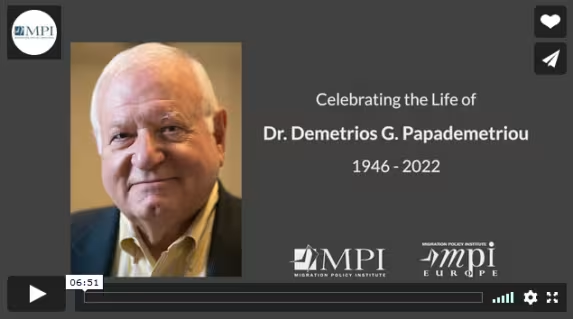
Friends and colleagues from around the world came together in March 2022 to celebrate Dr. Papademetriou's legacy during a tribute event in Washington, DC. To watch the event video, click on the image below.
For more on his remarkable legacy, read the MPI statement and a collection of tributes.
To read the obituary, click here.
During MPI's 20th anniversary celebration in 2021, its internship program was renamed the Demetrios G. Papademetriou Young Scholars Program in honor of the career-long dedication that he exhibited in training, mentoring, and helping the careers of the next generation of migration thinkers around the world.
To support the Young Scholars program, click here.
Explore Content by Demetrios G. Papademetriou
Showing 41-50 of 105 total results
A Strategic Framework for Creating Legality and Order in Immigration
Immigration enforcement lags other regulatory fields by failing to apply evidence-based, proportionate, and strategically prioritized responses to immigration harms.

Securing Borders: The Intended, Unintended, and Perverse Consequences
Border enforcement consistently generates perverse consequences, and strong borders require strong institutions and rule of law as much as physical controls.

Managing Borders in an Increasingly Borderless World
Securing borders demands an elusive mix of policies tailored to each context, with strong state institutions as the one common prerequisite across all regions, as this edited volume reveals.

Skilled Immigrants in the Global Economy: Prospects for International Cooperation on Recognition of Foreign Qualifications
Mutual recognition agreements reduce credential barriers for skilled immigrants, but professional autonomy and political fragmentation limit their scope and reach.

Maximizing Human Capital in a Rapidly Evolving Economic Landscape (Transatlantic Council Statement)
Immigrants should have access to job-relevant training and be able to put their skills to use, as policymakers seek to close skills gaps among immigrants and underserved workers.

Attracting and Selecting from the Global Talent Pool — Policy Challenges
Winning skilled immigrants demands coherent strategy across visa design, infrastructure, integration, and credential recognition—no single policy can substitute for the others.
Pensando Regionalmente para Competir Globalmente: Aprovechar la Migración y el Capital Humano en Estados Unidos, México y Centroamérica
La reforma migratoria de EE.UU. con visas flexibles y legalización, apoyada por inversión regional en capital humano, es clave para la competitividad de toda la región.
Thinking Regionally to Compete Globally: Leveraging Migration & Human Capital in the U.S., Mexico, and Central America
Shifting demographics and slowing emigration from Mexico and Central America demand a new U.S. regional strategy, this final report of the Regional Migration Study Group makes clear.

Legal Immigration Policies for Low-Skilled Foreign Workers
The near-absence of U.S. legal low-skilled work visas drives unauthorized immigration. Designing a new program raises fiercely contested questions on wages and portability.