Toward a Road Map for Digitalisation in the EU Humanitarian Protection Space
Digital solutions were crucial for governments and stakeholders involved in the reception and integration of displaced Ukrainians. This conversation examined lessons learned and how digital tools might strengthen migration and integration systems.
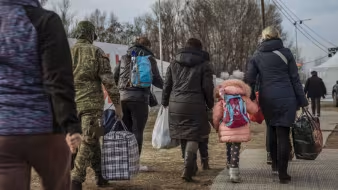
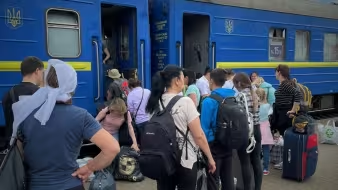
The arrival of more than 8 million people from Ukraine since Russia’s invasion in 2022 has added considerable pressure on reception and integration systems already under significant strain and confronting existing structural challenges. In 2022-2023, governments had to quickly register large numbers of arrivals, provide first-reception services, ensure access to education and health care, and incorporate newcomers into the labour market.
Faced with this herculean task, digital solutions became a lifeline for many governments and stakeholders in this time period. From remote registration to distance schooling and matching apps to facilitate access to housing and the labour market, 2022-2023 witnessed a boom of digital tools designed to quickly increase capacity, streamline processes, and improve support for the displaced. Yet, these were often standalone initiatives, endangering their sustainability. And while digitalisation holds promise to deeply transform migration and integration systems, without a clear vision and control over their development, digital tools also carry significant risk, such as eroded data privacy and exclusion.
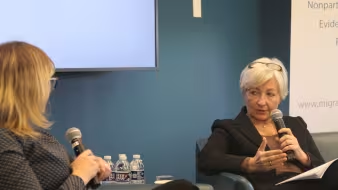
One year into the Ukrainian displacement crisis offered an opportunity to take stock of the digital solutions utilised. In this MPI Europe webinar, speakers examined the trade-offs, identified lessons learned, and explored how digital tools might strengthen migration and integration systems for the future. This webinar, part of an MPI Europe digitalisation project, featured the findings of a report from the Beyond Territorial Asylum: Making protection work in a bordered world initiative led by MPI and the Robert Bosch Stiftung. The initiative aims to redesign the global protection and resettlement infrastructure in a way that is more equitable, flexible, and sustainable.
Speakers:
Hanne Beirens, Director, MPI Europe
Jessica Bither, Senior Expert for Migration, Robert Bosch Stiftung
Evelina Gudzinskaitė, Director, Migration Department, Ministry of the Interior, Republic of Lithuania
Mariet Schiepers, Director of the Centre for Language and Education, KU Leuven
-
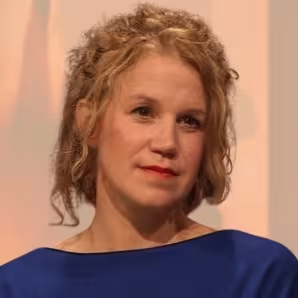
Jessica Bither

Evelina Gudzinskaitė
Mariet Schiepers
Related Content