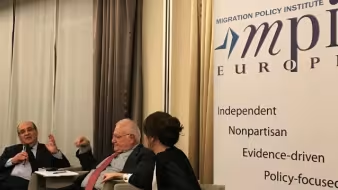
Migration in Europe: What trends to watch in 2018?
This webinar looks ahead to what the major external and internal events affecting migration in Europe may be in 2018, and whether the European Union will be able to overcome internal challenges to emerge as a leader on migration policy on the world stage.
Is 2018 the year that the European Union takes leadership on migration on the international stage, or where it focuses inwards on healing internal divisions and delivering on overdue migration and asylum system reforms? With two high-profile compacts on migration and refugees being negotiated by the United Nations, Europe can potentially seize the momentum to shape a new international migration framework—and fill the vacuum left by the United States’ withdrawal. But with a series of critical elections across the continent, and key states struggling to form coalition governments, Europe’s ability to set the agenda may be limited. Europe may need to first get its own house in order, passing reforms to the Dublin Regulations, hammering down citizens’ rights post-Brexit, and designing strategic legal pathways, to name a few. This webinar looks ahead at the major external and internal events affecting migration on the continent over the next year.
Speakers:
Elizabeth Collett, Director, Migration Policy Institute Europe
Milan Nič, Senior Fellow, Robert Bosch Center for Central and Eastern Europe, Russia, and Central Asia, German Council on Foreign Relations
Pierre Vimont, Senior Fellow, Carnegie Europe
Moderators:
Natalia Banulescu-Bogdan, Associate Director, International Program, Migration Policy Institute
About the Transatlantic Council on Migration
Through rigorous research, high-level convenings, and tailored policy advice, the Council provides policymakers with essential analysis and cutting-edge policy recommendations to help tackle the most vexing policy questions.
About the Global Program
The Global Program bridges policy advice, research, and candid dialogue to design effective migration policies, drawing on global evidence and anticipating the forces reshaping how people move.
Related Content