Migrant Integration: Learning from what works in times of uncertainty
Integration policy is often forged in the heat of crises, and failure to embrace an evidence culture in migrant integration may come at a high human, financial, and societal cost, as this webinar explores.
With millions fleeing war-torn Ukraine in 2022, this webinar looked at questions about how to effectively promote migrant integration. Integration policy is often forged in the heat of crises and led by political priorities, with limited resources devoted to making improvements along the way. As a result, lessons from promising innovations that tend to emerge particularly during crises often get lost. Understanding what works, under which conditions, and how to use this knowledge is crucial to design effective policies. Failure to embrace an evidence culture in migrant integration may come at a high human, financial, and societal cost for not only migrants, but also for governments and host societies.
This webinar, organized as part of the HORIZON SPRING project on Sustainable Practices on Integration, examined the state of the field in 2022 and promising innovations that facilitate an evidence culture in migrant integration, particularly in contexts marked by uncertainty and limited resources, such as the effort to integrate displaced Ukrainians. The discussion spotlighted projects that demonstrate how an evidence culture can be leveraged to benefit migrant integration policymaking, including from the frontline reception of Ukrainian refugees.
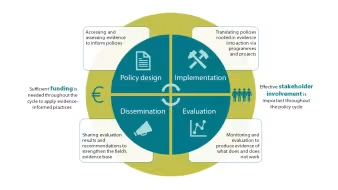
The webinar marked the publication of a policy brief that mapped out the state of play of an evidence culture in migrant integration and identified obstacles and promising steps policymakers at EU and national levels could take. It also previewed the launch of a toolkit designed to help policymakers and practitioners in their efforts to embed an evidence culture in migrant integration.
Speakers:
Claudia Spinelli, Policy Analyst, Joint Research Centre of the European Commission
Jürgen Wander, Programme Manager, For an Inclusive Labor Market Programme, Ministry of Social Affairs and Employment, the Netherlands
Tomasz Pactwa, Director, Projects and Social Affairs Department, City of Warsaw
Moderator:
Jasmijn Slootjes, Senior Policy Analyst, MPI Europe
-
Claudia Spinelli

Jürgen Wander
Tomasz Pactwa