- Keywords
- Irregular Migration
- Returns
Reaching Irregular Migrants in Europe: Harnessing the value of counselling
This transcript was generated using AI and may contain inaccuracies. If you notice an error, feel free to email [email protected].
[00:00:00.03] - María Belén Zanzuchi
Good afternoon or good morning, everyone, depending on where this finds you. Welcome to this new MPI Europe webinar on Reaching Irregular Migrants in Europe: Harnessing the Value of Counselling. My name is Maria Belén Zanzuchi. I'm a policy analyst at the Migration Policy Institute Europe, and I will be moderating the discussion today. So before we jump into the discussion, I have a few housekeeping notes. So we have 4 amazing speakers today and we have separated time for you to have a Q&A session. So in order to best organise this session and be able to sort through your questions in advance, we ask you that as speakers already share their interventions, that you type down any questions you may have into the Q&A box. And you, yeah, as I mentioned, you can already do this as speakers are delivering their interventions. I would also like to note that today's webinar is organised under the Reaching Undocumented Migrants project coordinated by the Return and Reintegration Facility, which is funded by the European Commission Directorate General for Migration and Home Affairs. And today I'm pleased not only to be hosting this very important and also I think timely conversation, but I'm also very happy to share that just a few hours ago, we released a new policy brief on this topic, which you can find on our website and also at the link at the screen, which is called No One Size Fits All: Outreach and Counselling for Irregular Migrants.
So before I give the floor to our speakers today, I wanted to take just a few minutes to set the goals for today's webinar and also to share a few remarks and set the ground for the conversation. So basically, the aim of the webinar is really to take a moment to take stock of the field of outreach and counselling targeting irregular migrants and to reflect on the importance of these practices in raising awareness among this population. And I know that there are different maybe definitions and approaches to what counselling means or what the goals are, with many focusing specifically on return counselling, but just wanted to clarify upfront front, and as we will hear later on during the webinar and from our speakers, is that we are considering counselling in a broader sense and more for awareness raising with this population about different pathways, let's say, out of irregularity. So the aim of today's webinar is also to dig a bit deeper into the challenges linked to the implementation effectiveness and also data gaps that exist in the field and briefly discuss some of next steps for moving this field forward. So as you know, the conversation around irregular migrants is definitely and certainly not new.
But I think many of the discussions around this population in the media or sometimes in political discourses have been around rising numbers, even though we see evidence even from recent EU projects that these numbers have stayed the same in Europe for about the last decade. And also these conversations or these debates have revolved around many times migration management through border controls and sanctions. But what we see actually from the field is that through, and that these counselling and outreach efforts to irregular migrants are a very powerful tool actually to tackle irregularity and to support this population in the decision-making, including through for those who want contributing to more greater return rates and more sustainable also. And what we've seen is that these efforts have also been very important because we're speaking about a population that, I mean, it's very diverse, of course. We, within the irregular migrant population, we may have asylum seekers with rejected applications. We may have people who enter through regular pathways and then at some point in the coming years lost their status because maybe they got divorced the partner that they entered with and had the visa associated to, or because they temporarily lost their job and sponsorship in Europe.
And also we may have people who, yes, enter through irregular pathways and then didn't know or didn't manage to regularise the situation. And in most of these cases, we see that this group tends to oftentimes evade authorities due to fear of detention or deportation. So this leaves them in a more vulnerable position in terms of knowledge about, again, opportunities for regularization or even support for returning home through voluntary return. So as a result, yes, we see many people who may be eligible to exit irregularity who are not aware of these options and these opportunities. And we see also that recognizing the potential for outreach and counselling, there have been some efforts from society, from local authorities, from national authorities also in better reaching and targeting these and informing them. And this is also out of a recognition that this situation also impacts the communities in which they live in. For example, during COVID we saw many national authorities desperately trying to reach out to this population to promote the use of vaccines and so on. So there's really a recognition that we need to be in touch with them. So, but what we see is that, especially in the field of counselling, These efforts have taken place in many different ways and with many different approaches.
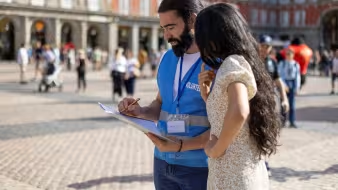
Like we've heard, for example, in some cases this outreach has been done mainly through distributing pamphlets to this group. In other cases, producing TikTok videos to better reach specific target population within this group. In other cases, as we will hear later on, mobile teams have been deployed to reach those specifically maybe living in train stations or in the street and with a very more vulnerable and pervasive and evasive maybe profile. And also in some cases, as we will hear also later today, through, for example, what is known as like kind of like embedding counselling within shelter and other types of support to better reach those who may not even be in a position to discuss or have a conversation about their future when all they worry about is current needs and the lack of maybe food or shelter or a roof above their head. So again, we've seen that many different approaches have taken place, often targeting different groups. And we see that there has been some experimentation in the field and so on. But the problem that we see is that the lack of robust data and an evidence base in the field it kind of has hindered progress in the sense that it has left frontline workers and civil society and others working in the field without specific knowledge on which approaches work best, maybe to target which specific groups, where and why, and also for identifying promising practices that should be scaled.
So it is in this context that these Reaching Undocumented Migrants projects took place. Coordinated by ICMPD and implemented by the Migration Policy Institute Europe in coordination also with the Mixed Migration Centre and Fedasil. And through the work in this project, we have tried to address some of the gaps that we've seen in the field. So for example, we have stimulated primary data collection, as you will also hear just in a few moments from our colleagues from MMC, from the Mixed Migration Centre. We've also, through the different research and so on have tried to better understand the perspectives and needs of this group, also from, uh, not only directly from them but also from stakeholders working with them. So psychologists, uh, people reaching out to them and so on. And we have also fostered collaboration through different roundtables, study visits, bringing together local authorities, NGOs, frontline workers, psychologists, national authorities, and so on to share ideas, to share best practices, and really to exchange also on obstacles that they are seeing in the. And these conversations we've seen have yielded very valuable lessons about the, let's say, ingredients in a way for a successful outreach and counselling approach.
And all these efforts also have translated into very diverse and important outputs, including snapshots with the survey results, the brief that was published earlier, training modules to frontline workers that ICMPD is developing, and also an indicator framework that our team has developed to try to support, to advance evaluation and evidence base in the field. And this indicator, for example, we try to raise the importance of collecting information about, to document aspects of service delivery. So resources that are put into outreach and counselling, the approaches used and so on, but also about the profile of the population that is being reached and also about results in a more comprehensive way than just measuring results through return rates. So a lot, a lot remains to be done. But I think it's important that today we take this space to really reflect on what's been achieved in the field, what are some of the obstacles, and what's the way forward. And I think this is also a very timely conversation because it takes place at the critical moment where with the new European Commission and return policies remaining very high on the agenda, a lot of the focus has sometimes been on sanctions or on coordination with countries of origin.
But I think there's a lot that can be done also in the field of counselling. So without further ado, I would like to turn to our speakers, and we have very amazing experts and a wide range of expertise from local authority, national government, and also civil society. And I would like to maybe first address my first set of questions to Giulia Bruschi, Data and Research Project Manager Europe at the Mixed Migration Centre. So Giulia, I mean, you've been the Mixed Migration Centre has been collaborating under this Reaching Undocumented Migrants project by carrying the very important and difficult task of reaching and conducting surveys with irregular migrants in Brussels and Paris. So I was wondering if you could tell our participants today a bit more about these efforts. What were some of the main findings that you discovered? What these findings tell us also about gaps and opportunities in the field? And what are some of the lessons learned from these efforts? So Giulia, over to you.
[00:11:22.24] - Giulia Bruschi
Thank you very much, Belén, and good afternoon and good morning to everyone. So the objective of the research in the RUM project was primarily to understand the current experiences, perceptions towards returns, more specifically of irregular migrants. We collected 1,000 interviews in the last 6 months of 2024, asking irregular migrants about their situation in the country of departure, their irregular journeys across Europe, their living situation in Brussels and Paris, and their intention to stay or return, as well as their knowledge about the assisted voluntary return and reintegration programs, AVRR in short. To be able to meaningfully analyse data by country of nationality, we have selected 5 nationalities of interest and focus our research on Afghani, Algerians, Moroccans, Tunisians, and Guineans. We have collected a lot of data, but I will limit my intervention to a few findings regarding their living standards, movement intentions, and influencing factors, as well as their perception to return. Due to the purpose of sampling that we have used, our data is not representative of the larger population of irregular migrants, and the findings should be considered indicative. So what you can see as In terms of the first of the three points that I will mention today is that many became irregular, but less than half entered through irregular channels.
So the others arrived with regular permits that, as you said, Belén, either expired or were not renewed or were irregularly in Brussels and Paris, but had an ongoing asylum application in the country of first arrival. Another aspect is that they have attempted to obtain regular status, and those attempts were frequent and unsuccessful. As half of our respondents already applied for asylum and was rejected. These two data points indicate that there is an impermanence and a flexibility of regular and irregular condition. But nevertheless, irregularity impacted the living condition and livelihood of the sample. In fact, if we can see to the next slide. Yes, thank you. 64% of respondents struggled with housing, and 48 faced challenges to accessing decent work, with the latter mostly due to their irregular status. Informal support that was provided within the migrant communities may have had a role in complementing the formal stakeholders' roles, such as municipalities, for example, to ensure minimum decent conditions in terms of ensuring basic needs. For example, housing challenges were primarily mitigated through the hospitality of family and friends or through accessing squats, along with the official emergency shelters. Despite the housing and livelihood challenges, the migrants chose to remain in Belgium or in France because of their economic possibilities, and very few have previously considered permanent returns.
Only 4% in Belgium and 7% in France did take steps in the past towards a permanent return. So the simple lack of willingness to return is a key reason, as 1 in 3 reported, but also the conditions in the country of departure, as many mentioned lack of freedoms, the unemployment and conflict as reasons for not returning. And additionally, 1 in 5 reported that they wouldn't return due to feeling of shame and failure towards their family and their community back home. Approximately 20% mentioned not having enough money to return home, but only a few said that, that it was their only obstacle. It means that any plan to boost returns via financial assistance must consider the evidence that demand for this specific service may remain very small in scale. And in fact, when touching the specific aspect of discussing voluntary returns, we found that only 8% was interested in knowing more about how to access return assistance in France and Belgium, with a fear of incarceration and deportation acting as a barrier towards reaching out to official sources of information. And this also emerged from quotes and comments made by respondents aside of the survey. While AVRR-related information was diffused by, by far and large, by non-official sources, there was more interest in knowing more about the assistance available for reintegration after returns, as 20% was interested in the overall return and reintegration assistance, which includes cash and grants upon return.
To conclude, these findings highlight significant gaps and opportunities in outreach to irregular migrants. A key gap is the mistrust towards official sources of information, with fear of deportation, fear of incarceration, deterring basically engagement. This emphasised the need for more accessible, transparent, and community-based communication channels. Opportunities lie in leveraging informal support networks within migrant communities, which play a critical role in addressing basic needs like housing or information sharing. Additionally, there is a notable interest in reintegration support rather than return assistance alone, suggesting that outreach strategies should emphasise long-term reintegration benefits to better resonate with the target population. Concerning challenges and lessons learned of this project, the main challenge that the research team could anticipate before starting the fieldwork was how enumerators were going to identify and interview a high number of respondents and ensure their participation. And this was possible thanks to the help of meticulous scoping among institutional and grassroots realities. We selected also a team of enumerators who all had migratory backgrounds. Of the same nationalities that we wanted to interview, and we tried to include people who had similar experiences of marginalization that our respondents might be facing. And also the dedication and enthusiasm of the project team and the enumeration team made this achievement possible.
In conclusion, the lessons learned were fundamentally two. So having an enumeration team that was composed of individuals that are peers to the respondents, it was essential for data collection with irregular migrants. And strengthening the referral links to service providers could have also helped, especially alleviate the feeling of helplessness that enumerators felt by participating to the study. It would be also really valuable to pair data collection from potential, with potential returnees in destination countries with interviews that we have conducted so far. This will help us see how the perception and the concerns of potential returnees about return and reintegration could match up with real experiences of returnees who have returned. So it would help clarify which concerns are tied to actual challenges and they can be addressed through assistance if they cannot be, they aren't ready. But also which of these concerns are based on myths that outreach efforts could focus on clarifying, dispelling, and addressing. So overall, having more detailed understanding on return and reintegration for specific national groups, both as a perspective in the country of destination and as a perspective in the country of return, could improve outreach efforts. And in this sense, the MMC has already successfully piloted data collection with returnees in Senegal.
And also, we look forward to expanding this to other countries.
[00:19:31.13] - María Belén Zanzuchi
Thank you. Thank you, Giulia, and all the MMC team for the amazing efforts in, in really trying to reach and have surveys with this population and enlighten us on what, what things need to be considered and the need to map other obstacles that might also stand in the way of returning, and also sharing a few thoughts on what other areas could be considered for exploring later on. So I think I would like to now turn to Jeroen Vanderkerckhove, Head of International Relations at Fedasil, so the Belgian federal agency for the reception of asylum seekers. Jeroen, I think Belgium has been one of the— I mean, and Fedasil has been very innovative and has committed a lot to reaching out and engaging with irregular migrants and supporting counselling efforts. So I was wondering if you could share with participants today a bit more about this approach. I know there are a lot of conversations also lately about innovative initiatives. So I was also curious to hear what's your uptake and what do we mean of where the field needs to go and how to make progress in this regard, and also what has motivated Fedasil to make these efforts and with what objectives and an idea of success, let's say, in mind.
So, Jeroen, over to you. And also maybe just briefly a reminder for participants that you can already start putting questions in the chat box.
[00:21:06.17] - Jeroen Vandekerckhove
Thank you very much, Belén. Yes, indeed, Fedasil was at the birth of the ReachOut project within, back in the days, ERIN, then subsequently it became RRF and the project became Reaching Undocumented Migrants. Initially, we started with OFI, our French colleagues, that also do outreach activities predominantly in the north of France. We started exchanging on experiences because we saw a similar target group in Belgium and France appearing and avoiding all contact with authorities. We started reaching out to them within our mandate as we are mandated with A, reception of asylum seekers, B, information provision, and then C, voluntary return. We thought it would be a good idea to reach out to these migrants and speak to them about voluntary return. But fairly quickly, we noticed that this wasn't a very successful strategy, and this was really one of the findings of the first two phases of the ReachOut project, that is that When you approach migrants that are avoiding contact with national authorities and have serious trust issues, as Giulia was actually pointing at, then you need to kind of embed your— widen the scope of subjects that you're talking about. And so we started moving away from strictly talking about return and return counselling to more like a case resolution system.
And I would like to thank Julia very much for her presentation. It was necessarily brief because we only received a few minutes. So one of the aspects that she didn't touch upon, but that I'd like to highlight here, is that, you know, there was a difference between Paris and Brussels on a number of topics. And one of them was in Brussels, apparently, during the majority of migrants, or at least a significantly bigger share of migrants, were aware of the existence of the assisted voluntary return programs, contrary to Paris, where a lot more migrants were unaware and had no knowledge about it. So this points at the fact that we're actually successful in Brussels at reaching migrants with information on voluntary return programs. Yet there was no significant difference between the two places in the uptake of voluntary return programs. So that means that that pointed at the conclusion, the same conclusion, that is that voluntary return is not always the best solution for these persons. And so we started thinking about a much wider range of solutions. For example, as I said, counselling people on perhaps regular stay, on access to family reunification procedures, on access to asylum procedures, and explaining the situation they're in, better explaining perhaps they still even have an appeal option or whatever.
So this is very pretty much have been an approach from the outreachers very quickly in the project. And our colleagues from the Migration Office, who have an individual case management function that follows up people on with a return decision, pretty much have the similar approach. So that it's— it really is an approach that came from the frontline workers, whether whatever organization they were from. Also, for long-term persons in a long-term period of irregular stay, it might be better to first stabilise their situation before you can actually approach them and talk about the future. So we set up these projects of orientation and observation where persons were first offered a safe space where they can stabilise mentally before we can actually counsel them on future options. And we are even thinking ahead of other options to widen the range of what we started calling durable solutions. It's also looking into return and legal remigration. Why not? Some of them may have acquired language skills, soft skills that very much relate to demands in our labour force. So why not include that in one of the options that we could counsel them in? Or even for persons coming from a post-conflict zone, and there is quite a few Afghans and Syrians, also counsel them in go and see visits to see if they can still to see what their personal belongings, their houses, in what shape they are, how the society is, how the services are, is there schooling, what kind of schooling, et cetera, for their kids.
So summing up, and you said it clearly, Belén, reaching out to undocumented migrants should include a much wider range of durable solutions before you can actually really start the conversation than if you narrow it down to return only. Then your chances of success may be relatively limited.
[00:27:31.07] - María Belén Zanzuchi
Thank you very much, Jeroen, for very important remarks and for sharing all the efforts that Fedasil has been doing in the field. I think you very importantly also flagged this gap that we see in between also knowledge about AVRR and then uptake, which really calls us, and Giulia was saying, to the need to really understanding what else is on the table, what's the decision-making process, what other obstacles may these people be facing in terms of wanting or even being able to actually return. And I think you also importantly mentioned the need to sometimes take a step back and address other more immediate needs before even being able to have a conversation about the futures. So I know that the municipality of Utrecht has been also doing a lot in working with irregular migrants. We have the pleasure to have Jan Braat today, who is a senior policy advisor for migration, diversity, and integration at the municipality of Utrecht in the Netherlands. So as I mentioned also in my introductory remarks, one of the many interesting initiatives that the city has been coordinating, including other cities also in the Netherlands, is this idea of providing embedding in a sense counselling into shelter and addressing other needs also in, in this before providing even counselling.
So, Jan, I was wondering if you could also tell us a bit more about the approach that the city has followed in doing counselling and outreach to irregular migrants. Also, how do you define success of these efforts and, and the policy objectives that have been driving also your efforts and any lessons learned. So, Jan, over to you. And then again, a reminder to participants that you can begin putting any questions that you may have into the Q&A box.
[00:29:32.22] - Jan Braat
Okay. Thanks for the invitation. And I will tell a bit about, in short, our program that we already have for 23 years since 2001. So we have a lot of experience in. In Dutch, it's called Bed, Bad, Brood. So it's bed, bath, bread, and guidance. And then it's a guidance, and Jeroen already mentioned it, to a durable solution. And a durable solution is or a residence permit or return to the home country or migrate to a third other country. So this is, you talk about the success, this is also what we think about the success. This is the results we want, and what we don't want is to lose people again into illegal stay, because there are a lot of problems, young women getting raped, drugs, people coming into the drugs circuit, and so on and so on. First, you could say, till 2019, we did it on our own because the national government didn't want this program. And then after a fierce negotiation, since 2019, we had a common program. It's called LVV. It's the same kind of program, but then in cooperation with the national government and also with the immigration office, the repatriation office, and the alien police.
And the goal was the same, durable solutions, as I mentioned them. And then what we do is we, through NGOs who have more trustworthy relationship with the undocumented population, they make sure that they are in contact with that population. If they come into that program, program, then the alien police can't forcefully return them because they are in a trajectory within the Bed Bath Bread program. So that's important. So that's always, always a safety game for, uh, for, uh, for, uh, the undocumented people. And then the NGOs with lawyers and with their legal knowledge really first look into the What is the situation? Is, for example, an asylum seeker who was maybe rejected the first time, how did that come? Because we saw that a lot of those current case files, not every, all the information was put into the application, or the lawyers were not so good, or the situation changed in the country of origin. Overlap. So we said, okay, we first look at that, and if then people are finally rejected, then we can really say this is what it is. Because many of the, when the commanders say, yeah, I'm not treated rightly or wrongly, but this is your opinion, and then we make it more objective.
And what we saw in, in general now, um, after the last, you could say, 25 years, is that 60% get a residence permit after our trajectory in our Bed, Bath, Bread and Guidance program. And, uh, and, uh, let's say about 20% returned, and about 10-15% went back to the national shelter system. So we only lose about 8-10% to illegal stay anymore, although all the people before the brood program were in illegal stay. So this is, you could say, a 90% success rate over many, many years. And the success rate when we had the program together with the National AC was even more successful because you could really tell, talk with each other, Oh, maybe this is— maybe the person has LHBTI and didn't— was scared to tell them, and then what is needed for them. So you know better what was needed for an application. So you really work with Immigration or with the repatriation office. What can you do in country of origin? What do you know how they can have a safe landing in the country of origin there. So, and if you look, for example, the last 5 years, all the repeated assignment requests we did within this program, 94% had a positive answer.
So it was not that we just did all kinds of applications. We, we only knew, uh, what was really necessary when, and the chances are high and the quality asylum. So, and that, that helped, helped a lot. And then you could also say better to the people who are denied asylum or other possibilities to stay, yeah, it's not in it for you. And many of them already a little bit knew that it's true, but now they can objectively, with a trustworthy organization like the NGO can tell them better and then they believe it. So then you can also work better, and Jeroen also said that a bit better on return. The problem now is that we had a different government with more far-right Minister of Asylum and they stopped the program at 1st of January, although it was a success. But it was completely a political decision. And what we did after that, because we didn't have— you have to know about two-thirds of the money was paid by the national government on the program. So we got a lot of money, millions, in five cities: Amsterdam, Rotterdam, Utrecht, Groningen, and Eindhoven. For this program.
So we have, we have had a financial program. So what we did in December, we had a strategic litigation with a human rights lawyer who took the minister to court that she couldn't stop this program or the finance of this program. And what happened in 4 decisions by different courts is that, um, the judges agreed with us that we couldn't stop. So, um, and they ordered the minister, Minister to pay, uh, till the court case in the end. And that will take probably something like the whole 2025 is, uh, finally decided on. So, and we did this, and this is interesting for international audience on the European Social Charter, Article 4. We did it on the European Human Rights Treaty on Article 3. And we did it on the Return Directive, Article 12. And the Thiong'o arrest, the Thiong'o jurisprudence. You can all look that up. And that gives us that European international law has a direct effect on decisions on giving shelter to undocumented and that it forces national government in this case to pay for the shelters that at the local level are organised. So that's— sometimes you have to do extraordinary things and this is just a new development.
But still, the success factor is have a shelter, have trustworthy organization who can reach out. We are also thinking like other cities like New York and Zurich and Philly to have a city card for undocumented. And so if you work on this, you can get durable solutions and can be successful that people have a future here or in their home country. Like future citizens in their home country or here, or almost none, very few, we didn't have a solution, but you can't win them all. This is it.
[00:38:37.08] - María Belén Zanzuchi
Thank you very much, Jan. And I think it's an amazing perspective that you bring because many times it's the city who are more in touch maybe with this population. And I mean, your starting point is maybe it's a more pragmatic approach to, we have this population here, how can we work better with them? How can we empower them and how can we support them in regularizing their situation, whatever that means? If it's staying, if it's getting job permits, if they want returning and so on. I think the case resolution, in a sense, rate that you mentioned of 90% is really, really impressive. And it shows that a lot can be done Although I'm sure that, of course, it's quite resource intense on your side and it requires a lot of work and efforts. So we have about 10, 12 minutes, I think, for Q&A. So, and I think there's one quick question about how many irregular migrants are in Europe. And I just wanted to briefly mention that from a MIrreM study, The numbers, the most recent numbers on the stock of irregular migrants is around, it's estimated to be around 2.6 and 3.2 million in Europe between 2016 and 2023.
[[FOR THE Q&A PORTION OF THE TRANSCRIPT, SPEAKERS ARE NOT IDENTIFIED BY NAME. PLEASE SEE THE RECORDING TO IDENTIFY SPEAKERS.]]
[00:40:00.18] - Speaker 1
So staying relatively stable, but actually I think there's very little information that we have on specific numbers and data on this population. So I'm gonna group maybe a few questions for you and you can feel free to jump in and answer. I don't know if anyone else wants to comment on number, but something else that was a question in the chat is how do we approach and how do you offer counselling to a population that has very different profiles, right? We are speaking in some cases about rejected asylum seekers. In some cases it's about asylum or people who just enter maybe the country and are thinking about applying for asylum. In the other case, if we're thinking of— and we are speaking about people who might have been in Belgium or in the Netherlands or anywhere else for about 20 years maybe now. So how do you address these differences? And then maybe a final question. So first on numbers, if you have any comments. Second one on approaches, given these different and very diverse profiles. And then something else that was mentioned was, I think it's linked to the conversation around return hubs and this idea of externalizing also resettlement applications or working with third countries to, in a way, ease what you see here in Europe.
[00:41:26.16] - Speaker 1
So just wanted to give the floor to you to comment on that. Maybe, Jeroen, I'll start with you first and then we can go to Giulia and Thank you.
[00:41:37.13] - Speaker 3
Yeah, the number of irregular migrants, it's indeed largely a dark number. I'll give one example. We know from observations that around 65,000 persons yearly take small boats to the UK. We have no clue who they are, where they're from, were they previously in France, in Belgium, in Italy, all of that together. So monitoring the number of irregular migrants that by nature abscond from any contact is a very difficult task. And as you said, the estimations go from 2.6 to 3.2 million. That's a large fork, and that just points at how difficult these questions are. Somebody asked the question on whether the same approach could be done for asylum seekers that have received a negative decision in a refugee centre. Indeed, very much. We start return counselling and future orientation, as we call it, actually much earlier. We don't wait for the negative decision. We start already talking about the life after asylum procedure. That could be anything. And so we call it future orientation already during the asylum procedure while people are staying in a reception centre. And when they receive a negative decision and there are no other pending procedures, that will be accompanied with a return decision.
[00:43:20.10] - Speaker 3
And this sparks an individual case management trajectory where they will also be counselled on all the different legal options that remain for them and that I already set out. So, yes, very much indeed. Sorry, Belén, can you help me with summarizing some of the questions?
[00:43:41.05] - Speaker 1
Yes, I think, I mean, if you want to provide any other comments on this idea of the return hubs, you're welcome, and otherwise I will turn to Giulia and then Jan mainly Just to ask you for now, I mean, I will introduce some other questions later, but for now it was about numbers. Again, how to provide counselling to maybe different profiles and, and on this idea of incentivise investing a bit more on return hubs.
[00:44:11.13] - Speaker 3
Return hubs is a very sensitive topic because it's— there's not so much that I can say about it. It really, the concept is still very vague to me personally. I'm speaking from a personal point of view, so that leads that I cannot really further elaborate on it. But obviously, and this is the position that most of us actually look at is, what is the cost efficiency of these kind of what they call innovative ideas? I think, you know, when I think of innovative ideas, I think about Albert issues than these return hubs. But yeah, if we look at what happened in the Italian-Albania deal, questions of cost efficiency should really be considered before experimenting with these kinds of innovations. But furthermore, I think it's a vague concept so far, and There's not so much that I can say about it.
[00:45:20.18] - Speaker 1
Thank you, Jeroen. Yes, maybe I'll turn to actually first Jan also to see if he has anything to add. And also, Jan, I think there is a lot of interest also in the chat in this 90% case resolution rate and some questions on how do you do it, how do you work to make sure that maybe these asylum applications are reconsidered? Is it a matter maybe of language barriers in the first place that were rejected, or how do you support in that sense? And if you could be brief, as we don't have a lot of time.
[00:45:57.20] - Speaker 4
Yeah, I try to be quite quickly. What you see is that in many first procedures, people are not believed. For example, because their nationality or identity are not officially, uh, recognised by, by the, the immigration office and the court, uh, because they didn't have papers or whatever. So what we always try is first to look at papers, birth certificate, passport, whatever, uh, to, and to get that from their home country so that people or believe that they come from country A that they are already saying they did. And then if that's proved, then their story, for example, with LHBTI or with people who got from a Christian belief or other things, things who are tortured, then we also try to prove it extra information that their story is true. And it's more about giving much more proof and getting it from everywhere, from medical exams or from home country or whatever, that makes their story more believable. And then you win the cases. So it's upgrading the file a lot that makes the success. And the people who do that are very good in it because they do it a lot of time. They've— of course, there are my— I don't know, dozens of countries that people come from, and you always have to look at the specific case for that.
[00:47:48.09] - Speaker 4
And they know the jurisprudence and etc., etc. So it's professional legal guidance, you could That helps to get the 90% thing. And of course, some of them, we say we don't do an extra procedure because they don't think there is new information that can be proven, uh, what, what they say, uh, is, is the truth, but we can't prove it. And then sometimes it has, it has no use. So that's, that, that helps, uh, uh, that helps a lot. And it is of course sometimes more difficult for people who are maybe 20 years in the Netherlands, then it's much more difficult. So then we try also to have some specific return trajectories with somebody with maybe— he had a guy in a wheelchair and refurnishing the house of his sister in there in his home country. So that it's, it is better landed. So, and there are a lot of, Jeroen also knows, a lot of examples of that. So I think that, that can help. And our new idea is also, what is also making the legal and more circular migration that you upscale people in, for example, the Netherlands who come from, let's say, an African country and then go back through the directory of businesses with a job, not only an offer, but that they have a guarantee of a job over there.
[00:49:28.13] - Speaker 4
So then it's not so necessary anymore that people go the difficult and dangerous journey on the boats through the, over the sea. So this is also what we are trying to develop now. So we are trying to have a lot of different solutions for different situations.
[00:49:53.06] - Speaker 1
Thank you, Jan. And maybe over to Julia, but in the meantime, I also wanted to introduce another question for Julia and also the other speakers to reflect on. You can come in. I think we can go with the Q&A for 5 more minutes, and then I'll turn to Christina. But I think there are questions also in the chat about what are some maybe of the enablers or obstacles to return and that you have identified maybe from the surveys or in your work with this population. So, Giulia, over to you if you have any comments on the other questions that we've been discussing before about numbers and so on, or if you have any, if you want to come in on the enablers factors or barriers for return and for other case resolution.
[00:50:39.19] - Speaker 2
Yes. So just one comment on the numbers that I wanted to chip in is that irregular, the stock of irregular migrants can be calculated differently by country. So there is also a little bit of, let's say, caution when we have aggregate numbers at European level of this figure because it needs to take into account every methodology of every different national calculation. I just wanted to point out that. Then coming into the aspect on the findings of the study, the barriers and enables to return. As I said before, there is a big role of unwillingness to return, and this is tied to expectation, migration goals. So we had in many instances throughout the fieldwork of this research, the answer, "Yes, but I just don't want to return." Like, that is my answer. I don't want to give you more information about the obstacles or the challenges or the specific aspects of lack of money, feeling sense of shame, and other barriers that might do exist because my unwillingness is where I draw the line. So that was a clear-cut answer that especially from our data in Paris came, came through. There are nuances, but those more, let's say, mixed and more varied factors at play as barriers to return emerged only when we looked at the intentions to return in the first place.
[00:52:17.06] - Speaker 2
So we measured whether people had a previous plan to return in the past that was abandoned. We could say that wasn't followed through because we couldn't interview them in Belgium and France. And that group was quite limited. And in that case, more specific and personal answers came up, such as, I would feel ashamed to return. I don't have enough money. I am afraid. Of how this would be taken, but there are also very important role of systemic factors that prevent people to return. The unemployment, presence of conflict, lack of rights that emerged particular from the Tunisians and Moroccan respondents that we interviewed, especially with the latest development for what concerns Tunisia. People will say there is no freedom In my country, the news that I get are worse and worse. Why would I be encouraged to return back there? So, and that's especially also for Afghan respondents was particularly prominent. So there is this aspect of the persistence of the same conditions that led them to leave in the first place that haven't been addressed, that might be the obstacle itself. And now I— thank you.
[00:53:45.19] - Speaker 1
Thank you, Giulia. And yeah, apologise if we might not get to every question, but we can— when you can reach out to speaker, we can put you in touch with them if you want to also be in touch later on. I have just in one minute, maybe one more question to raise is because Jan, you were mentioning about these changes in the national government's commitment and how did this impact funding and so on. So a question maybe for the three of you, and if you can reply like in one sentence, what could be done in the field also to secure more sustainable funding for these type of efforts and practices? And also what role maybe from the national governments to better support these populations? So I don't know in which order you want to go. Maybe Jan, you Do you want to go first?
[00:54:35.08] - Speaker 4
Again, even though— Two things. One, with the new European program of funding, I think from starting 2027, there should be also the possibility to fund in the broad sense the support of undocumented migrants, not only return, but more broader. And second, I hope the strategic litigation which is happening now in the Netherlands Funds can also help other programs be financed by, or force maybe, national governments to be financed there. Because, yeah, if it's only political, it's a bit difficult at the moment. So sometimes you need some human rights who just has to provide the right legal constraints for a government to do something.
[00:55:31.22] - Speaker 1
Thank you, Jan. Jeroen and Giulia, anyone wants to add anything?
[00:55:36.14] - Speaker 3
Well, we are the national authority. No, we started it under ERIN, which is AMIF-funded, so EU-funded, and we very much appreciated this opportunity to just pilot and test innovations, innovative ideas, etc., with EU funding. So this is something that definitely should remain a possibility. But then when we saw that this was actually really something not nice to have but need to have, we incorporated it in our national program and put it on national funding. But there, and Jan will firmly not— we are— there is the risk of how the political landscape will then evolve, and then all of a sudden programs can be cut off because of shifting political priorities. So a backing of EU funding would always be a good option for that matter.
[00:56:40.01] - Speaker 1
Thank you, Jeroen. Giulia, if you want to add maybe anything to the chat, I think we need to apologise for not getting to every question, but we did our best with the time allocated. I would like to now turn last But certainly not least, before we close, I wanted to welcome Christina Jespersen from ICMPD, our lead partners at this Reaching Undocumented Migrants project. Christina, you've been involved in several projects through the Return and Reintegration Facility. So with this project nearing its conclusion, but with many others open and many other efforts, what are the next steps in this field and how are you using the findings from this project to push the field forward?
[00:57:29.03] - Speaker 5
Thank you very much, Belén, and thank you for convening us all today. And thank you to all the panellists for the really insightful presentations. So as you rightfully presented this, reaching undocumented migrants is a project under the Return and Reintegration Facility, which is, which is a program. It's an EU-funded, member-state-led program, and the Reaching Undocumented Migrants endeavour fits into the broader activities of the Return and Reintegration Facility, broadly named counselling and outreach. So the, the, the important components here of, of the reaching undocumented migrants, namely the, the, the, the, the data collection, the development actually under this project of the return module of the 4MI, which MMC regularly conducts. So this is a very specific new tool that, that we're very, very proud of, of being a part of and being adjacent to this, this development of the tool. And you've seen here how the important sort of insights that allow us to maybe to be a little bit more evidence-based in our, in our thinking on how to, how to further refine the way that we, that we all collectively work with, with undocumented migrants. Then another component has been the, the exchanges, the between and field visits with— we had 3 different exchanges under this program, under this project rather, where it was possible for, for several member states to go to 3 different locations.
[00:59:36.15] - Speaker 5
So Belgium and Denmark and Switzerland, and to go and see actually on the field the frontline workers working with undocumented migrants, how field workers and the agencies, the government agencies that they, and authorities, parties that they, that they work with and sometimes are funded by, at other times just, just exist in parallel with, how, how, how it actually, how, how the, the outreach, the actual work of connecting between fieldwork frontline workers and the, the populations on the, on the streets of undocumented migrants. Patients and others, you know. So it's a mixed— normally the frontline workers are faced with sort of mixed groups, mixed populations on the street. How that actually works and how that feeds into finding the most, like we've heard from our colleague from Utrecht, from Jeroen, in the national outreach activities, how that can work to benefit the individual undocumented migrants in finding some kind of future solution to the situation that they're in right now, whether that be return or any other durable solution to their current situation. And then the focus group discussions which have been led by MPI, and which have resulted in a number of papers sort of summarizing the insight of the focus group participants, and indeed also the sets of indicators.
[01:01:34.18] - Speaker 5
What we will— ICMPD will contribute with a toolbox for counsellors working in— and counsellors writ large, irrespective of whether this would be counsellors working for a government agency or for an NGO or for any other entity that works with populations on the street with undocumented migrant status. Specifically for persons experiencing psychosocial needs, psychosocial challenges, and/or substance abuse— substance use disorders, excuse me. So that's— and that's very specific in an outreach situation. So this is a, this is a toolbox consisting of guidelines, training modules, and what we call action cards for that specific group. Now, this, this toolbox that is one of the deliverables of, of this particular project, Reaching Undocumented Migrants, will sit alongside other deliverables that we are developing under the RF, which is, which are other counselling, return counselling toolboxes relating to either counselling in specific situations or counselling for specific target groups, including persons with specific vulnerabilities. So the, this outreach training or counselling toolbox will sit alongside a number of other toolboxes that will, that falls within the, within the deliverables of the RRF. So speaking to this, this important, this, the importance of having, recognizing the importance of frontline workers' impact on the everyday lives of persons living in precarious situations, including undocumented migrants.
[01:04:18.00] - Speaker 5
In moving forward, we are going to, once this Reaching Undocumented Migrants project concludes at the end of January. We will take the deliverables from this project, and we plan to bring that to networks of frontline workers. So the aim is to make all the good knowledge and the good tools and insights that have been, that have been generated through, through this important project. We plan to make that available to frontline workers writ large so that the impact can really be felt among the target group that we, that we've been talking about today. We will also continue the exchanges and the field visits, allowing Member State authorities to, to experience approaches in the field of, of other European Member States, recognizing that, that it, it does take, it does take going to the field and experiencing concretely how good practices are being put to use in different ways in our different neighbour member states. So moving forward, we hope to bring both the results of the MMC surveys and the methodologies used there, the good MPI papers that that have come out of the focus groups and the results of the other member state field visits and exchanges, as well as the counselling training modules relating to undocumented migrants.
[01:06:28.19] - Speaker 5
We hope to take that more, you know, to spread that more broadly among especially frontline workers and to other member states. Member States authorities to spread the good word, spread the good knowledge, and to see if we can generate even more, even more experience of how these different tools play out when they, when they, when they reach the realities of new Member States putting them in, putting them into practice.
[01:07:02.05] - Speaker 1
Thank you, Christina, very much. Big thanks to our 4 speakers. Our speakers today and to the audience for being very engaging in the chat conversation. Also, we apologise again for the questions that we didn't get to answer, but we do encourage you to reach out. Just a reminder that an audio and a video recording will be available on the event site. The report that was discussed today is also available at MPI Europe's website. And as you can see, any reporters can contact my colleague Michelle at the email address shown on the screen. So thank you very much, everyone. Again, we wish you a lovely afternoon or day ahead, or depending on where you are, and do reach out if you have any questions.
Connecting with and providing counselling to irregular migrants is crucial for addressing irregular migration in Europe. This webinar explored outreach and counseling strategies for irregular migrants in Europe and related policies.
Connecting with and providing counselling to irregular migrants, especially those living on the streets or in transit, is crucial for addressing irregular migration. Yet it remains a challenging and underexplored area, due in part to the difficulty engaging with a population often living in precarity and avoiding contact with authorities due to fear of deportation or past negative experiences. A pervasive lack of trust coupled with a concealed lifestyle often prevents irregular migrants in Europe from accessing critical information about existing services, pathways to regularisation, and voluntary return options. As a result, many remain unaware of the support available to help them exit irregularity.
In recent years, various stakeholders have sought to strengthen outreach and counselling for irregular migrants, whether to encourage voluntary return, provide information on regularisation, or raise awareness about access to services. However, the fragmented nature of these initiatives, combined with a lack of evidence on their effectiveness, highlights the need for greater collaboration and dialogue.
This webinar brought together policymakers, practitioners, and other experts to explore the value of outreach and counselling to irregular populations and the policy goals and approaches used. The conversation included key findings from an MPI Europe brief, offering valuable insights into challenges for those involved in outreach and counselling activities aimed at irregular migrants. The brief offered some recommendations as well as a proposed framework to advance the knowledge base in the field.
The conversation also discussed the first steps towards a more solid evidence base made under the Reaching Undocumented Migrants (RUM) project carried out by the Return and Reintegration Facility (RRF), an EU-funded entity that supports EU Member States and other Schengen countries as they seek to increase the effectiveness of their return and reintegration programming. The RUM project aims to develop and promote evidence-based tools, datasets, and processes that can be used by a wide European community of practice to improve outreach to irregular migrants within the European Union.
Speakers:
Jan Braat, Senior Policy Advisor, Migration, Diversity, and Integration, Municipality of Utrecht, the Netherlands
Giulia Bruschi, Data and Research Project Manager Europe, Mixed Migration Centre
Christina Jespersen, Senior Project Manager, Return and Reintegration Facility
Jeroen Vandekerckhove, Head of International Relations, Fedasil, Belgium
Moderator:
María Belén Zanzuchi, Policy Analyst, MPI Europe
- Keywords
- Irregular Migration Returns
- Region
- Europe
- Speakers
-
Jan Braat
Senior Policy Advisor, Migration, Diversity, and Integration,Municipality of Utrecht, the Netherlands

Giulia Bruschi
Data and Research Project Manager Europe,Mixed Migration Centre
Christina Jespersen
Senior Project Manager,Return and Reintegration Facility
Jeroen Vandekerckhove
Head of International Relations,Fedasil, Belgium
- Moderator
-
María Belén Zanzuchi
Policy Analyst, MPI Europe

Related Content