Europe’s Migration Crisis: A status report and the way forward
A discussion with the President of MPI Europe, Demetrios Papademetriou, on the current policy responses to the refugee crisis at EU and national levels, and possible future responses that can deal more effectively with the crisis and longer-term integration challenges.
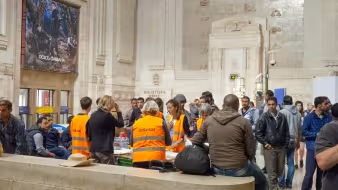
As the migration crisis in Europe continues unabated and a deepening crisis in Syria unfolds, European policymakers are struggling to come to terms with two of the most urgent elements: making certain that 2016 is not just a repetition of 2015 (or worse) and finding the key to incorporating those among the 1.5 million migrants who will be allowed to stay (whether under some form of protection or simply because EU Member States find deportations “difficult”).
The first challenge is critical in that the circumstances that have propelled migrants to Europe—war, violence, political instability, and enduring poverty in the Middle East, Africa, and beyond—will not abate. As a result, and in order to avert an even greater humanitarian crisis or the growing storm of reaction among European publics, Europe must do more of the things it knows it has to, but has so far found it extremely difficult to do. First among them is stopping the spontaneous and chaotic way in which migrants have been coming to Europe. The second challenge is about finding ways to bring last year’s entrants into the labor force, and hence put them on the road to self-sufficiency as soon as possible and, together with educating their children, putting together the building blocks to maintaining cohesive societies.
With the first EU summit of 2016 upon us, and the flows continuing unabated, the urgency of a policy response that EU Member States can implement could not be greater. At its center is EU political and financial support for Turkey, as well as additional massive humanitarian and development support for Turkey, Lebanon, and Jordan—the three first-asylum countries that are sheltering well over 4 million Syrians. The “newest” ideas about such assistance have coalesced around creating opportunities for refugees and local populations alike so that refugees and their families can be allowed to resume their lives.
After several months of working on the crisis from MPI Europe’s offices in Brussels, Demetrios G. Papademetriou provides a briefing on how the policy response to the crisis has unfolded at EU and national levels, and sketches an affirmative vision for what the short-, mid-, and long-term responses must be if Europe is to respond more effectively to the crisis and tackle the longer-term integration challenges.
Check out MPI Resources: Moving Europe Beyond Crisis
Speakers:
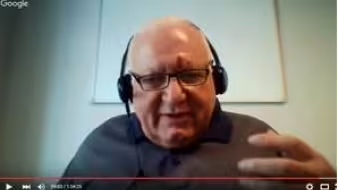
Demetrios G. Papademetriou, Distinguished Senior Fellow and President Emeritus, MPI; and President, Migration Policy Institute Europe
Moderators:
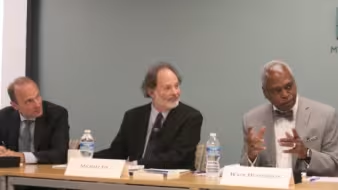
Doris Meissner, Senior Fellow and Director, U.S. Immigration Policy Program
About the Global Program
The Global Program bridges policy advice, research, and candid dialogue to design effective migration policies, drawing on global evidence and anticipating the forces reshaping how people move.
About the Moving Europe Beyond Crisis Project
As the systems designed to process migration flows to Europe buckled in 2015-16, this project offered new ideas to manage mixed flows and create sustainable long-term solutions for refugees.
Related Content